AI for Optimized Ad Placement: The AIM‑PACT Framework for SMB Growth


If you run a small or mid‑size business, every ad dollar must work. AI for Optimized Ad Placement changes the game by deciding, in real time, where an ad should appear, who should see it, and what you should pay for that impression. Moreover, see this ad-placement playbook for visibility tactics. Instead of static rules, intelligent advertising learns from signals—intent, context, and behavior—to lift conversions and reduce waste. You don’t need a big marketing department to benefit. With today’s built‑in tools, you can use AI in marketing to automate the grunt work and focus on growth. This guide takes a forward‑thinking view of the next 12–24 months and gives you a method you can execute now to improve lead generation and profit.
Meet the AIM‑PACT Framework (Your 7‑Step Method)
To make AI practical, we’ll use a named framework you can follow step by step: AIM‑PACT. Moreover, see this unified-campaign explainer to align channels before you scale. AIM stands for Align Objectives, Instrument Data, and Model Audiences. You’ll clarify outcomes, install reliable tracking, and build segments that actually buy. PACT stands for Predict & Price, Automate Placement & Budget, Create & Personalize, and Test, Learn & Expand. You’ll use platform intelligence to set bids, place ads, shift spend, tailor creative, and compound results with continuous experiments. Each step gets its own section with quick wins, tools, and checkpoints—so you can use AI in advertisement without bloated complexity.
The 2025 Context: Privacy, Platforms, and Performance
Marketing is entering a new phase. Consequently, consult our AI-in-business overview for the trends shaping what’s next. Third‑party cookies are fading, signal loss is real, and platform AI is getting stronger. That mix rewards teams who invest in first‑party data, server‑side conversion APIs, and measurement that blends attribution with incrementality. Meanwhile, retail media, connected TV, and walled gardens raise the bar for Intelligent Advertising. The upside for founders is big: platform models can price each impression, select the best placement, and personalize at scale. Your edge comes from feeding those models clean data, clear goals, and constraints that reflect unit economics. Do that, and AI will help you move budget to the highest‑return audiences hour by hour.
Step 1 — Align Objectives with Unit Economics
Before you let algorithms run, decide what “good” looks like. Additionally, use this ad-placement playbook to translate goals into surfaces. Align outcomes to unit economics. Choose a payback window (30, 90, or 180 days) that fits your cash flow. Estimate LTV (lifetime value) within that window and apply contribution margin to get allowable CAC (customer acquisition cost). Break‑even Target CAC = LTV_payback × contribution margin. Convert that to platform guardrails. If your site converts at 2%, then Max CPC ≈ Target CAC × 0.02. Translate CAC to Target ROAS (return on ad spend) if you bid on value. As a rule, break‑even tROAS ≈ revenue/ad spend required to hit Target CAC. Set Target CPA (cost per acquisition) or tROAS goals in Google, Meta, and Amazon to anchor the models. With guardrails set, AI optimizes fast without drifting toward vanity metrics like cheap clicks. Document these guardrails before you activate automation.
Quick story. A local fitness studio was paying for social clicks without a north star. They chose a 90‑day payback window, with membership revenue of $120 and a 30% contribution margin. That gave a Target CAC of $36. Site conversion sat at 3%, so Max CPC was about $1.08. They switched campaigns to value‑based bidding and capped bids to protect that CPC. Within eight weeks, blended CAC fell from $52 to $34, and trials grew 27% on the same budget. The moral is simple: when you align goals, AI for Optimized Ad Placement stops chasing cheap clicks and starts buying profitable attention. Retention also improved, with trial‑to‑member conversion up three points, compounding lifetime value.
Step 2 — Instrument Data Like a Pro
Instrumentation is the fuel for Intelligent Advertising. Start with a minimum viable stack: platform pixels, enhanced conversions, and server‑side events. In Google Ads, enable Enhanced Conversions and import revenue. In Meta, send Conversions API events with deduping (duplicate event prevention) against the pixel. For Amazon, map Store, Brand, and Amazon Attribution where relevant. Standardize event names such as view_content, add_to_cart, lead, subscribe, and purchase. Pass value, currency, and product IDs on every event. Capture offline conversions from your CRM and upload daily so the models see full‑funnel wins. Maintain UTM parameters (tracking tags) and auto‑tagging so analytics can reconcile platform reports. Finally, configure consent and data retention properly. Clean, privacy‑safe data lets AI for Optimized Ad Placement learn faster, stabilize bids, and recover signal lost to browser restrictions.
Step 3 — Model Audiences That Actually Convert
Audience modeling turns platform automation into profit. Start with clean first‑party signals from your CRM and analytics. Build seed lists of recent, high‑quality buyers (ideally 1,000+), then create lookalike or similar audiences at 1–5%. Layer RFM scoring (Recency, Frequency, Monetary) to isolate your top 10–20% customers. In parallel, craft high‑intent segments: cart abandoners, product viewers, repeat buyers, and category explorers. Create exclusions for recent purchasers to reduce waste and frequency fatigue. Map these segments across Google, Meta, Amazon, and your DSP so creative and bidding match intent. Finally, add contextual cohorts (content topics and placements) to counter cookie loss. When you pair strong seeds with platform intelligence, AI for Optimized Ad Placement finds fresh, profitable reach while avoiding cheap, low‑intent clicks that rarely convert.
Prospect Engine for Online Service SMBs
AI only optimizes the demand you feed it. If your small or mid‑size business sells services online—design, marketing, analytics, compliance, content, or development—strengthen Step 3 by seeding audiences with verified decision‑maker contacts from newly launched token‑based projects. LeadGenCrypto delivers a daily stream of vetted prospects at the exact moment budgets are allocated. Sync them to your CRM via API or table, trigger speed‑to‑lead automations, and loop closed‑won deals back into ad platforms to build lookalikes and exclusions. The result is faster learning, higher match quality, and steadier CAC as third‑party signals fade. Start with verified leads for online service providers to keep your pipeline full while AIM‑PACT scales paid acquisition.
Step 4 — Predict & Price: Bid with Confidence, Not Guesswork
Let the platforms price every impression with value in mind. Use value‑based bidding where possible: Target ROAS in Google (with value rules), Advantage+/value optimization in Meta, and Dynamic Bids—Up/Down in Amazon. Set sensible guardrails: portfolio‑level tROAS or tCPA, daily budget ranges, and hard caps for experimental ad sets. Ensure learning volume—aim for 50+ conversions per campaign per week—so models stabilize. Feed offline conversions and LTV proxies to reward profitable sales, not just cheap ones. Enforce frequency caps in DSPs, and allow automated placements so algorithms can surface undervalued inventory. Many advertisers see 10–25% ROAS gains when moving from manual CPC to value bidding. With objectives, data, and pricing aligned, Intelligent Advertisingreallocates spend hourly toward the audiences and contexts producing the highest incremental revenue.
Quick story. A direct‑to‑consumer home décor brand rebuilt targeting from broad interests to an LTV‑top‑decile seed and 1% lookalikes. They shifted from manual CPC to tROAS, added offline conversions, and enabled automated placements. Within six weeks, CAC fell from $49 to $38 (‑22%), while revenue rose 31% on flat spend. Wasted impressions dropped 18% after exclusions, and lead generation improved 44% by retargeting “viewed category, no add‑to‑cart.” The team kept one weekly control group to verify incrementality. The lesson is clear: when you use AI in marketing to model audiences and price impressions by value, AI for Optimized Ad Placement compounds gains you can’t reach with manual tweaks alone.
AIM-PACT Optimization Map
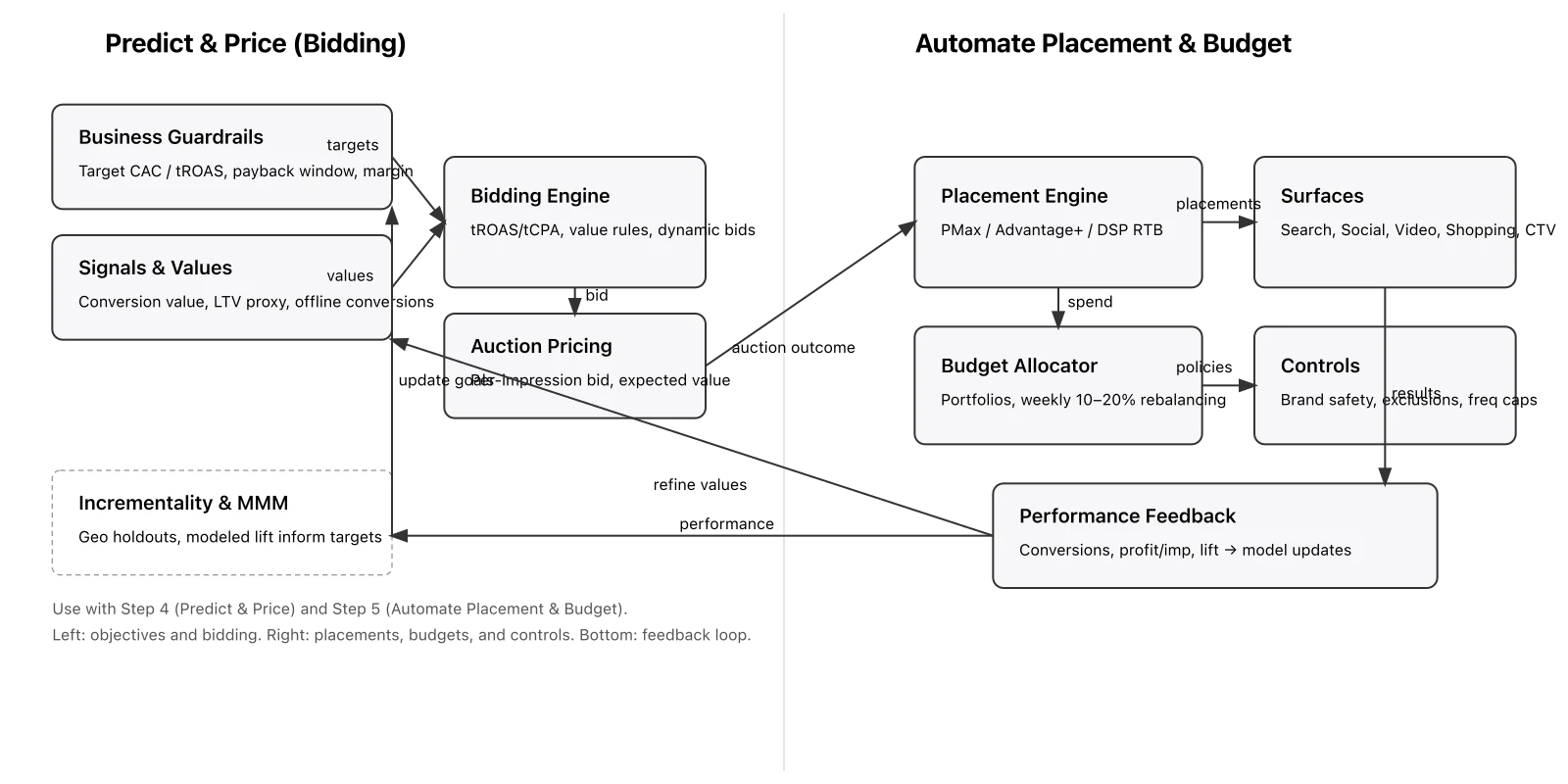
AIM-PACT Optimization Map: value-based bidding feeds automated placements and budgets; performance flows back to refine targets and signals.
Step 5 — Automate Placement & Budget Across Channels
Now let algorithms do what humans can’t at scale. Turn on automated placements so platform models discover undervalued inventory you’d never test manually. In Google, use Performance Max with asset groups by audience and product line. For example, in Meta, enable Advantage+ placements and consolidate ad sets to raise learning volume. In Amazon, use Dynamic Bids—Up/Down and test placement multipliers. For DSPs, let real‑time bidding seek cheap, viewable reach, then cap frequency by audience. Add guardrails: portfolio budgets, bid caps for prospecting, and looser caps for remarketing. Require incrementality checks (geo splits or holdouts) before shifting big spend. Finally, adopt a weekly rebalancing ritual: move 10–20% of budget toward the top three ROAS segments. When you combine budget agility with AI for Optimized Ad Placement, wasted impressions fall and profitable reach compounds.
Step 6 — Create & Personalize at Scale (DCO Without the Chaos)
Creative wins the auction after pricing. Similarly, apply message-tailoring essentials to lift engagement. Build a modular system of headlines, bodies, CTAs, and visuals that your platforms can mix and match. Use Dynamic Creative Optimization (DCO) to personalize offers by intent: new users see problem‑solution messages; cart abandoners see urgency and social proof. Feed‑based ads (catalogs) keep price and availability current. Let AI propose variants, but apply brand guardrails: tone rules, banned phrases, and approved color palettes. Refresh on a 28–35‑day cadence to avoid fatigue, and rotate two to three concept families at once. Name everything clearly, so you can spot winners fast. This is where you use AI in advertisement to tailor at scale while you stay in control. Expect better lead generation and lower CPA when copy and visuals adapt to context, device, and audience.
Quick story. A boutique outdoor brand shipped three concept families—adventure, durability, and sustainability—each with modular copy blocks and product scenes. Meta Advantage+ handled placements; Google PMax handled surfaces. DCO matched “trail‑runner” segments with durability proofs and short product videos. Budget rules shifted 15% weekly toward the best audience‑creative pairs. In six weeks, CTR rose from 1.3% to 2.6%, add‑to‑cart rate improved from 4.1% to 6.0%, and blended CAC dropped 19% on flat spend. The team kept brand voice consistent with a style guide and auto‑checks. The moral: when creative is modular and platforms personalize, Intelligent Advertisingunlocks gains that targeting alone cannot reach.
Step 7 — Test, Learn & Expand (Build a Compounding Experiment Engine)
Turn improvement into a habit. Run a simple weekly experiment loop: plan, launch, measure, decide. Pre‑register your hypothesis (“If we raise Target ROAS by 10%, profit per order will rise without losing volume”). Define MDE (minimum detectable effect) so tests aren’t underpowered. Use clean splits: A/B inside platforms for creative, and geo holdouts(regions with no spend) to measure incrementality—sales that wouldn’t happen without ads. Keep a 90/10 budget split: 90% exploit proven winners; 10% explore new audiences, creatives, and bids. Freeze settings during test windows to avoid noise. Name each test clearly and track start/end dates. When you use AI in marketing this way, the model gets better data, your decisions get faster, and the gains compound month after month.
Operationalize learning
Maintain a living “promote/kill” scoreboard. Graduation rules are simple: promote variants that improve ROAS or reduce CAC with statistical confidence; kill fatigued ads that drop below baseline CTR or conversion rate for two consecutive weeks. Add lead quality checks—pipeline velocity, show‑up rates, or first‑purchase margin—not just top‑of‑funnel volume. Refresh creative on a 28–35‑day cadence and rotate concept families so AI can discover new winners. For AI for Optimized Ad Placement, set a monthly re‑allocation day: shift 10–20% of budget from laggards to the top three segments. Document every decision in a one‑page retro so future teammates understand what worked and why.
Quick story. A regional home‑services brand suspected search ads were cannibalizing organic leads. They ran a four‑week geo holdout with PSA (public‑service) ads in control markets. Incremental bookings were only +12%, not the +30% they’d assumed. They tightened match types, raised tROAS, and moved 18% of spend into high‑intent local keywords and retargeting video. Net effect: CAC fell from $96 to $78, bookings rose 22%, and wasted spend dropped 17%. The lesson: disciplined testing turns hunches into math, and math turns Intelligent Advertising into reliable profit.
Platform Deep‑Dive: Where the Models Win by Channel
Google Ads: Intent + Surfaces Working Together
Google is your intent engine. People tell you what they want with keywords, then Google decides the best surfaces—Search, YouTube, Display, Discover, Maps—through Performance Max (PMax). Turn on enhanced conversions and value rules so AI for Optimized Ad Placement can price each impression by expected revenue, not clicks. Use broad match sparingly at first; pair it with smart negatives and tROAS (target ROAS) to avoid drift. Structure PMax with asset groupsby product or audience so the model can find winners faster. Feed product feeds, first‑party audiences, and offline conversions to improve match quality. For lead gen, import qualified‑lead events from your CRM, not just form fills. The result is steady reach across surfaces, with the model pushing spend toward the placements and hours that quietly produce the most profit.
Meta + Amazon + DSPs: From Signals to Purchase Intent
Meta excels at behavioral signals—interests, creators, and social interactions. Use Advantage+ placements, consolidated ad sets, and creative families that DCO (dynamic creative optimization) can remix. Start broad, then exclude recent converters to reduce fatigue. Amazon, by contrast, owns purchase intent. Dynamic Bids—Up/Down, product targeting, and Sponsored Brands intercept shoppers close to checkout. For display at scale, a DSP (demand‑side platform) uses real‑time bidding to buy across thousands of sites and CTV (connected TV). Lean on predictive segments, attention metrics, and frequency caps to prevent waste. Across these channels, you’ll use AI in advertisement to move bids, swap placements, and adapt creative automatically. Expect lower CPA and more qualified lead generation when signals (Meta), intent (Amazon), and reach (DSP) are orchestrated together.
AIM-PACT Channel Fit Matrix
So, choose platforms by strength; moreover, align bidding, creative, and signals for higher ROI.
Matrix.
| Google Ads | Meta Ads | Amazon Ads | DSP / CTV |
|---|---|---|---|
Primary Strength
| | Intent surfaces; therefore, capture demand at the moment of search; moreover, extend via PMax. SearchYouTubePMax | Behavioral signals; consequently, discover net-new audiences; additionally, scale with Advantage+. LookalikesDCO | Purchase intent; thus, intercept shoppers near conversion; furthermore, upsell with product targeting. Sponsored ProductsDynamic Bids | Broad reach; meanwhile, optimize frequency and attention; moreover, extend into living-room screens. RTBCTV | |
Best For
| | High-intent leads; consequently, brand + non-brand capture; in addition, local demand. Lead GenLocal | Prospecting; therefore, upper-funnel discovery; moreover, community-driven categories. ProspectingUGC | Retail conversions; thus, catalog sales; additionally, cross-sell and upsell. Retail Media | Incremental reach; consequently, storytelling; furthermore, niche B2B sites. AwarenessABM | |
Key AI Levers
| | tROAS/tCPA; moreover, value rules; consequently, broad match with guardrails; additionally, Enhanced Conversions. Smart Bidding | Advantage+ placements; furthermore, lookalikes; consequently, dynamic creative; nevertheless, exclude recent buyers. A+DCO | Dynamic Bids—Up/Down; therefore, placement multipliers; moreover, product/category targeting. ASIN Targeting | Predictive segments; consequently, attention scoring; moreover, frequency caps per audience. AttentionFreq Cap | |
Signals to Prioritize
| | Query intent; thus, offline conversions; moreover, revenue values; in addition, geo and device. Offline Rev | First-party lists; consequently, RFM seeds; furthermore, engagement events. 1P Data | SKU margins; therefore, inventory; moreover, browse vs. cart events. SKU Margin | Contextual topics; consequently, seller-defined audiences; additionally, consented IDs. Contextual | |
Creative Approach
| | Benefit-led copy; consequently, structured assets; moreover, short videos for YouTube. Assets | Thumb-stopping hooks; therefore, UGC; furthermore, modular visuals for DCO. UGCModular | Clear value props; consequently, lifestyle images; moreover, A+ content. A+ | Narrative video; thus, bold supers; moreover, 6–15s edits for frequency. Short-Form | |
Budget & Bidding
| | Portfolio tROAS; therefore, weekly 10–20% rebalancing; moreover, protect brand terms. Portfolio | Consolidated ad sets; consequently, A+ placements; furthermore, cost caps for scale. Cost Cap | Daily pacing; thus, placement multipliers; moreover, bid by profitability. Pacing | CPM guardrails; consequently, attention floors; moreover, sequential messaging. Seq Story | |
Caveats & Watchouts
| | Broad match drift; however, add negatives; moreover, ensure conversion quality. Negatives | Creative fatigue; nevertheless, rotate families; furthermore, monitor frequency. Refresh | Low-margin SKUs; therefore, cap bids; moreover, avoid out-of-stock waste. OOS Risk | Viewability variance; however, enforce attention; moreover, block unsuitable inventory. Suitability | |
Measurement Tip
| | Import offline revenue; consequently, validate with geo holdouts; moreover, reconcile to MER. Holdout | Conversion API; therefore, audience holdouts; furthermore, creative lift tests. CAPI | Use Attribution; consequently, cohort ROAS; moreover, compare to non-retail channels. Attribution | PSA holdouts; thus, attention-to-outcome models; moreover, MMM triangulation. MMM | |
Quick Start
| | Enable tROAS; consequently, add value rules; moreover, launch one PMax with clean assets. tROAS | Seed 1% lookalike; therefore, turn on A+ placements; furthermore, ship two concept families. 1% LAL | Start Sponsored Products; consequently, test Up/Down; moreover, apply placement multipliers. Up/Down | Begin with whitelisted inventory; therefore, set freq caps; moreover, run a 4-week PSA holdout. Whitelist |
AIM-PACT Channel Fit Matrix: therefore, match goals to platforms; moreover, let AI optimize bids and placements while you govern guardrails.
Cross‑Channel Orchestration: Make the Algorithms Collaborate
Platforms don’t share brains—you create the brain with data, guardrails, and measurement. For example, extend reach with direct-mail + digital synergy. Connect CRM and ecommerce events to all channels, standardize naming, and run incrementality checks (geo holdouts or audience holdouts) each quarter. Use a simple budget policy: 70% to the best profit per impression channel, 20% to strategic growth (new surfaces like Reels or CTV), 10% to experiments. Review overlap weekly: if Meta prospecting often assists Google brand search, protect that assist with creative refreshes and frequency caps, not knee‑jerk cuts. Many teams see 15–30% better blended ROAS when they reallocate budgets based on cross‑channel lift rather than last‑click reports. This is where AI for Optimized Ad Placement shines—surfacing invisible pockets of performance and shifting dollars there before a human would notice.
Measurement & Attribution: Proving Lift from AI for Optimized Ad Placement
You can’t scale what you can’t measure. Treat measurement as the control system for AI for Optimized Ad Placement. Start with event hygiene: dedupe pixel and server events, pass a transaction ID, and record value on every conversion. Track three financial views—CAC (per channel), ROAS, and MER (total revenue ÷ total ad spend). Then add incrementality: run geo holdouts or audience holdouts each quarter to estimate sales that occur only because of ads. Calibrate platform‑reported conversions against modeled or offline outcomes so targets reflect reality. Build a weekly scoreboard that ranks channels by profit per impression, not clicks. Finally, publish one truth source—an executive dashboard that reconciles platforms, analytics, and finance. When you use AI in marketing with this discipline, budget flows toward impact, and attribution debates stop delaying growth.
A Simple, Durable Measurement Stack for Intelligent Advertising
Use a three‑layer stack. Layer 1, operational: day‑to‑day platform dashboards for pacing, learning phase progress, and creative fatigue. Then, Layer 2, causal: monthly or quarterly incrementality tests—geo holdouts, PSA ads, or audience exclusions—to quantify true lift. Finally, Layer 3, planning: a lightweight MMM (media mix model) or regression that blends ad spend, seasonality, and promos to forecast revenue. Keep assumptions simple and documented. Tie every experiment to a decision rule—what will you change if lift is lower or higher than expected? Report variance in plain language: “Prospecting video added 14% incremental revenue at a $72 CAC”. This system lets Intelligent Advertising models optimize tactically while your finance view stays grounded, improving confidence to raise budgets when the numbers prove it.
Quick story: Measuring What Matters Unlocks Budget
A bootstrapped SaaS used last‑click reports and thought search drove everything. They added CRM revenue to their dashboards, ran a four‑week geo holdout for Meta, and found +18% incremental trials at a sustainable CAC. They raised Meta prospecting by 25%, trimmed branded search by 12%, and shifted creative toward problem‑solution videos. In eight weeks, MER improved from 2.4 to 2.9, churn fell one point from better fit leads, and net revenue rose 19% on nearly flat spend. The takeaway: when you measure incrementality and pass clean values, AI for Optimized Ad Placement gets credit for real lift, not noise. That proof unlocks the budget you need for faster, steadier lead generation.
Governance, Privacy & Brand Safety for Intelligent Advertising
Privacy by Design: Consent, First‑Party Data, and Minimal Collection
Treat data as a product with rules. Start by obtaining clear, auditable consent and respecting regional requirements (e.g., GDPR/EEA, state privacy laws). Minimize what you collect—only gather fields that improve targeting or measurement. Shift to first‑party data (emails, purchase events) and server‑side event collection to stabilize signals as browsers limit tracking. Set retention windows, document lawful bases, and sign DPAs (data processing agreements) with vendors. Map every conversion event to a business purpose. Finally, practice data hygiene: dedupe IDs, validate emails, and standardize currency and tax fields. When your data house is in order, platform models learn faster, and AI for Optimized Ad Placement allocates budget with fewer blind spots. You’ll also de‑risk audits and reduce the chance of jittery performance when policies or browsers change.
Brand Safety & Risk Controls: Keep Ads Aligned with Values
Intelligence without guardrails can backfire. Establish allow lists (trusted domains, creators, apps) and block lists(sensitive topics, unvetted placements). Use viewability and attention thresholds to filter low‑quality inventory, and enable IVT (invalid traffic) protection to cut bots. Configure GARM‑aligned suitability settings in social and video channels, and cap frequency to protect experience. If you use AI in advertisement with generative copy, enforce brand rules: tone, banned claims, regulated phrases, and mandatory disclaimers. For UGC‑heavy platforms, require creator whitelisting and contract terms on edits. Review placement reports weekly; when you find a risky context, add it to your block list and annotate the change. These routines keep Intelligent Advertising productive, protect reputation, and prevent wasted impressions in mismatched environments.
Cookieless Readiness: Build Resilience for the Next 24 Months
The future favors durable signals and privacy‑safe math. Invest in contextual 2.0 (topic and keyword relevance scored by engagement), seller‑defined audiences from publishers, and retail media where purchase intent is native. Use clean rooms (privacy‑safe environments to match your first‑party data with platform data) to measure reach and frequency without exposing raw records. Blend modeled conversions with offline revenue so bidding stays stable as third‑party cookies fade. In parallel, pilot predictive LTV segments (buyers likely to repeat) and creative automation tied to intent, not just demographics. When you use AI in marketing this way, auctions remain efficient even as signals shift. The payoff is resilience: steadier CAC, stronger lead generation, and fewer surprises when policies or platforms evolve—exactly what you need to keep compounding returns.
30/60/90‑Day Rollout Plan for AI for Optimized Ad Placement
Days 0–30: align objectives to unit economics, set Target CAC/tROAS, and instrument tracking (Enhanced Conversions, Meta CAPI, Amazon Attribution). Build first‑party seed lists, enable brand‑safety controls, and launch lean pilots: a focused PMax, Meta Advantage+ with consolidated ad sets, and Amazon Dynamic Bids if relevant. Consolidate until you hit 50+ conversions per optimization event weekly; baseline MER and run a tiny geo holdout. Days 31–60: switch manual CPC to value‑based bidding, allow automated placements, import offline conversions, refresh creative on day ~35, and reallocate 10–20% weekly to top segments. Add frequency caps and your first incrementality test. Days 61–90: expand to DSP/CTV or retail media, test predictive LTV audiences, stand up a lightweight MMM, pilot a clean room, codify automation rules, and lock naming, exclusions, and governance.
Quick Checklist (AIM‑PACT on One Page)
Goals set to payback window; conversion events deduped and valued; first‑party seeds built; exclusions live; value‑based bidding active; automated placements on; modular creative families rotating; frequency caps enforced; weekly rebalancing and experiment loop running; incrementality tests scheduled; cross‑channel dashboard published; privacy and brand‑safety lists maintained. If any line reads “no,” fix it before scaling. When this checklist is green, AI for Optimized Ad Placement compounds returns instead of amplifying noise. Use it in weekly reviews to keep teams honest and to decide where the next dollar goes. Revisit guardrails after each planning cycle so your models chase profit, not inexpensive traffic. Keep the list short, visible, and tied to decision rules that move budget, bids, or creative without delay.
Ready to Act? Your Next Three Moves
First, run a one‑hour unit‑economics workshop and publish Target CAC/tROAS. Second, ship a two‑week pilot that consolidates campaigns, enables value bidding, and rotates two creative concept families. Third, schedule a four‑week incrementality test with a clear decision rule (“If lift ≥ X, raise budget Y%”). If you want a head start, book an AIM‑PACT working session: we’ll map events, seed audiences, and launch a pilot across Google and Meta geared for lead generation. You’ll leave with guardrails, dashboards, and a 90‑day plan you can execute. However you proceed, use AI in marketing to automate pricing and placement while you apply human judgment to brand, offer, and strategy. That blend wins now—and it will win even more as signals shift.
Offer, Landing Pages, and Sales Process: The Multiplier on AI Gains
Even the smartest AI for Optimized Ad Placement can’t rescue a weak offer or leaky funnel. Start with a sharp value proposition and a specific promise tied to pain relief or gain. Match ad messages to landing headlines, benefits, and proof—testimonials, ratings, case snippets, and guarantees. Reduce friction: short forms, autofill, and staged questions. Speed matters; aim for sub‑2‑second loads and pass Core Web Vitals. Add clarity microcopy near fields (“We’ll never spam”) and show pricing early to prequalify. For sales‑assisted funnels, instrument speed‑to‑lead and call outcomes so bidding can prefer high‑quality sources, not just volume. When offer, page, and process align, platform models convert curiosity into revenue, compounding your Intelligent Advertising gains without raising budget.
What’s Next: The Future of AI for Optimized Ad Placement
The next 24 months will be about richer signals and smarter automation. Accordingly, review this AI-personalization primer to prepare data and creative. Expect generative creative to tailor scenes and copy to micro‑segments, scored by attention and lift, not vanity CTR. Bidding will increasingly optimize for profit per impression, using modeled LTV and margin rules. Privacy‑preserving measurement—clean rooms, modeled conversions, and MMM—will steady optimization despite signal loss. Retail media and CTV will converge with search and social, letting you retarget viewers who browsed or watched. On‑device models will improve relevance with less data sharing. Finally, expect predictive LTV and price‑elasticity segments to guide discounts and offers in real time. Teams that prepare data, governance, and creative systems now will surf this wave, not chase it.
Conclusion: Turn AI into a Profit Engine
You’ve seen the method, the pitfalls, and the path forward. When you align goals to unit economics, instrument clean signals, and let platforms price impressions by value, AI for Optimized Ad Placement becomes a compounding engine. Use AIM‑PACT to structure the work, then keep a weekly cadence of tests, rebalancing, and creative refreshes. The payoff is tangible: steadier CAC, stronger lead generation, and clearer decisions about where the next dollar goes. If you’re ready to act, start the two‑week pilot, schedule a holdout test, and rotate two creative concept families. That small start is enough to build momentum—and a durable advantage—as auctions, privacy, and channels evolve.
Additionally, learn how Toklis Solutions can boost your business’s digital marketing and software development.