Predictive Analytics in Marketing: How AI Powers Data-Driven Strategies

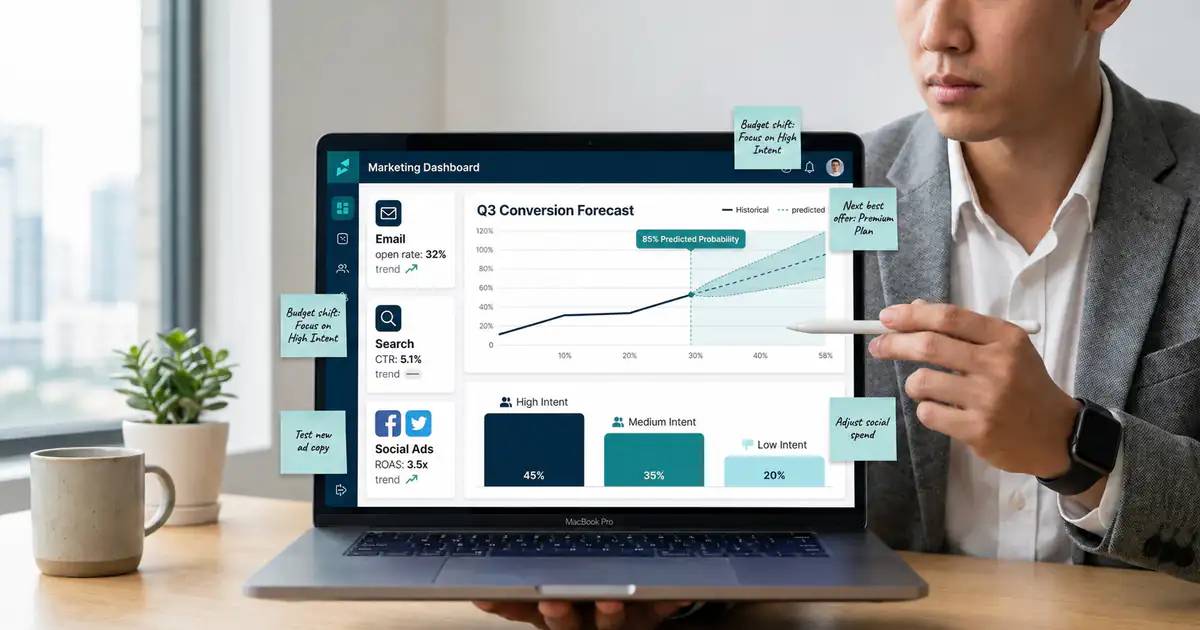
Predictive Analytics in Marketing helps you stop guessing and start planning with foresight. Instead of reacting to last month’s clicks, you predict what customers are likely to do next, then you act early. AI makes this practical for small and medium size businesses because it can learn patterns from real campaign and customer data. You do not need a data science department to benefit. You need one clear business question, reliable tracking, and a way to turn predictions into actions inside your funnel. In this guide, you will use the PREDICT Framework, a step by step method Toklis.Solutions uses to turn data into decisions. You will learn how to anticipate behavior, improve lead generation, and run more intelligent advertising with confidence.
Real-World Impact: Moving Beyond the Coin Flip
A solo founder selling B2B workshops once told me, “My ads bring leads, but the calls are a coin flip.” We added a simple propensity score, meaning a prediction of who would book a call within seven days. The founder did not change targeting at first. They only changed follow up speed and message sequencing for the top scored leads. Within four weeks, booked calls rose from 11% to 18% with the same budget, and no extra hours in the week [Add data source]. The biggest surprise was emotional, not technical. The founder stopped debating opinions and started asking, “What does the model expect, and what will we test next?”
The Core Shift: From Reports to Operating Systems
That is the core shift: prediction is not a shiny report, it is a repeatable operating system for marketing. When AI powers data-driven strategies, you can allocate budget earlier, personalize offers sooner, and protect margin before it erodes. However, the model is only one component. The leverage comes from activation, meaning your ads, emails, landing pages, and sales workflows change based on the prediction. You will see practical examples for ecommerce, services, and SaaS, plus a realistic 30 day launch plan. You will also learn guardrails that keep your team safe when you use AI in marketing, including privacy, bias checks, and simple ways to validate lift. By the end, you will know exactly what to build first and what to ignore for now.
Meet the PREDICT Framework for Predictive Analytics in Marketing
PREDICT is the roadmap we use to operationalize Predictive Analytics in Marketing without turning your business into a research lab. P stands for Pinpoint the profit question. R means to Ready your data. E represents Engineering the signals. D covers Deciding on models and KPIs. I is for Implementing predictions in campaigns and CRM. C is about Calibrating with experiments. Finally, T reminds you to Track and tune over time. Each step is designed for real constraints: limited data, limited time, and tools that were not built for data science. Your goal is not a perfect model. Your goal is a decision system that improves results week after week. As you read, keep one use case in mind, because focus beats complexity every time.
P: Pinpoint the profit question before you use AI in marketing
Choose one decision that moves profit
Most “AI marketing” projects fail because they start with a tool and end with a dashboard. Predictive analytics only works when you tie it to a decision with a clear owner. Start by picking one decision you make weekly that changes revenue, margin, or cash flow. For example, you can decide which leads get a sales call, which customers get a retention offer, or which product bundle gets pushed in ads. This focus also protects you from vanity metrics. A model that predicts clicks might look impressive, yet it can still lose money if it attracts bargain hunters. If you are a founder, the fastest path is to choose one decision, one metric, and one workflow you can actually change this month.
Define the outcome, the window, and the segment
A prediction needs a definition that a computer can learn and your team can audit. Choose an outcome you can measure, like purchase, booked call, renewal, or churn. Then choose a time window, like seven days after signup or 30 days after first purchase. Finally, define the segment, such as new visitors, trial users, or past buyers. This structure prevents confusion later when results get reviewed, because everyone agrees on what “success” means. It also forces you to connect the model to your funnel stages. For lead generation, strong starter outcomes are booked call, sales qualified lead, or deposit paid, because they are closer to revenue than form fills today.
Micro case study: from more leads to better pipeline
A boutique home services company spent $4,000 per month on ads and celebrated a growing inbox. However, the owner noticed a pattern: the cheapest leads asked for the smallest jobs. We reframed the profit question to “Which leads are likely to request a project above $2,500?” We used past jobs, zip codes, device type, and landing page behavior to predict high value intent. Then we built two follow up flows: fast phone calls for high value leads and a helpful email sequence for everyone else. After six weeks, close rate on calls rose from 22% to 30%, and average job size increased by about $600 [Add data source]. The model did not create demand, it redirected attention to the demand that already existed.
Starter profit questions you can use this week
If you feel stuck, borrow a profit question that matches your model. Ecommerce businesses should ask who is likely to buy again in the next 14 days, then trigger a replenishment offer. In B2B services, the question is which inbound leads will book a call within seven days, allowing you to prioritize fast outreach. SaaS founders might ask which trial users will activate a key feature by day three to guide them with in-app prompts. Alternatively, if you sell high ticket programs, ask which leads will show up and match your ideal profile to protect your calendar. Pick one question, write the exact outcome definition, and you have a project that can be built, tested, and improved.
R: Ready your data so AI powers data-driven strategies
Start with a minimum viable dataset
You do not need big data to make predictions. You need connected data that tells a consistent story. A minimum viable dataset includes an identifier, a source, key events, and an outcome. For most SMBs, that means web analytics, ad platform clicks, email engagement, and CRM stages. The critical requirement is linkage. If your CRM lead does not connect to the form submission, the model cannot learn what drives quality. Therefore, treat identifiers as your first technical milestone. Pass a lead ID from the landing page to the CRM, store UTMs, and keep the same ID through the funnel. Once your data is connected, even a simple spreadsheet export can support useful scoring.
Fix tracking before you build the model
It is tempting to jump into modeling because it feels like progress. However, tracking fixes often create the biggest lift. Start with event definitions: what counts as a lead, what counts as qualified, and what counts as revenue. Then confirm your events fire reliably across devices and browsers. Next, align naming so “purchase” means the same thing in analytics, CRM, and ads. Finally, remove obvious noise like duplicate leads, test transactions, and internal traffic. A founder friendly rule is to audit one week of data line by line. If you cannot explain where each conversion came from, your model will not either, and you will chase ghosts in meetings for months.
Micro case study: the hidden form field that unlocked accuracy
A coaching business ran Meta ads and Google Search, but “source” in the CRM was often blank. The owner assumed the platforms were unreliable, so they kept shifting budgets based on gut feel. The real issue was simple: UTMs were not being captured and there was no lead ID stored with the form. We added a hidden field that stored UTMs and click IDs when available, then passed it into the CRM. Within two weeks, attribution completeness improved from about 55% to 92% [Add data source]. Only then did predictive scoring become meaningful, because the model could connect intent signals to channels. The owner also discovered one campaign produced fewer leads but twice the qualified rate, which changed their entire budget plan.
Data readiness checklist for small teams
Before you move forward, confirm four data readiness basics. First, outcomes exist as analytics events and as CRM stages, not just notes in a call log. Second, each lead or customer has a stable ID that persists across steps, from first click to purchase. Third, key sources are captured consistently, including UTMs and ad click IDs when consent allows. Fourth, the data can be exported into a simple table with one row per lead or customer. If any of these fail, pause and fix them, because every model trained on broken data will waste time and money. If you want help, Toklis.Solutions can implement tracking and pipelines so you can focus on offers and growth.
E: Engineer signals that predict behavior and improve lead generation
Focus on signals that reflect intent, not just activity
Raw activity is not the same as intent. Intent shows up as patterns, like repeated visits to pricing, time on a comparison page, or returning via branded search. Feature engineering means you turn behavior into signals a model can learn and you can explain. Start with three categories: recency, frequency, and depth. Recency answers how recently someone engaged. Frequency answers how often. Depth answers how far they went. For example, “visited pricing twice in three days” is stronger than “visited pricing once.” In addition, include funnel milestones, like starting checkout or reaching a demo scheduler. These signals make Predictive Analytics in Marketing feel tangible because they map directly to real customer behavior.
Build a small signal library you can reuse
Founders move faster when they reuse patterns. Create a small signal library that you can apply across models and campaigns. For lead generation, common signals include form completion time, number of pages viewed, repeat visits within seven days, and engagement with case studies or pricing. For ecommerce, signals include cart adds, category affinity, discount sensitivity, and days since last purchase. For subscriptions, signals include feature usage count, time to first value, and support ticket frequency. Keep signals simple at first. You are not trying to capture every detail. You are trying to capture the few behaviors that consistently separate buyers from browsers. Once you find two or three strong signals, you can scale them into intelligent advertising segments.
Micro case study: the two touch rule that raised conversion
An online course creator believed long form blog traffic was “low quality.” The numbers seemed to agree, because first visit conversion was tiny. We looked deeper and found a simple pattern: visitors with two meaningful touches, like a blog visit plus a webinar signup, were far more likely to buy. We built a signal called “two touch within 10 days” and used it as the main trigger for retargeting and email follow up. We also stopped retargeting one touch visitors with direct discounts, and instead sent them educational content. Over a month, purchase conversion from retargeted traffic moved from 1.6% to 2.4%, while ad spend dropped by 18% [Add data source]. The lesson was clear: good traffic was there, but the timing was wrong.
Feature examples you can copy without a data team
If you want a fast start, copy these feature patterns without hiring a data team. Count events in a window, like sessions in the last seven days. Measure recency, like days since last visit or days since last email click. Capture depth, like max scroll depth on a key page or time on site above 90 seconds. Track intent pages, like pricing views, demo views, and shipping policy views. Add simple ratios, like email opens divided by emails sent. Finally, add monetary summaries when available, like average order value and total spend. Each feature should be explainable to a teammate in one sentence, because explainability builds trust and better decisions.
D: Decide on models and KPIs that match profit
Start simple, then earn complexity
You do not need a complex neural network to win. In most SMB use cases, simple models outperform complicated ones because they are easier to maintain. Logistic regression, decision trees, and gradient boosting can produce strong results with modest data. The key is to choose a model that you can explain, monitor, and retrain without drama. A score that ranks leads from 0 to 100 can already transform prioritization. In addition, simpler models train faster and are easier to validate. That matters when you are moving quickly. Start with a baseline model, measure lift, then add complexity only if the gain is real. Your goal is performance you can repeat, not a clever model you cannot ship.
Pick KPIs that reflect value, not vanity
Your model will optimize whatever you label as success, so choose KPIs that match profit. For lead generation, prioritize sales qualified lead rate, booked call rate, and revenue per lead. For ecommerce, prioritize expected margin, repeat purchase probability, and cart recovery profit. For intelligent advertising, focus on incremental conversions and contribution margin, not just ROAS. ROAS can be misleading when it counts branded demand you would have captured anyway. If you cannot measure margin, start with revenue, but keep a note to improve your data later. A helpful rule is: if a KPI does not change a decision, it is not the right KPI for the model. When in doubt, pick the metric closest to cash.
Micro case study: when a high accuracy model lost money
A DTC brand built a model that predicted who would click a new ad creative. The accuracy looked strong, so they increased spend. Clicks rose, but revenue did not. The model had learned to target bargain hunters who clicked everything. We replaced the target with “profit per user over 30 days,” then retrained. The new model produced fewer clicks, but higher value customers. Over eight weeks, repeat purchase rate rose from 19% to 24% and refund rate dropped from 7% to 5% [Add data source]. The marketing team also felt calmer, because performance stopped swinging with every new creative test. The moral is simple: the label you choose becomes the behavior you get.
A simple scoring approach you can implement quickly
If you want to move fast, build a two stage scoring system. Stage one predicts likelihood to convert, like booking a call or purchasing. Stage two estimates expected value, like predicted revenue or margin. Then compute a priority score, such as conversion probability times expected value. This pushes the system toward both likelihood and impact, which is what founders care about. It also makes activation easier. Sales teams can focus on the top scores, and marketing can reserve higher bids for higher value segments. Even if your value estimate is rough, the direction is useful. Once the workflow is running, you can refine value with better cost and margin data, and your predictions will keep improving.
I: Implement predictions in intelligent advertising and your CRM
Turn scores into actions inside your funnel
A prediction that sits in a spreadsheet is wasted. Implementation means the score shows up where decisions happen: ads, email automation, and CRM tasks. Start by creating action bands, such as high, medium, and low intent. Then assign each band a next step. High intent might get personal outreach or a demo offer. Medium intent might get a case study sequence. Low intent might get educational content, or it might be excluded from expensive retargeting. This is how you use AI in marketing without overcomplicating the stack. You are not automating everything. You are choosing where prediction changes behavior. If you can name the action for each band, you are ready to activate predictive analytics.
Intelligent advertising: better audiences, better bids, better creative
Predictive segments improve advertising in three practical ways. First, you build better audiences, like people likely to buy in 14 days or leads likely to qualify. Second, you adjust bids and budgets based on predicted value, not on gut feel. Third, you tailor creative and offers by segment. A high intent segment might see proof and urgency, while a warm segment sees education and differentiation. When you use AI in advertisement like this, you avoid one size fits all messaging. You also reduce frequency waste, because low intent users stop seeing the same expensive ad ten times. Start with one channel where you already have conversion volume, then expand. Implementation is a marketing skill, not just a technical task.
Micro case study: retargeting that became cheaper and more effective
A B2B software company ran retargeting to all site visitors and complained about rising costs. We introduced a simple “demo likelihood” score based on visits to docs, pricing, and integrations pages. Only the top 30% of scored visitors entered the retargeting audience. The team feared volume loss. Instead, cost per booked demo dropped from $210 to $155 and sales reported fewer low fit calls [Add data source]. The creative also changed. High score users saw messaging about implementation speed and integrations, while lower score users saw a short explainer video. The company did not need more traffic. It needed better timing and better relevance. That is the quiet power of intelligent advertising when prediction drives segmentation.
CRM activation for lead generation and sales speed
In the CRM, predictive scores shine when they drive prioritization and timing. Add the score to the lead record, then create simple rules. High score leads get a task within one hour. Medium score leads get a task within one day. Low score leads enter nurture. Also route high score leads to your best closer, because speed and skill compound. In addition, align messaging. High score leads should receive the shortest path to a conversation, while medium score leads need proof, clarity, and objections handled. This is where predictive analytics becomes lead generation fuel, not just analytics. If you want to start small, implement only one rule: respond faster to the top band. It often delivers the quickest ROI [Add data source].
C: Calibrate with experiments so you can trust the lift
Prove impact with tests, not vibes
Prediction feels persuasive, so it is easy to fool yourself. Calibration means you prove the model improves outcomes compared to your current process. The simplest test is a holdout. Keep a random slice of leads on your normal workflow, and apply the predictive workflow to the rest. Then compare outcomes over a consistent window, like booked call rate within seven days or revenue within 30 days. Make sure the groups are comparable and that your team follows the rules. Also watch for leakage, where sales reps treat control leads differently because they can guess intent. A clean test gives you confidence to scale spend. A messy test creates debate and stalls progress. If you only do one thing, document your baseline before you change anything.
Design experiments that fit small sample sizes
SMBs do not always have thousands of conversions per week, so your experiments must fit small sample sizes. Choose high leverage decisions, like follow up speed, offer sequencing, and retargeting inclusion. These often show impact with fewer samples. Use one primary metric tied to profit, plus one guardrail metric like refund rate or unsubscribes. Avoid changing too many variables at once. For example, when testing a predictive retargeting audience, keep creative stable for the first two weeks. When testing predictive lead routing, keep scripts stable. In addition, run tests long enough to cover day of week effects. A seven day window is often a minimum. If you cannot run a clean experiment, treat results as directional and stay conservative with scaling.
Micro case study: the speed to lead experiment that paid for itself
A consultant received about 40 inbound leads per month and assumed predictive scoring would not matter. We used a simple model to identify the top 20% most likely to book. Then we ran a timing experiment. High score leads got a personalized email within 15 minutes, while everyone else followed the normal 12 hour response time. After two months, the fast follow up group booked at 2.2 times the rate of the control group [Add data source]. The model did not change the consultant’s brand, pricing, or ads. It changed timing and attention. That is why calibration matters. Without a test, the consultant would have blamed the model for “not working,” even though the workflow change was the real driver. Use experiments to separate model value from execution value, then improve both.
Experiment checklist you can reuse every quarter
Before you run a test, confirm four items. First, you have a clear hypothesis, like high score segments will convert more with offer A than offer B. Second, you have a control group and a measured window. Third, you have one primary metric tied to profit, plus one secondary metric that protects brand trust. Fourth, you have a plan for what you will change if the test wins or loses. Then run the test and write down the result. This documentation becomes a library of decisions, which helps when tools or team members change. If you want support setting up clean tests, Toklis.Solutions can build the measurement plan and dashboards so your experiments stay honest. The goal is not to “prove AI.” The goal is to prove a better decision system.
T: Track, tune, and turn Predictive Analytics in Marketing into a growth engine
Monitor drift so predictions stay accurate
Markets change, offers change, and traffic quality changes. That means models drift, which is a simple way of saying yesterday’s patterns stop predicting tomorrow. Tracking helps you catch drift early and protect budget. Start by monitoring input health, like missing UTMs or broken events. Then monitor output behavior, like average score over time and conversion rate by score band. If your average score suddenly spikes, it might mean tracking broke or your traffic mix changed. Also monitor calibration, meaning whether a 70 score still converts near the expected rate. You do not need advanced tools to start. A monthly spreadsheet review can catch most issues. Treat the model like any marketing asset: it needs upkeep, or it decays.
Build lightweight governance that keeps you safe and fast
Using AI in marketing does not remove responsibility. You still own privacy, fairness, and brand trust. Set basic rules. Use consented data. Minimize sensitive attributes. Document what the score means and what it does not mean. If you operate in regulated industries, get legal guidance on data usage and disclosures. Also set guardrails for automation. Do not auto deny service based on a score. Use the score to prioritize outreach, not to exclude people unfairly. In addition, keep a human review loop for edge cases, like high value clients who behave differently. These practices protect customers and protect you, and they also make the model easier to defend internally when results get questioned.
Micro case study: the monthly retrain that prevented wasted spend
A subscription business launched a new onboarding flow and saw performance decline. Their churn prediction model began flagging too many users as “at risk,” so the team offered discounts broadly. Margins suffered and the discounts trained customers to wait for deals. We reviewed the data and found a behavioral shift: new users behaved differently because onboarding changed. We retrained the model on the last 90 days and updated features to include onboarding milestones. In the next month, the discount audience shrank by 35% while retention stayed steady [Add data source]. The team learned a key lesson: model maintenance is not optional. It is how Predictive Analytics in Marketing stays profitable as your business evolves. If you change your product, update your model too.
A monthly review routine for founders and solo teams
Set a 30 minute monthly review with yourself or your team. Review three views: outcomes by score band, cost per outcome by channel, and exceptions where high score did not convert. Then decide one action, like adjusting a segment threshold, updating a nurture sequence, or retraining with fresh data. Also check data health: missing sources, duplicate leads, and broken events. Finally, write down what you changed and why. This record prevents repeat mistakes and builds confidence in the system. The biggest advantage of predictive systems is learning speed. When you review and adjust regularly, you compound improvements. If you skip reviews, the model becomes a forgotten file and your team returns to gut feel. Consistency wins here, not hero effort.
Common pitfalls when you use AI in advertisement and predictive analytics
Predictive projects fail in predictable ways. The first failure is starting with a model and hoping value appears. Always start with a profit question and a clear action. The second failure is optimizing the wrong label, like clicks or cheap leads, which trains the system to chase low value behavior. The third failure is weak measurement. If you cannot connect outcomes to sources, you will not know what works, and your model will inherit that confusion. The fourth failure is treating predictions as truth. A score is a probability, not a verdict, so avoid hard exclusions that hurt trust. Finally, many teams forget creative and offer fit. Even the best score cannot fix a weak landing page or unclear promise. When you see poor results, diagnose in this order: tracking, offer, workflow, then model. That order saves time and money.
Another failure is tool hopping. Founders try three AI tools, see inconsistent outputs, and conclude AI does not work. Usually the inputs and goals were unclear, so each tool learned a different story. Instead, commit to one use case for 30 days. Measure it, learn, and improve. Also be careful with privacy and data sharing. Do not upload sensitive customer data into unknown tools without clear agreements and access controls. Use vendors with strong security practices, and follow your local regulations. If you want speed without risk, start with aggregated or pseudonymous signals, then add richer data only when you have governance in place. Smart predictive marketing is not reckless automation. It is disciplined decision making with better evidence.
A practical 30 day plan to launch Predictive Analytics in Marketing
Here is a practical 30 day launch plan that works for founders. Week one focuses on definition and tracking. Choose one profit question, define the outcome and window, and confirm events and CRM stages match. During week two, shift to data shaping. Export a table with one row per lead or customer, then add basic signals like recency, frequency, and intent page views. By week three, move to modeling and activation. Build a simple score, create three action bands, and deploy one workflow, like faster follow up for high score leads. Finally, use week four for calibration. Run a holdout test, compare outcomes, and adjust thresholds. Do not expand scope mid month. Your first goal is a working loop, not perfection. Once the loop exists, improvements become easy, because you have a baseline and a place to apply learning.
Your first model should feel almost boring. Boring means it is understandable, measurable, and maintainable. Once the first use case works, you can expand into retention and upsell. Add a churn risk score to protect renewals. Add a next best offer score to improve customer lifetime value. Over time, these models become building blocks for intelligent advertising and lifecycle marketing. You will also notice your team conversations change. Instead of debating opinions, you will ask, “What does the data predict, and what will we test next?” If you want a faster path, Toklis.Solutions can build the pipeline, scoring, and activation so you start learning in weeks, not quarters. The long term win is not one prediction. It is a culture of better decisions.
Quick checklist to implement the PREDICT Framework today
Use this quick checklist to apply the PREDICT Framework today. Write one profit question tied to a decision and a deadline. Confirm your outcome event and CRM stage definitions match. Capture source data consistently, including UTMs. Build a simple table with one row per lead or customer and add recency, frequency, and depth signals. Create a basic score and three action bands. Activate one workflow, such as faster follow up for high score leads or tighter retargeting for high intent visitors. Run a holdout test for at least seven days and record the lift. Finally, schedule a monthly review to monitor drift and update thresholds. If you do these steps in order, Predictive Analytics in Marketing becomes a system, not a one off project. When you are ready, the next upgrade is to connect scoring directly to budgets and creative, so every campaign learns faster.
Next steps: build your predictive marketing system with Toklis.Solutions
If you want Predictive Analytics in Marketing to drive revenue, treat it like a product you deploy, not a report you admire. Toklis.Solutions helps small and medium size businesses build the full system: tracking that captures clean signals, data pipelines that connect web and CRM, and scoring that activates inside campaigns. We also help you design experiments so you can trust the lift before you scale spend. You get a practical setup that improves lead generation, reduces wasted ads, and supports faster decisions. Most importantly, you get workflows your team will actually use, because the score shows up where work happens. If you are building software solutions internally, we can also advise on architecture so models and data stay maintainable as you grow.
A simple next step is to pick one use case and write down the decision, the metric, and the workflow. To get feedback, turn that into a one page plan and share it with your team. Alternatively, for an outside partner, reach out to Toklis.Solutions for a predictive marketing audit. We will review your tracking, your data quality, and your campaign structure, then recommend the fastest path to measurable lift. Even if you are early, you can start with lightweight scoring and upgrade later. The key is to start learning now, because your competitors are already using AI to move faster. When you are ready to use AI in advertisement more aggressively, you will have the foundation to do it safely and profitably.
Also, find how the Toklis Solutions can improve the digital marketing and software development in your business.
FAQ
- What is Predictive Analytics in Marketing, in plain English? It uses past behavior and campaign data to predict what a customer or lead is likely to do next, so you can act sooner and spend smarter.
- How does predictive analytics improve lead generation? It helps you prioritize high intent leads, tailor follow up, and reduce time spent on low fit prospects, which improves booked calls and qualified pipeline.
- What data do I need as a founder or solo entrepreneur? Start with connected basics: traffic source, key site events, email engagement, CRM stages, and a clean outcome like booked call or purchase.
- How can I use AI in marketing without hiring a data scientist? Use a single use case, clean tracking, and a simple score with action bands. Start with one workflow that changes behavior inside your funnel.
- How do I use AI in advertisement responsibly? Focus on consented data, avoid sensitive attributes, document what the score means, and test lift with holdouts before scaling budgets.
- What is “model drift” and why should I care? Drift happens when customer behavior changes and your model stops predicting well. Monthly reviews and periodic retraining keep performance stable.
- How quickly can I see results from Predictive Analytics in Marketing? Many SMBs see early lift within 30 days when the score triggers faster follow up or tighter retargeting, especially with clear measurement [Add data source].
- What is the most common mistake teams make? They optimize for the wrong outcome, like clicks or cheap leads, instead of profit aligned metrics like qualified rate, revenue per lead, or contribution margin.