Open-Source AI Harness: A Home-Server Guide

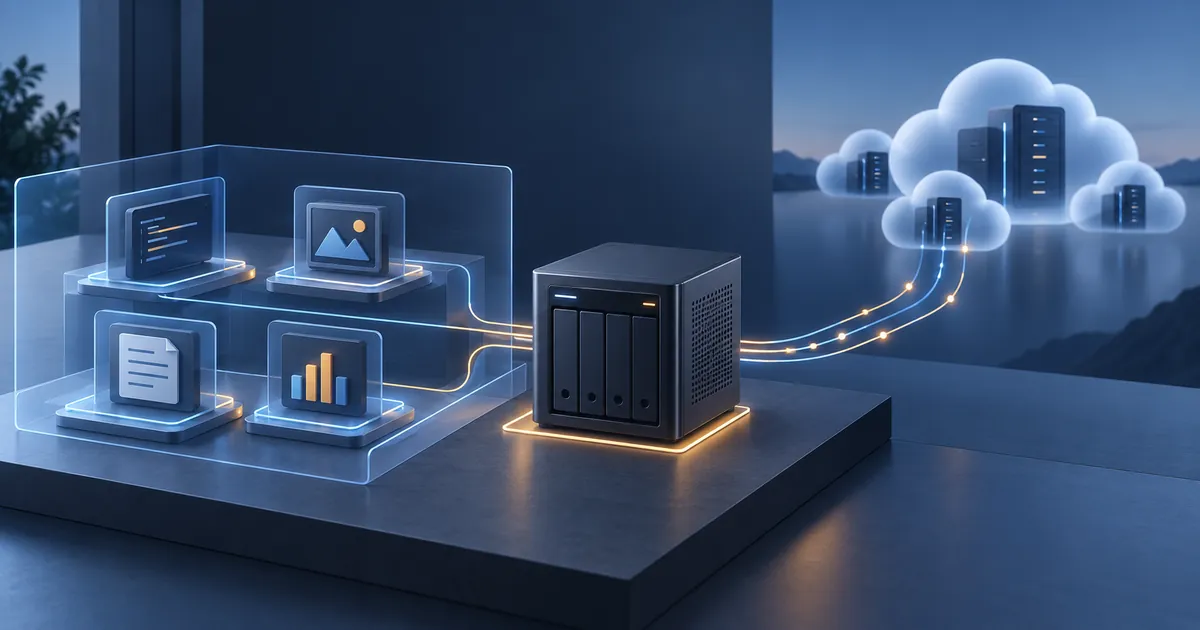
Before giving an AI agent access to a home server, decide which files it may read, which actions it may take, and where its model calls go. An open-source AI harness can put the workflow under your control while still sending selected context to a cloud provider.
For a founder building software, a practical starting point is one supervisor, one coding worker, a restricted execution environment, and explicit acceptance checks. Add more models or local inference when a measured need justifies them. You do not need to assemble every available agent tool before testing whether one useful job works.
This guide separates those decisions and provides a checklist for a first private development pilot. Product details were checked on 4 October 2026.
What an open-source AI harness actually controls
A harness is the software that keeps an agent working through a task: it supplies context, interprets tool requests, collects results, and continues or stops the loop. A model generates responses and proposed actions. The execution environment is where commands, file edits, and browser operations happen.
For example, an agent asked to repair a bug might inspect a repository, edit a file, run a test, read the failure, and try again. The harness coordinates that sequence. The model and the machine running the tests can be in different places.
| Decision | Choice and remaining question |
|---|---|
| Harness | Coordinates the task loop, context, tools, and integrations. Where is each model request processed? |
| Model or provider | Generates responses through inference. Which files and tools can the agent access? |
| Execution environment | Runs code and commands with configured restrictions. Does the result meet the requirement? |
| Release process | Sets the evidence and authorization needed to ship. Is the proposed answer correct? |
An open-source harness and an open-weight model are also separate choices. Read the harness license and the exact model's license independently. Downloadable application code does not give you the weights of a hosted model.
The distinction matters for privacy. OpenClaw's own project description says state, memory, and credentials live on your hardware, while prompts go to the model providers and chat platforms you configure. Local storage and remote processing can exist in the same workflow.
Where OpenClaw, DeepSeek Harness, Codex, and Claude fit
These products overlap, but comparing them as interchangeable models obscures the implementation work. Use the table to identify the role you need first.
| Component | Role and reason to evaluate |
|---|---|
| OpenClaw | Self-hosted assistant with swappable model and harness integrations. Consider it for an ongoing entry point for tasks and connected channels. |
| DeepSeek Harness | Plugin-based agent harness built on Cordis. Consider it to explore or customize how agent capabilities compose. |
| Codex CLI | Agent that inspects repositories, edits files, and runs local development tools. Consider it for a bounded software change. |
| Claude Agent SDK | Programmable Claude Code agent loop in Python or TypeScript. Consider it when embedding that loop in software you operate. |
The role descriptions come from the OpenClaw project, DeepSeek Harness repository, official Codex CLI documentation, and Claude Agent SDK overview. They describe capabilities, not a comparative benchmark.
Use one owner for the overall workflow
If you need a persistent assistant that receives and routes work, OpenClaw is a candidate for the outer supervisor. If all you need is an interactive coding task, a coding agent alone may be enough. Adding another supervisor creates another configuration, state store, and recovery path to understand.
OpenClaw's Codex harness integration illustrates a defined division of responsibility: Codex app-server manages the low-level agent session, while OpenClaw retains responsibilities such as channels, routing, and approvals. This is more specific than simply pointing a generic agent at a model endpoint.
When connecting systems, document who owns cancellation, retries, permissions, and the final task result. A task should not be retried independently by two supervisors after an uncertain failure.
Treat DeepSeek Harness as a separate evaluation decision
DeepSeek Harness is MIT-licensed and uses a plugin architecture built on Cordis. Its repository currently labels it a developer preview and warns of compatibility-breaking changes. That makes upgrade and compatibility testing part of the evaluation. DeepSeek Harness documentation and preview notice.
Evaluate it against a concrete workflow before making it a dependency of your development process. Pin a tested version, keep configuration backups, and check that the tools you need behave as expected after an update. You do not need DeepSeek Harness merely because you want to call a DeepSeek model.
Assign model roles from evidence
You could ask a Codex worker to implement a change and a Claude-based worker to inspect the result. That is a workflow hypothesis, not proof that one provider is always the best implementer or reviewer.
Start with one worker. Add a separate review pass when it identifies useful issues on your actual tasks. Record what the reviewer found and whether a person accepted the finding. Agreement between two models is not a substitute for tests or an accountable release decision.
Design the home server around explicit boundaries
Think of the server as the place that coordinates approved work and runs development tools. Cloud inference is a service it may call. Local inference is another workload you may choose to host.
For a private coding pilot, use this ownership table as a design worksheet. The entries are recommendations to implement and verify, not defaults promised by every harness.
| Boundary | Responsibility and evidence |
|---|---|
| Supervisor | Accept a task, select an allowed worker, stop or resume it. Inspect the task ID, owner, status, and retry history. |
| Coding worker | Change a designated checkout and run allowed tools. Inspect the diff, command results, and actual mounted paths. |
| Model connection | Receive only context permitted for that provider. Inspect the endpoint, payload policy, and fallback behavior. |
| Verification | Evaluate the change against requirements. Inspect test results, review findings, and the acceptance record. |
| Publication | Apply a separately authorized release decision. Inspect the approved revision and deployment result. |
Classify task data before selecting a provider. A repository permitted for cloud processing can use an approved hosted model. A local-only task needs a route that cannot silently fall back to a cloud provider. Review supporting services too: search, embeddings, telemetry, remote tools, and chat delivery may move information independently of the main model call.
Give each job an input contract: the repository, the goal, allowed data, permitted tools, expected output, and stop conditions. Keep credentials out of that natural-language contract. Supply only the task-specific access the execution environment actually needs.
For the output, request a patch plus evidence: what changed, which checks ran, what failed, and what remains uncertain. Store that record where a person can inspect it after the conversation ends.
Verify the execution boundary before adding autonomy
A Git worktree gives a task a separate working directory and branch. It does not prevent a process from reading other files or reaching the network. A sandbox controls a different layer, and its protection depends on the configured mounts, permissions, tools, and escape paths.
OpenClaw's sandboxing documentation states that sandboxing is off by default. When enabled, tool execution moves into a sandbox backend, while the gateway process remains on the host. The documentation also identifies elevated execution as a path outside the sandbox. Inspect the effective configuration for the worker you will actually run.
OpenAI likewise distinguishes sandbox restrictions from approval policy: one limits what commands can technically do; the other determines when permission is required. An approval prompt does not by itself create filesystem isolation.
Test the restrictions with harmless fixtures
Before using valuable repositories or sensitive data, create disposable files and test the intended boundaries:
- Can the worker edit its assigned checkout and run the required checks?
- Is an unrelated test directory inaccessible when your policy requires that?
- Can it reach only the network destinations permitted for the job?
- Are production credentials, personal folders, and unrelated storage absent from its environment?
- Does a blocked action stop clearly, rather than trigger a less restricted fallback?
- Can you cancel the task and recover its patch and logs?
Run those checks again after changing the execution backend or adding a powerful integration. These checks validate specific restrictions; they do not certify the whole system as secure.
Keep untrusted content separate from authority
A repository file, issue description, or web page can contain instructions that try to redirect the agent. OpenClaw's prompt-injection guidance explicitly includes documents, attachments, logs, and retrieved pages as possible sources of adversarial instructions.
Treat that material as task data. Keep secrets outside the worker's reachable files, grant narrow tools, and require an appropriate decision before an external side effect. An agent does not need production database access to prepare a code patch.
Keep administration private as well. For a home deployment, start with local access and a deliberately authenticated remote-access path if needed. OpenClaw's gateway exposure runbook recommends narrow exposure patterns and avoiding direct public port-forwarding to the gateway.
Size the server for measured work
Calling a cloud model does not require your home server to perform that model's inference. Your local capacity still needs to support the actual work: builds, test runners, browsers, containers, storage, and any databases used in development.
Start on an existing suitable machine when possible. Measure one representative task before buying a dedicated server:
- Record peak memory and disk use during the build and test cycle.
- Measure task duration and note which stage is slow.
- Repeat at the concurrency you intend to allow.
- Include logs, workspaces, backups, and recovery needs in storage planning.
- Set a limit on simultaneous jobs so the machine remains usable.
Local inference changes the calculation. Its requirements depend on the exact model, quantization, runtime, context length, and concurrency. Ollama's context-length guidance confirms that increasing context increases memory requirements. A model loading successfully is only the beginning of the test; it must also complete your intended tasks at an acceptable speed and quality.
A GPU may help a local inference workload, but it is not a universal prerequisite for running an agent harness. Make the purchase decision after identifying a local-only requirement or a measured workload that justifies it. For the broader economic decision, see the TokLis analysis of self-hosted LLM costs.
Run one bounded coding pilot
Choose a small change with observable behavior, such as improving validation in a non-critical form. Use a test repository or sanitized checkout and keep production access outside the pilot.
First define what a correct result looks like. The TokLis guide to spec-driven development for AI coding explains how to connect requirements, constraints, and acceptance evidence before code is written.
Then complete this pilot record:
| Field | What to write before starting |
|---|---|
| Scope | The one behavior to change and explicit exclusions |
| Data | What may go to the selected model and what must remain local |
| Permissions | Allowed checkout, commands, network destinations, and credentials |
| Acceptance | Observable outcomes and the checks that demonstrate them |
| Limits | Maximum time, spending, retries, and simultaneous workers |
| Review | Who inspects the diff and decides whether it is acceptable |
| Recovery | How to stop the task, discard changes, and restore the starting state |
For example, a hypothetical form-validation task could require an invalid input to show a useful error while a valid submission still works. The output should include the patch and evidence for both paths. No deployment permission is needed to produce that result.
Evaluate the pilot by accepted work, not the number of generated lines. Record model usage, elapsed time, manual corrections, failed checks, review findings, and whether the acceptance criteria passed. Count the time spent operating the harness as part of the effort.
Keep retries bounded. After a timeout, inspect whether the intended action already happened before repeating it. This matters especially once a workflow can create tickets, send messages, or change external records.
Expand only when the previous stage is understood. A reasonable sequence is read-only repository analysis, a patch in a disposable checkout, a reviewed pull request, and then separately authorized release actions. For wider team adoption, use the TokLis guide to AI coding tools for software teams.
A private assistant and a customer service need different designs
A home-server pilot can help you evaluate development work. It does not establish that the same gateway is suitable for unrelated customers.
OpenClaw's security model assumes one trusted boundary per gateway, such as a single operator or mutually trusting team. It explicitly says the gateway is not a security boundary for mutually adversarial tenants. A customer-facing application therefore needs a separate design for identity, authorization, execution, credentials, and data isolation.
Authentication terms also depend on the provider and use case. Anthropic's Agent SDK documentation says third-party products should use the documented API-key authentication methods; offering claude.ai login or its rate limits requires prior approval. Do not assume that a personal development login supplies the rights or operating model for a customer product.
Before depending on a home server for business-critical work, define how work stops and recovers when the machine, power, internet connection, or provider is unavailable. Test backups and restoration. Choose availability and support arrangements from the consequences of an outage, rather than from the convenience of the prototype.
Common questions
Do I need a GPU to run an AI harness?
Not for calling a hosted model. Size the machine for its local tools and job concurrency. If you add local inference, test the chosen model and runtime before deciding what acceleration it needs.
Does self-hosting mean all my data stays at home?
No. The configured model, tools, channels, and diagnostics determine where data goes. Inspect the complete data path and prevent cloud fallback for work classified as local-only.
Is DeepSeek Harness the same as a DeepSeek model?
No. The harness coordinates agent work; the model performs inference. Evaluate their interfaces, licenses, and runtime requirements separately.
Should I start with several agents?
Start with one bounded job and one worker unless the task has a clear reason for separation. Add another agent for a defined responsibility, and measure whether it contributes useful evidence or accepted work.
Can this work offline?
Only if the required model, tools, dependencies, and data are available locally and the workflow does not depend on remote services. Ollama supports a local-only mode that disables its cloud models and web search. You still need to check the rest of the stack.
Define the first job before choosing the full stack
Write down one useful task, its allowed data and actions, and the evidence required to accept the result. Use that document to evaluate a harness, then add infrastructure when the pilot shows why it is needed.
If the difficult part is turning the business goal into clear requirements and acceptance criteria, start a conversation with TokLis. Bring the proposed task, its constraints, and the unresolved decisions.