18 posts tagged with "B2B"

View All Tags

Predictive Analytics in Marketing: How AI Powers Data-Driven Strategies


· 27 min read
TokLis Solutions
Software delivery and digital marketing insights

Predictive analytics in marketing powered by AI data-driven strategies

Predictive Analytics in Marketing helps you stop guessing and start planning with foresight. Instead of reacting to last month’s clicks, you predict what customers are likely to do next, then you act early. AI makes this practical for small and medium size businesses because it can learn patterns from real campaign and customer data. You do not need a data science department to benefit. You need one clear business question, reliable tracking, and a way to turn predictions into actions inside your funnel. In this guide, you will use the PREDICT Framework, a step by step method Toklis.Solutions uses to turn data into decisions. You will learn how to anticipate behavior, improve lead generation, and run more intelligent advertising with confidence.

Real-World Impact: Moving Beyond the Coin Flip

A solo founder selling B2B workshops once told me, “My ads bring leads, but the calls are a coin flip.” We added a simple propensity score, meaning a prediction of who would book a call within seven days. The founder did not change targeting at first. They only changed follow up speed and message sequencing for the top scored leads. Within four weeks, booked calls rose from 11% to 18% with the same budget, and no extra hours in the week [Add data source]. The biggest surprise was emotional, not technical. The founder stopped debating opinions and started asking, “What does the model expect, and what will we test next?”

The Core Shift: From Reports to Operating Systems

That is the core shift: prediction is not a shiny report, it is a repeatable operating system for marketing. When AI powers data-driven strategies, you can allocate budget earlier, personalize offers sooner, and protect margin before it erodes. However, the model is only one component. The leverage comes from activation, meaning your ads, emails, landing pages, and sales workflows change based on the prediction. You will see practical examples for ecommerce, services, and SaaS, plus a realistic 30 day launch plan. You will also learn guardrails that keep your team safe when you use AI in marketing, including privacy, bias checks, and simple ways to validate lift. By the end, you will know exactly what to build first and what to ignore for now.

Meet the PREDICT Framework for Predictive Analytics in Marketing

PREDICT is the roadmap we use to operationalize Predictive Analytics in Marketing without turning your business into a research lab. P stands for Pinpoint the profit question. R means to Ready your data. E represents Engineering the signals. D covers Deciding on models and KPIs. I is for Implementing predictions in campaigns and CRM. C is about Calibrating with experiments. Finally, T reminds you to Track and tune over time. Each step is designed for real constraints: limited data, limited time, and tools that were not built for data science. Your goal is not a perfect model. Your goal is a decision system that improves results week after week. As you read, keep one use case in mind, because focus beats complexity every time.

P: Pinpoint the profit question before you use AI in marketing

Choose one decision that moves profit

Most “AI marketing” projects fail because they start with a tool and end with a dashboard. Predictive analytics only works when you tie it to a decision with a clear owner. Start by picking one decision you make weekly that changes revenue, margin, or cash flow. For example, you can decide which leads get a sales call, which customers get a retention offer, or which product bundle gets pushed in ads. This focus also protects you from vanity metrics. A model that predicts clicks might look impressive, yet it can still lose money if it attracts bargain hunters. If you are a founder, the fastest path is to choose one decision, one metric, and one workflow you can actually change this month.

Define the outcome, the window, and the segment

A prediction needs a definition that a computer can learn and your team can audit. Choose an outcome you can measure, like purchase, booked call, renewal, or churn. Then choose a time window, like seven days after signup or 30 days after first purchase. Finally, define the segment, such as new visitors, trial users, or past buyers. This structure prevents confusion later when results get reviewed, because everyone agrees on what “success” means. It also forces you to connect the model to your funnel stages. For lead generation, strong starter outcomes are booked call, sales qualified lead, or deposit paid, because they are closer to revenue than form fills today.

Micro case study: from more leads to better pipeline

A boutique home services company spent $4,000 per month on ads and celebrated a growing inbox. However, the owner noticed a pattern: the cheapest leads asked for the smallest jobs. We reframed the profit question to “Which leads are likely to request a project above $2,500?” We used past jobs, zip codes, device type, and landing page behavior to predict high value intent. Then we built two follow up flows: fast phone calls for high value leads and a helpful email sequence for everyone else. After six weeks, close rate on calls rose from 22% to 30%, and average job size increased by about $600 [Add data source]. The model did not create demand, it redirected attention to the demand that already existed.

Starter profit questions you can use this week

If you feel stuck, borrow a profit question that matches your model. Ecommerce businesses should ask who is likely to buy again in the next 14 days, then trigger a replenishment offer. In B2B services, the question is which inbound leads will book a call within seven days, allowing you to prioritize fast outreach. SaaS founders might ask which trial users will activate a key feature by day three to guide them with in-app prompts. Alternatively, if you sell high ticket programs, ask which leads will show up and match your ideal profile to protect your calendar. Pick one question, write the exact outcome definition, and you have a project that can be built, tested, and improved.

R: Ready your data so AI powers data-driven strategies

Start with a minimum viable dataset

You do not need big data to make predictions. You need connected data that tells a consistent story. A minimum viable dataset includes an identifier, a source, key events, and an outcome. For most SMBs, that means web analytics, ad platform clicks, email engagement, and CRM stages. The critical requirement is linkage. If your CRM lead does not connect to the form submission, the model cannot learn what drives quality. Therefore, treat identifiers as your first technical milestone. Pass a lead ID from the landing page to the CRM, store UTMs, and keep the same ID through the funnel. Once your data is connected, even a simple spreadsheet export can support useful scoring.

Fix tracking before you build the model

It is tempting to jump into modeling because it feels like progress. However, tracking fixes often create the biggest lift. Start with event definitions: what counts as a lead, what counts as qualified, and what counts as revenue. Then confirm your events fire reliably across devices and browsers. Next, align naming so “purchase” means the same thing in analytics, CRM, and ads. Finally, remove obvious noise like duplicate leads, test transactions, and internal traffic. A founder friendly rule is to audit one week of data line by line. If you cannot explain where each conversion came from, your model will not either, and you will chase ghosts in meetings for months.

Micro case study: the hidden form field that unlocked accuracy

A coaching business ran Meta ads and Google Search, but “source” in the CRM was often blank. The owner assumed the platforms were unreliable, so they kept shifting budgets based on gut feel. The real issue was simple: UTMs were not being captured and there was no lead ID stored with the form. We added a hidden field that stored UTMs and click IDs when available, then passed it into the CRM. Within two weeks, attribution completeness improved from about 55% to 92% [Add data source]. Only then did predictive scoring become meaningful, because the model could connect intent signals to channels. The owner also discovered one campaign produced fewer leads but twice the qualified rate, which changed their entire budget plan.

Data readiness checklist for small teams

Before you move forward, confirm four data readiness basics. First, outcomes exist as analytics events and as CRM stages, not just notes in a call log. Second, each lead or customer has a stable ID that persists across steps, from first click to purchase. Third, key sources are captured consistently, including UTMs and ad click IDs when consent allows. Fourth, the data can be exported into a simple table with one row per lead or customer. If any of these fail, pause and fix them, because every model trained on broken data will waste time and money. If you want help, Toklis.Solutions can implement tracking and pipelines so you can focus on offers and growth.

E: Engineer signals that predict behavior and improve lead generation

Focus on signals that reflect intent, not just activity

Raw activity is not the same as intent. Intent shows up as patterns, like repeated visits to pricing, time on a comparison page, or returning via branded search. Feature engineering means you turn behavior into signals a model can learn and you can explain. Start with three categories: recency, frequency, and depth. Recency answers how recently someone engaged. Frequency answers how often. Depth answers how far they went. For example, “visited pricing twice in three days” is stronger than “visited pricing once.” In addition, include funnel milestones, like starting checkout or reaching a demo scheduler. These signals make Predictive Analytics in Marketing feel tangible because they map directly to real customer behavior.

Build a small signal library you can reuse

Founders move faster when they reuse patterns. Create a small signal library that you can apply across models and campaigns. For lead generation, common signals include form completion time, number of pages viewed, repeat visits within seven days, and engagement with case studies or pricing. For ecommerce, signals include cart adds, category affinity, discount sensitivity, and days since last purchase. For subscriptions, signals include feature usage count, time to first value, and support ticket frequency. Keep signals simple at first. You are not trying to capture every detail. You are trying to capture the few behaviors that consistently separate buyers from browsers. Once you find two or three strong signals, you can scale them into intelligent advertising segments.

Micro case study: the two touch rule that raised conversion

An online course creator believed long form blog traffic was “low quality.” The numbers seemed to agree, because first visit conversion was tiny. We looked deeper and found a simple pattern: visitors with two meaningful touches, like a blog visit plus a webinar signup, were far more likely to buy. We built a signal called “two touch within 10 days” and used it as the main trigger for retargeting and email follow up. We also stopped retargeting one touch visitors with direct discounts, and instead sent them educational content. Over a month, purchase conversion from retargeted traffic moved from 1.6% to 2.4%, while ad spend dropped by 18% [Add data source]. The lesson was clear: good traffic was there, but the timing was wrong.

Feature examples you can copy without a data team

If you want a fast start, copy these feature patterns without hiring a data team. Count events in a window, like sessions in the last seven days. Measure recency, like days since last visit or days since last email click. Capture depth, like max scroll depth on a key page or time on site above 90 seconds. Track intent pages, like pricing views, demo views, and shipping policy views. Add simple ratios, like email opens divided by emails sent. Finally, add monetary summaries when available, like average order value and total spend. Each feature should be explainable to a teammate in one sentence, because explainability builds trust and better decisions.

D: Decide on models and KPIs that match profit

Start simple, then earn complexity

You do not need a complex neural network to win. In most SMB use cases, simple models outperform complicated ones because they are easier to maintain. Logistic regression, decision trees, and gradient boosting can produce strong results with modest data. The key is to choose a model that you can explain, monitor, and retrain without drama. A score that ranks leads from 0 to 100 can already transform prioritization. In addition, simpler models train faster and are easier to validate. That matters when you are moving quickly. Start with a baseline model, measure lift, then add complexity only if the gain is real. Your goal is performance you can repeat, not a clever model you cannot ship.

Pick KPIs that reflect value, not vanity

Your model will optimize whatever you label as success, so choose KPIs that match profit. For lead generation, prioritize sales qualified lead rate, booked call rate, and revenue per lead. For ecommerce, prioritize expected margin, repeat purchase probability, and cart recovery profit. For intelligent advertising, focus on incremental conversions and contribution margin, not just ROAS. ROAS can be misleading when it counts branded demand you would have captured anyway. If you cannot measure margin, start with revenue, but keep a note to improve your data later. A helpful rule is: if a KPI does not change a decision, it is not the right KPI for the model. When in doubt, pick the metric closest to cash.

Micro case study: when a high accuracy model lost money

A DTC brand built a model that predicted who would click a new ad creative. The accuracy looked strong, so they increased spend. Clicks rose, but revenue did not. The model had learned to target bargain hunters who clicked everything. We replaced the target with “profit per user over 30 days,” then retrained. The new model produced fewer clicks, but higher value customers. Over eight weeks, repeat purchase rate rose from 19% to 24% and refund rate dropped from 7% to 5% [Add data source]. The marketing team also felt calmer, because performance stopped swinging with every new creative test. The moral is simple: the label you choose becomes the behavior you get.

A simple scoring approach you can implement quickly

If you want to move fast, build a two stage scoring system. Stage one predicts likelihood to convert, like booking a call or purchasing. Stage two estimates expected value, like predicted revenue or margin. Then compute a priority score, such as conversion probability times expected value. This pushes the system toward both likelihood and impact, which is what founders care about. It also makes activation easier. Sales teams can focus on the top scores, and marketing can reserve higher bids for higher value segments. Even if your value estimate is rough, the direction is useful. Once the workflow is running, you can refine value with better cost and margin data, and your predictions will keep improving.

I: Implement predictions in intelligent advertising and your CRM

Turn scores into actions inside your funnel

A prediction that sits in a spreadsheet is wasted. Implementation means the score shows up where decisions happen: ads, email automation, and CRM tasks. Start by creating action bands, such as high, medium, and low intent. Then assign each band a next step. High intent might get personal outreach or a demo offer. Medium intent might get a case study sequence. Low intent might get educational content, or it might be excluded from expensive retargeting. This is how you use AI in marketing without overcomplicating the stack. You are not automating everything. You are choosing where prediction changes behavior. If you can name the action for each band, you are ready to activate predictive analytics.

Intelligent advertising: better audiences, better bids, better creative

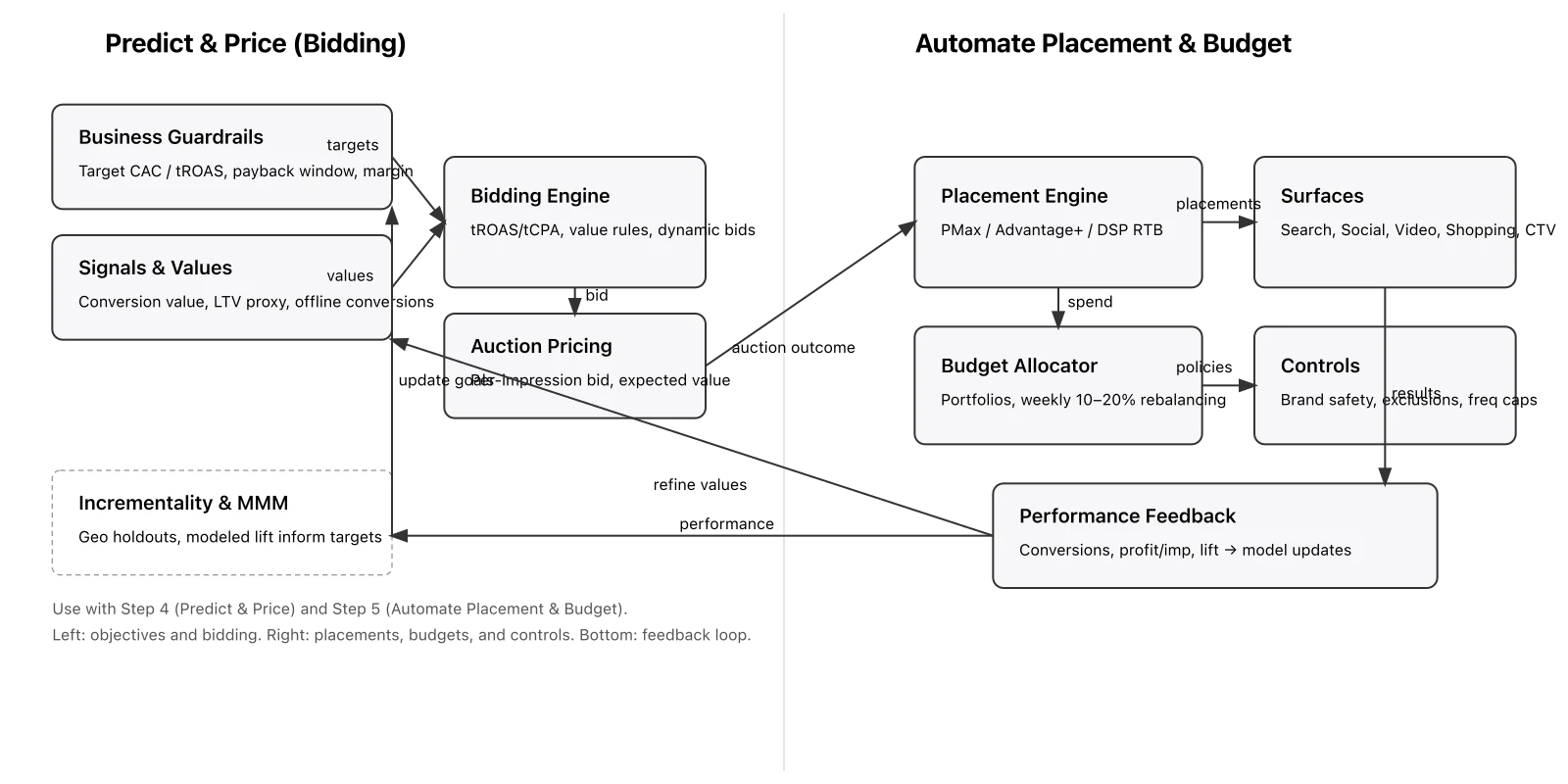
Predictive segments improve advertising in three practical ways. First, you build better audiences, like people likely to buy in 14 days or leads likely to qualify. Second, you adjust bids and budgets based on predicted value, not on gut feel. Third, you tailor creative and offers by segment. A high intent segment might see proof and urgency, while a warm segment sees education and differentiation. When you use AI in advertisement like this, you avoid one size fits all messaging. You also reduce frequency waste, because low intent users stop seeing the same expensive ad ten times. Start with one channel where you already have conversion volume, then expand. Implementation is a marketing skill, not just a technical task.

Micro case study: retargeting that became cheaper and more effective

A B2B software company ran retargeting to all site visitors and complained about rising costs. We introduced a simple “demo likelihood” score based on visits to docs, pricing, and integrations pages. Only the top 30% of scored visitors entered the retargeting audience. The team feared volume loss. Instead, cost per booked demo dropped from $210 to $155 and sales reported fewer low fit calls [Add data source]. The creative also changed. High score users saw messaging about implementation speed and integrations, while lower score users saw a short explainer video. The company did not need more traffic. It needed better timing and better relevance. That is the quiet power of intelligent advertising when prediction drives segmentation.

CRM activation for lead generation and sales speed

In the CRM, predictive scores shine when they drive prioritization and timing. Add the score to the lead record, then create simple rules. High score leads get a task within one hour. Medium score leads get a task within one day. Low score leads enter nurture. Also route high score leads to your best closer, because speed and skill compound. In addition, align messaging. High score leads should receive the shortest path to a conversation, while medium score leads need proof, clarity, and objections handled. This is where predictive analytics becomes lead generation fuel, not just analytics. If you want to start small, implement only one rule: respond faster to the top band. It often delivers the quickest ROI [Add data source].

C: Calibrate with experiments so you can trust the lift

Prove impact with tests, not vibes

Prediction feels persuasive, so it is easy to fool yourself. Calibration means you prove the model improves outcomes compared to your current process. The simplest test is a holdout. Keep a random slice of leads on your normal workflow, and apply the predictive workflow to the rest. Then compare outcomes over a consistent window, like booked call rate within seven days or revenue within 30 days. Make sure the groups are comparable and that your team follows the rules. Also watch for leakage, where sales reps treat control leads differently because they can guess intent. A clean test gives you confidence to scale spend. A messy test creates debate and stalls progress. If you only do one thing, document your baseline before you change anything.

Design experiments that fit small sample sizes

SMBs do not always have thousands of conversions per week, so your experiments must fit small sample sizes. Choose high leverage decisions, like follow up speed, offer sequencing, and retargeting inclusion. These often show impact with fewer samples. Use one primary metric tied to profit, plus one guardrail metric like refund rate or unsubscribes. Avoid changing too many variables at once. For example, when testing a predictive retargeting audience, keep creative stable for the first two weeks. When testing predictive lead routing, keep scripts stable. In addition, run tests long enough to cover day of week effects. A seven day window is often a minimum. If you cannot run a clean experiment, treat results as directional and stay conservative with scaling.

Micro case study: the speed to lead experiment that paid for itself

A consultant received about 40 inbound leads per month and assumed predictive scoring would not matter. We used a simple model to identify the top 20% most likely to book. Then we ran a timing experiment. High score leads got a personalized email within 15 minutes, while everyone else followed the normal 12 hour response time. After two months, the fast follow up group booked at 2.2 times the rate of the control group [Add data source]. The model did not change the consultant’s brand, pricing, or ads. It changed timing and attention. That is why calibration matters. Without a test, the consultant would have blamed the model for “not working,” even though the workflow change was the real driver. Use experiments to separate model value from execution value, then improve both.

Experiment checklist you can reuse every quarter

Before you run a test, confirm four items. First, you have a clear hypothesis, like high score segments will convert more with offer A than offer B. Second, you have a control group and a measured window. Third, you have one primary metric tied to profit, plus one secondary metric that protects brand trust. Fourth, you have a plan for what you will change if the test wins or loses. Then run the test and write down the result. This documentation becomes a library of decisions, which helps when tools or team members change. If you want support setting up clean tests, Toklis.Solutions can build the measurement plan and dashboards so your experiments stay honest. The goal is not to “prove AI.” The goal is to prove a better decision system.

T: Track, tune, and turn Predictive Analytics in Marketing into a growth engine

Monitor drift so predictions stay accurate

Markets change, offers change, and traffic quality changes. That means models drift, which is a simple way of saying yesterday’s patterns stop predicting tomorrow. Tracking helps you catch drift early and protect budget. Start by monitoring input health, like missing UTMs or broken events. Then monitor output behavior, like average score over time and conversion rate by score band. If your average score suddenly spikes, it might mean tracking broke or your traffic mix changed. Also monitor calibration, meaning whether a 70 score still converts near the expected rate. You do not need advanced tools to start. A monthly spreadsheet review can catch most issues. Treat the model like any marketing asset: it needs upkeep, or it decays.

Build lightweight governance that keeps you safe and fast

Using AI in marketing does not remove responsibility. You still own privacy, fairness, and brand trust. Set basic rules. Use consented data. Minimize sensitive attributes. Document what the score means and what it does not mean. If you operate in regulated industries, get legal guidance on data usage and disclosures. Also set guardrails for automation. Do not auto deny service based on a score. Use the score to prioritize outreach, not to exclude people unfairly. In addition, keep a human review loop for edge cases, like high value clients who behave differently. These practices protect customers and protect you, and they also make the model easier to defend internally when results get questioned.

Micro case study: the monthly retrain that prevented wasted spend

A subscription business launched a new onboarding flow and saw performance decline. Their churn prediction model began flagging too many users as “at risk,” so the team offered discounts broadly. Margins suffered and the discounts trained customers to wait for deals. We reviewed the data and found a behavioral shift: new users behaved differently because onboarding changed. We retrained the model on the last 90 days and updated features to include onboarding milestones. In the next month, the discount audience shrank by 35% while retention stayed steady [Add data source]. The team learned a key lesson: model maintenance is not optional. It is how Predictive Analytics in Marketing stays profitable as your business evolves. If you change your product, update your model too.

A monthly review routine for founders and solo teams

Set a 30 minute monthly review with yourself or your team. Review three views: outcomes by score band, cost per outcome by channel, and exceptions where high score did not convert. Then decide one action, like adjusting a segment threshold, updating a nurture sequence, or retraining with fresh data. Also check data health: missing sources, duplicate leads, and broken events. Finally, write down what you changed and why. This record prevents repeat mistakes and builds confidence in the system. The biggest advantage of predictive systems is learning speed. When you review and adjust regularly, you compound improvements. If you skip reviews, the model becomes a forgotten file and your team returns to gut feel. Consistency wins here, not hero effort.

Common pitfalls when you use AI in advertisement and predictive analytics

Predictive projects fail in predictable ways. The first failure is starting with a model and hoping value appears. Always start with a profit question and a clear action. The second failure is optimizing the wrong label, like clicks or cheap leads, which trains the system to chase low value behavior. The third failure is weak measurement. If you cannot connect outcomes to sources, you will not know what works, and your model will inherit that confusion. The fourth failure is treating predictions as truth. A score is a probability, not a verdict, so avoid hard exclusions that hurt trust. Finally, many teams forget creative and offer fit. Even the best score cannot fix a weak landing page or unclear promise. When you see poor results, diagnose in this order: tracking, offer, workflow, then model. That order saves time and money.

Another failure is tool hopping. Founders try three AI tools, see inconsistent outputs, and conclude AI does not work. Usually the inputs and goals were unclear, so each tool learned a different story. Instead, commit to one use case for 30 days. Measure it, learn, and improve. Also be careful with privacy and data sharing. Do not upload sensitive customer data into unknown tools without clear agreements and access controls. Use vendors with strong security practices, and follow your local regulations. If you want speed without risk, start with aggregated or pseudonymous signals, then add richer data only when you have governance in place. Smart predictive marketing is not reckless automation. It is disciplined decision making with better evidence.

A practical 30 day plan to launch Predictive Analytics in Marketing

Here is a practical 30 day launch plan that works for founders. Week one focuses on definition and tracking. Choose one profit question, define the outcome and window, and confirm events and CRM stages match. During week two, shift to data shaping. Export a table with one row per lead or customer, then add basic signals like recency, frequency, and intent page views. By week three, move to modeling and activation. Build a simple score, create three action bands, and deploy one workflow, like faster follow up for high score leads. Finally, use week four for calibration. Run a holdout test, compare outcomes, and adjust thresholds. Do not expand scope mid month. Your first goal is a working loop, not perfection. Once the loop exists, improvements become easy, because you have a baseline and a place to apply learning.

Your first model should feel almost boring. Boring means it is understandable, measurable, and maintainable. Once the first use case works, you can expand into retention and upsell. Add a churn risk score to protect renewals. Add a next best offer score to improve customer lifetime value. Over time, these models become building blocks for intelligent advertising and lifecycle marketing. You will also notice your team conversations change. Instead of debating opinions, you will ask, “What does the data predict, and what will we test next?” If you want a faster path, Toklis.Solutions can build the pipeline, scoring, and activation so you start learning in weeks, not quarters. The long term win is not one prediction. It is a culture of better decisions.

Quick checklist to implement the PREDICT Framework today

Use this quick checklist to apply the PREDICT Framework today. Write one profit question tied to a decision and a deadline. Confirm your outcome event and CRM stage definitions match. Capture source data consistently, including UTMs. Build a simple table with one row per lead or customer and add recency, frequency, and depth signals. Create a basic score and three action bands. Activate one workflow, such as faster follow up for high score leads or tighter retargeting for high intent visitors. Run a holdout test for at least seven days and record the lift. Finally, schedule a monthly review to monitor drift and update thresholds. If you do these steps in order, Predictive Analytics in Marketing becomes a system, not a one off project. When you are ready, the next upgrade is to connect scoring directly to budgets and creative, so every campaign learns faster.

Next steps: build your predictive marketing system with Toklis.Solutions

If you want Predictive Analytics in Marketing to drive revenue, treat it like a product you deploy, not a report you admire. Toklis.Solutions helps small and medium size businesses build the full system: tracking that captures clean signals, data pipelines that connect web and CRM, and scoring that activates inside campaigns. We also help you design experiments so you can trust the lift before you scale spend. You get a practical setup that improves lead generation, reduces wasted ads, and supports faster decisions. Most importantly, you get workflows your team will actually use, because the score shows up where work happens. If you are building software solutions internally, we can also advise on architecture so models and data stay maintainable as you grow.

A simple next step is to pick one use case and write down the decision, the metric, and the workflow. To get feedback, turn that into a one page plan and share it with your team. Alternatively, for an outside partner, reach out to Toklis.Solutions for a predictive marketing audit. We will review your tracking, your data quality, and your campaign structure, then recommend the fastest path to measurable lift. Even if you are early, you can start with lightweight scoring and upgrade later. The key is to start learning now, because your competitors are already using AI to move faster. When you are ready to use AI in advertisement more aggressively, you will have the foundation to do it safely and profitably.

Also, find how the Toklis Solutions can improve the digital marketing and software development in your business.

FAQ

  1. What is Predictive Analytics in Marketing, in plain English? It uses past behavior and campaign data to predict what a customer or lead is likely to do next, so you can act sooner and spend smarter.
  2. How does predictive analytics improve lead generation? It helps you prioritize high intent leads, tailor follow up, and reduce time spent on low fit prospects, which improves booked calls and qualified pipeline.
  3. What data do I need as a founder or solo entrepreneur? Start with connected basics: traffic source, key site events, email engagement, CRM stages, and a clean outcome like booked call or purchase.
  4. How can I use AI in marketing without hiring a data scientist? Use a single use case, clean tracking, and a simple score with action bands. Start with one workflow that changes behavior inside your funnel.
  5. How do I use AI in advertisement responsibly? Focus on consented data, avoid sensitive attributes, document what the score means, and test lift with holdouts before scaling budgets.
  6. What is “model drift” and why should I care? Drift happens when customer behavior changes and your model stops predicting well. Monthly reviews and periodic retraining keep performance stable.
  7. How quickly can I see results from Predictive Analytics in Marketing? Many SMBs see early lift within 30 days when the score triggers faster follow up or tighter retargeting, especially with clear measurement [Add data source].
  8. What is the most common mistake teams make? They optimize for the wrong outcome, like clicks or cheap leads, instead of profit aligned metrics like qualified rate, revenue per lead, or contribution margin.


AI Chatbots and Virtual Assistants: Enhancing Customer Service and Lead Generation

· 36 min read
TokLis Solutions
Software delivery and digital marketing insights

AI chatbots and virtual assistants for customer service and lead generation

If your team is still debating “Should we use AI chatbots?” you’re focusing on the wrong problem.

The real question for a small or medium-sized business is:

How quickly can you turn AI chatbots into a reliable engine for customer service and lead generation—without damaging customer trust or overloading your team?

You don’t need a stack of new tools or a giant AI team to pull this off. You need a simple, repeatable method that fits into the broader evolution of AI in business today, transforming digital marketing and software development.

That’s where the L.E.A.D. Framework for AI Chatbots comes in:

  • L – Learn the Journey: Map where AI chatbots and virtual assistants create real value.
  • E – Engineer Conversations: Design assistants that actually help, not annoy.
  • A – Activate Across Channels: Deploy AI chatbots where customers already are.
  • D – Dial In Performance: Measure, optimize, and govern your assistants like real teammates.

By the end of this guide you’ll also get a one-glance L.E.A.D. checklist you can copy straight into your project doc or task manager.

This article is written for founders, solo entrepreneurs, and small teams who want to:

  • Improve Customer Service without hiring an army.
  • Use AI chatbots and virtual assistants to generate more and better leads.
  • Create a practical, low-drama roadmap for implementation.

What We Mean by “AI Chatbots” and “Virtual Assistants”

Before you invest time, budget, or reputation in this, let’s get our terminology straight.

What Are AI Chatbots?

When we talk about AI chatbots, we mean conversational interfaces powered by advanced language models that can:

  • Understand natural questions (not just button clicks or rigid menus).
  • Respond in real time.
  • Pull information from your docs, help center, or systems.
  • Live in places like:
    • Your website (e.g., pricing, product, or help pages).
    • Your web app or SaaS product.
    • Embedded widgets in channels like WhatsApp, Messenger, or SMS.

Think of them as your front-line digital greeters and first responders.

What Are Virtual Assistants?

Virtual assistants go one step further.

They’re still AI chatbots at the core, but with deeper capabilities:

  • Work across multiple channels (web, app, messaging, maybe even email summaries).
  • Access account or order data (“What’s my plan?”, “Where’s my shipment?”).
  • Trigger workflows in your CRM, support platform, or billing system.
  • Help internal teams answer faster, not just customers.

You can think of them as junior teammates who never sleep, never get bored of password resets, and never complain about time zones.

Why You Should Treat Them as One Integrated Experience

AI chatbots and virtual assistants often get treated as separate tools:

  • “We have a chatbot on the homepage.”
  • “We built a support assistant in the help center.”
  • “Sales uses a scheduling bot.”

The real magic happens when you design them as one integrated experience, with:

  • A shared brain (knowledge sources and rules).
  • Consistent tone and boundaries.
  • Shared data across support, marketing, and sales.

That’s when every interaction—support or sales—feeds your funnel instead of sitting in a silo.


Why AI Chatbots Are Now a Revenue Channel (Not Just a Cost Saver)

For years, chatbots were the “voicemail of the website.”

They popped up, asked for an email, made you pick from clunky menus, and eventually dumped your message into a black hole. You never knew if anyone read it.

That era is over.

Today, well-designed AI chatbots can:

  • Solve a large share of repetitive support questions.
  • Qualify, score, and route leads in real time.
  • Guide visitors to the right product, plan, or content.
  • Capture context that sales and success teams can use later.

From Digital Form to Digital Sales Ally

Imagine this scenario:

It’s 10:43 PM. A visitor hits your pricing page from a Google Ads campaign.

If you’re also thinking about how to improve the effectiveness of that spend, explore frameworks such as AI for optimized ad placement (AIM-PACT framework) to align smarter media buying with your chatbot strategy.

A smart virtual assistant can:

  1. Recognize they came from a specific campaign or keyword.
  2. Ask 2–3 intelligent, low-friction questions:
    • “How big is your team?”
    • “Are you mostly interested in [Feature A] or [Feature B]?”
    • “When do you plan to make a decision?”
  3. Recommend a plan based on their answers.
  4. Offer to:
    • Book a demo with the right rep.
    • Start a free trial.
    • Send a tailored comparison or case study.

That’s not a “nice extra.” That’s the difference between a curious browser and a qualified pipeline opportunity.

The New Goal for Founders and SMB Teams

Your target isn’t just “We installed a chatbot.”

Your goal is to turn AI chatbots and virtual assistants into front-line partners for both:

  • Customer Service (fewer tickets, faster support, happier customers), and
  • Lead Generation (more qualified leads, more context for reps, higher conversion).

The L.E.A.D. Framework is your roadmap to do this without chaos.


The L.E.A.D. Framework for AI Chatbots

Here’s the big picture before we dive into each step.

  • L – Learn the Journey Understand your key customer and lead flows. Identify exactly where AI chatbots create value, instead of spraying bots everywhere.
  • E – Engineer Conversations Design conversations that feel natural, stay on-brand, and either solve the problem or smoothly escalate to humans.
  • A – Activate Across Channels Put AI chatbots on high-intent pages and channels your customers already use: website, in-app, messaging, and even internal tools.
  • D – Dial In Performance Measure what matters, review conversations, coach the assistant, and keep governance tight.

We’ll walk through each step with examples, stories, and concrete actions you can assign to your team.


Step 1 – Learn the Journey: Map Where AI Chatbots Actually Help

Here’s a blunt truth:

AI chatbots don’t fix a broken customer journey. They just reveal the cracks faster.

Most teams start with tools:

  • “Which platform should we use?”
  • “Which AI model is best?”
  • “How do we integrate with our CRM?”

Those questions matter, but not first.

Your first job as a founder or leader is to understand where customers get stuck today and where AI can actually make a difference.

Start With Two Simple Journeys: Support and Sales

You don’t need a design degree or a 50-slide journey map.

For most small and mid-sized businesses, you can start with two basic flows on a whiteboard or digital board:

1. Customer Service Journey

  1. Discover your brand (ad, referral, search, content—often supported by AI in content marketing).
  2. Sign up, buy, or onboard.
  3. Start using your product or service.
  4. Hit confusion, friction, or a problem.
  5. Seek help (search, email, chat, phone, social).
  6. Get a response.
  7. Issue is resolved—or not.

2. Lead Generation Journey

  1. Discover your brand or content.
  2. Show intent (pricing page, product page, trial signup, contact form).
  3. Need clarity, reassurance, or proof.
  4. Interact with sales or self-serve touchpoints.
  5. Convert into a customer—or disappear.

Now, for each step, ask:

“What questions show up here again and again?”

This one question is gold.

  • The answers reveal patterns.
  • Patterns reveal opportunities for AI chatbots.

Capture those recurring questions from:

  • Support inbox and tickets.
  • Sales call notes and CRM.
  • Live chat transcripts.
  • Comments and DMs on social channels.

Identify “High-Volume, Low-Emotion” Moments First

AI chatbots shine in “high-volume, low-emotion” situations.

These are questions customers want answered quickly, where they don’t need deep empathy—just clarity.

Examples in Customer Service:

  • “How do I reset my password?”
  • “Where is my order?”
  • “How do I change or cancel my plan?”
  • “What does this feature do?”
  • “How do I update my billing details?”

Examples in Lead Generation:

  • “Which plan works best for a small team?”
  • “Do you integrate with [Tool X]?”
  • “Do you offer monthly billing?”
  • “Can I try this without a credit card?”
  • “How long does onboarding take?”

These are prime candidates for AI chatbots because:

  • The answers are repeatable.
  • The risk is low.
  • The value to the customer is speed and convenience.

Your first wins—and your internal credibility—come from automating these moments.

Simple Prioritization Grid

Take your list of recurring questions and mark each with:

  • H or L – High or Low volume.
  • H or L – High or Low emotional impact.

Target these first: High volume + Low emotion (H + L)

Examples:

  • “Reset password” — H volume, L emotion.
  • “Where is my order?” — H volume, L emotion (unless delayed or lost).
  • “Does this integrate with Slack?” — H volume, L emotion.

Use “Time-to-Response” as a Compass

Next, look at how long customers currently wait for help at different stages:

  • How long for a first reply on email?
  • How long to get someone on live chat?
  • How long between “Request a demo” and an actual conversation?
  • How long to receive basic answers from your team?

Anywhere the realistic answer is “hours” or “days”, you have a candidate for an AI chatbot or virtual assistant.

Typical hotspots:

  • Evenings and weekends when no one is staffing chat.
  • Time zones outside your main region.
  • High-traffic campaigns where your team can’t keep up.
  • Busy launch periods.

You don’t need perfect automation. You need a meaningful improvement over “We’ll get back to you tomorrow.”

Story: The SaaS Company Drowning in “Quick Questions”

A mid-market SaaS company felt like it was always underwater.

  • Support queues backed up.
  • Customers complained about slow replies.
  • The team felt burnt out.

But when they analyzed their ticket data, they discovered something shocking:

41% of all tickets came from just 15 recurring questions.

Most were simple “how-to” questions or basic billing issues.

Instead of hiring more agents immediately, they:

  1. Built a first AI chatbot for Customer Service focused on those 15 questions.
  2. Connected it to a curated part of their help center.
  3. Let the assistant:
    • Answer those FAQs.
    • Surface key configuration links.
    • Escalate complex issues to humans with context attached.

Within a few days:

  • The “quick question” tickets dropped sharply.
  • First response time improved.
  • Agents had more time for complex, high-value problems.

They didn’t change their product. They simply learned the journey and let a virtual assistant handle the repetitive front line.

Workshop: A 2-Hour “Learn the Journey” Sprint

Before touching a chatbot configuration screen, run a short workshop with people from:

  • Support / Customer Service
  • Sales
  • Marketing
  • (Optional) Product or Operations, if relevant

In 2 hours, you can:

  1. Map the Customer Service and Lead Generation journeys on a whiteboard.
  2. List the top 20–30 recurring questions from each team.
  3. Mark H/L volume and H/L emotion for each.
  4. Identify your top 5 high-intent pages (e.g. pricing, checkout, trial signup, key feature pages, help center).
  5. Highlight your best early chatbot opportunities.

Action Step: Create a shared doc called “AI Chatbot – Journey & FAQ Map” and fill it in during this workshop. This becomes your foundation for the rest of the L.E.A.D. Framework.


Step 2 – Engineer Conversations: Designing AI Chatbots That Serve and Sell

Most customers don’t hate AI chatbots. They hate bad conversations.

  • The bot that ignores what you typed.
  • The one that traps you in menus.
  • The one that insists on five questions before answering anything simple.

If your AI chatbot behaves like a scripted answering machine, people will spam “agent” or close the window.

If it feels like a helpful virtual assistant, customers will gladly engage—even knowing it's not human.

The difference is conversation design, not buzzwords.

Give Your AI Chatbot a Clear Role and Persona

Start by defining the assistant’s purpose in one crisp sentence.

Examples:

  • “I help customers solve common issues and find the right help article.”
  • “I help visitors understand pricing and pick the right plan.”
  • “I help prospects book time with the right sales rep based on their needs.”
  • “I help existing customers troubleshoot common issues and know when to escalate.”

Then, add a light persona:

  • Tone: friendly, professional, or playful?
  • Formality: “Hi there” vs. “Good afternoon, how can I help?”
  • Pace: concise or more explanatory?
  • Boundaries: what it will and will not answer.

This might sound soft, but it matters:

  • A clear role ensures focused, consistent conversations.
  • A defined tone keeps the experience on-brand across channels.
  • Boundaries protect you from risky or off-topic answers.

You’re turning a general AI model into your brand’s AI assistant.

Set Guardrails: What the Assistant Should and Shouldn’t Do

Next, define guardrails so your AI chatbot doesn’t “wing it” in dangerous territory.

Your AI chatbot / virtual assistant should:

  • Answer only from approved knowledge sources (help center, docs, policies).
  • Ask for clarification when uncertain, instead of guessing.
  • Escalate sensitive topics quickly (billing disputes, security, legal, health, etc.).
  • Stay within brand, legal, and compliance guidelines.
  • Be transparent: clearly present itself as an AI assistant.

Your AI chatbot should not:

  • Invent policies, discounts, or prices.
  • Provide legal, financial, or medical advice.
  • Change account details without secure verification.
  • Argue with customers or get stuck in loops.
  • Pretend to be human.

Most modern platforms allow you to encode these as instructions, policies, or system prompts. Use them. This is where you control risk.

Design Conversational Flows Around “Jobs,” Not Menus

Old-school bots forced users through rigid decision trees:

“Press 1 for billing. Press 2 for support…”

AI chatbots handle real language, but they still benefit from a light conversational structure.

Think in terms of jobs to be done—each interaction is a “job” your customer wants the assistant to handle:

  • “Help me fix an issue.”
  • “Help me understand pricing.”
  • “Help me check my order status.”
  • “Help me book a call or demo.”
  • “Help me decide if this is right for my situation.”

For each job, sketch a simple flow:

  1. Greeting & Intent Detection
    • “Hi, I’m your AI assistant. What can I help you with today?”
    • Or a targeted greeting based on the page:
      • “Comparing plans? I can help you pick one in under a minute.”
  2. Clarifying Questions
    • “Got it—can you tell me your order number?”
    • “How many team members will use this?”
    • “Are you using [Tool X] today?”
  3. Answer or Action
    • Provide a tailored answer, link to help articles, or perform an action (e.g., fetch order status).
  4. Follow-up & Close
    • “Does this solve your question?”
    • “Do you want to schedule a quick call to go deeper?”

This backbone keeps conversations efficient while still allowing users to type freely.

Example: An AI Chatbot for Order Tracking

Let’s revisit a retail example.

On an order status page, a Customer Service AI chatbot might handle:

Bot: “Hey! I can help you track your order. Do you have your order number handy?”

User: “Yes, it’s #10483.”

Bot: “Thanks, I’ll check that now.”

(Behind the scenes, the virtual assistant calls your order tracking API.)

Bot: “Your order #10483 shipped yesterday and is due to arrive on Thursday. Here’s your tracking link: [link]. Would you like help with returns, exchanges, or anything else?”

No ticket needed. No agent involved. The user feels supported, and the team stays free for complex cases.

Story: How One Startup Turned Its AI Chatbot into a Sales Ally

A B2B analytics startup noticed visitors were spending time on their pricing page but rarely converting.

Instead of just tweaking copy, they launched a sales-focused AI chatbot with one mission:

“Help visitors figure out if this product fits and which plan is best.”

The assistant asked three simple, high-signal questions:

  1. “How many people will use the product?”
  2. “Do you need advanced integrations like [Tool A] or [Tool B]?”
  3. “How soon are you planning to implement a solution?”

Based on answers, the virtual assistant would:

  • Recommend the best-fit plan.
  • Surface a relevant case study (e.g., “Teams your size usually start with…”).
  • Offer to:
    • Book a demo, or
    • Share a 5-minute product tour.

Results:

  • More visitors moved from “lurking” to “talking to sales.”
  • Reps got richer context before each call.
  • The assistant became a quiet but powerful lead generation engine.

Practical Exercise: Script 3–5 Key Conversations

Pick your top jobs to be done from Step 1 and, for each one, write a short script:

  • Greeting
  • 1–3 clarifying questions
  • Example answer or action
  • Follow-up question

Action Step: Create a doc titled “AI Chatbot Conversation Scripts – v1” and draft 3–5 flows. Treat it like a short play. Then hand it to whoever will configure the assistant in your platform.


Step 3 – Activate Across Channels: Put AI Chatbots Where Customers Already Are

A powerful AI chatbot stuck on a single page is like your best sales rep locked in a broom closet.

If you only deploy the assistant on your homepage, you miss the moments where intent and frustration are highest—like pricing, signup, in-product onboarding, or high-stakes support pages.

Start thinking of your assistant as an omnichannel teammate.

Start With High-Intent Pages

Don’t try to “AI-ify” your entire site on day one. Begin where motivation is strongest and where a helpful nudge changes outcomes.

Common high-intent candidates:

  • Pricing page: Answer plan questions, handle objections, help compare options.
  • Product / Feature pages: Explain use cases, integrations, and ROI.
  • Checkout / Signup flows: Clear friction, handle last-minute doubts, reduce drop-off.
  • Help center & FAQ: Offer fast answers, summarize articles, and escalate when needed.
  • Contact / “Talk to Sales” pages: Replace generic forms with a conversational intake.

On each page, tailor the assistant’s greeting and prompts:

  • Pricing:“Comparing plans? I can help you decide in under a minute.”
  • Help center:“Tell me what you’re trying to do, and I’ll suggest the best article or next step.”
  • Checkout:“Need help with shipping, payment, or discounts? Ask me anything before you place your order.”

Extend Your AI Chatbots into Messaging and Social Channels

Customers increasingly expect answers inside the channels they already use:

  • WhatsApp or SMS
  • Facebook Messenger or Instagram DMs
  • In-app mobile chat
  • Slack or Teams (for B2B / internal use)

Good news: you don’t need a separate brain for each.

You can use one central AI assistant and connect it to different channels, customizing:

  • Greetings
  • Timeouts
  • Escalation paths
  • Tone (slightly more casual in WhatsApp, more formal in LinkedIn or email-like flows)

Example: B2B Slack-Based Assistant

A B2B SaaS company might:

  • Use a public-facing AI chatbot on their website for prospects.
  • Use a Slack-based virtual assistant for internal teams that:
    • Checks key account stats (MRR, plan, last activity).
    • Summarizes recent support tickets.
    • Drafts responses or updates for customer success.
    • Preps a quick briefing before customer meetings.

Same AI core, different roles depending on context.

Integrate AI Chatbots with CRM and Support Tools

Your AI chatbot becomes truly powerful when it talks to your existing systems.

At a minimum, target integrations with:

  • Support / ticketing tools (Zendesk, Freshdesk, Help Scout, etc.):
    • Create tickets when issues need human attention.
    • Attach the conversation context so agents don’t start from scratch.
  • CRM (HubSpot, Pipedrive, Salesforce, etc.):
    • Log conversations as activities.
    • Update lead fields (company size, use case, urgency).
    • Assign owners and stages based on chatbot qualification.
  • Marketing automation tools:
    • Add prospects to relevant nurture flows based on what they asked about.
    • Update tags and segments (e.g., “Integration-interested,” “Churn risk,” “Upsell opportunity”).
  • Billing / account systems:
    • Show plan information, renewal dates, and limits.
    • Trigger upgrade flows or connect to billing support.

This turns every chat into structured, reusable data, rather than a one-off dialog.

When a lead books a call through the bot, the sales rep should see:

  • Pages visited.
  • Questions asked.
  • Answers provided by the assistant.
  • Any objections or concerns the prospect raised.

That context is gold.

Story: The Ecommerce Brand Turning Late-Night Chats into Leads

An ecommerce brand noticed something interesting in their analytics:

  • A big chunk of traffic arrived after 7 PM.
  • These visitors browsed multiple products but rarely purchased.
  • Many never came back.

Previously, the only option was a generic “Leave your email” form. Almost no one used it.

The brand rolled out an AI chatbot across:

  • Product pages
  • Cart pages
  • Their help center

The virtual assistant could:

  • Explain return policies clearly.
  • Answer questions about sizing, materials, and shipping times.
  • Offer “Save for later” wishlists and collect email addresses.
  • Capture product preferences and abandoned carts, then pass them into their email platform.

Within a few weeks:

The assistant didn’t “hard sell.” It simply removed friction and captured leads that previously vanished.

Quick Channel Activation Checklist

Action Step: List your top 5 high-intent pages or channels and, for each, define:

  1. Role of the AI assistant
    • (e.g., “Help pick a plan”, “Handle order questions”, “Qualify demo requests”)
  2. Greeting message
    • Keep it specific to the page.
  3. Primary actions
    • Answer questions, collect contact details, book demos, etc.
  4. Where the data goes
    • Which fields are updated in your CRM or support tool?
    • Who gets notified, and how?

This becomes your Activation Plan for Step 3.


Step 4 – Dial In Performance: Measure, Optimize, and Govern Your AI Chatbots

Launching an AI chatbot is not the finish line.

Once it’s live, the real work begins.

You wouldn’t hire a sales rep and never:

  • Check their performance,
  • Listen to their calls, or
  • Give them coaching.

Your AI chatbots and virtual assistants deserve the same ongoing attention—especially if they’re representing your brand 24/7.

Define Clear Metrics for Customer Service and Lead Generation

Avoid vanity metrics like “Number of conversations” without context.

Instead, choose metrics that matter for your business.

For Customer Service

Track:

  • Deflection rate
    • Percentage of conversations resolved by the assistant without human intervention.
  • Time to first response
    • How much faster customers get their first answer compared to previous channels.
  • Customer Satisfaction (CSAT)
    • Simple thumbs-up/down or a 1–5 rating post-chat.
  • Escalation quality
    • Do agents receive the right context and categorization when the assistant hands off?

For Lead Generation

Track:

  • Engagement rate
    • Percentage of visitors who interact with the assistant at all.
  • Lead qualification rate
    • Percentage of conversations that become marketing-qualified (MQL) or sales-qualified (SQL) leads.
  • Conversion events
    • Calls booked, demos requested, trials started, content downloaded.
  • Lead quality feedback
    • Sales input: Are bot-generated leads worth the time? Do they convert?

Pick 3 core metrics for support and 3 for growth to start. You can always expand later.

Make Conversation Reviews Your Coaching Ritual

Numbers show what is happening. Conversation transcripts show you why.

Schedule a weekly or bi-weekly review with people from:

  • Support
  • Sales
  • Marketing
  • (Optional) Product

In each session:

  1. Sample real conversations from the AI chatbot.
  2. Tag them as:
    • “Great” (we want more of this)
    • “Okay” (works, but could be smoother)
    • “Needs work” (off, confusing, or risky)
  3. Look for patterns:
    • Are customers asking questions the bot can’t answer?
    • Where does the assistant sound robotic or repetitive?
    • Are there missed opportunities for gentle upsells or qualification?
    • Does escalation happen at the right moments?
  4. Translate insights into action:
    • Add or refine FAQs in your knowledge base.
    • Improve prompts, instructions, or guardrails.
    • Add intent detection rules.
    • Expand integration points (e.g., access more data via APIs).

This is your “assistant coaching program.”

Build Feedback Loops for Human Agents

Your team on the front lines sees the real impact of AI chatbots day to day.

Make it easy for them to contribute:

  • A simple “Flag this conversation” option in your tool.
  • A dedicated Slack/Teams channel like #bot-feedback.
  • A quick internal form:
    • “What did the assistant do?”
    • “What should it do instead?”
    • “What info is missing?”

Someone (you, a product owner, or a “bot manager”) should review this weekly and decide:

  • What gets fixed now.
  • What becomes part of the roadmap.

Story: From “Bot Hater” to “Bot Coach”

At one company, a senior support agent was openly skeptical:

  • “This chatbot will just create more mess.”
  • “It’ll confuse customers and we’ll fix it all anyway.”

Instead of excluding him, the team invited him in.

They asked him to:

  • Review a batch of transcripts weekly.
  • Tag bad answers and suggest better versions.
  • Identify where escalation should happen sooner.
  • Propose new FAQs based on customer language.

Within a month:

  • The assistant’s answers improved.
  • Escalations got cleaner.
  • Customers were happier.

The agent went from “bot hater” to proudly calling himself the “Bot Coach.” The assistant didn’t replace him—it amplified his expertise.

Don’t Skip Governance: Compliance, Ethics, and Brand Safety

As your AI chatbot handles more traffic, governance becomes critical, especially in regulated industries.

Define clear rules around:

  • Data access
    • Which systems and fields can the assistant read?
    • Which (if any) can it write to or update?
  • Data retention
    • How long do you store chat logs?
    • Who can access them?
  • Sensitive topics and escalation
    • Billing disputes, fraud, health, security issues, etc.
    • The assistant should triage and escalate, not handle them end-to-end.
  • Regulatory requirements
    • Consent, privacy (e.g., GDPR-style requirements), and disclosures.

Also decide how you present the assistant:

  • “I’m your virtual assistant powered by AI.”
  • “I’m an AI chatbot that can help with X, Y, Z.”

Transparency helps customers feel respected rather than tricked.

Action Step: Write a one-pager called “AI Assistant Governance Guidelines” that covers data access, retention, escalation rules, and how you present the assistant to users.


How AI Chatbots Enhance Customer Service in Practice

Let’s zoom in on the Customer Service side.

AI chatbots are often feared as “agent replacements.” In reality, at most SMBs they’re:

Force multipliers that free humans to handle complex, emotional, and high-value work.

Faster Responses for Simple Issues

Customers usually care more about speed and clarity than about who (or what) answers.

AI chatbots can:

  • Handle common questions instantly.
  • Surface relevant help articles or snippets.
  • Walk users through step-by-step troubleshooting.
  • Collect context for agents when a handoff is required.

Example for a SaaS product:

  1. User asks: “I can’t log in.”
  2. Assistant asks:
    • “Do you see an error message?”
    • “Have you tried resetting your password?”
  3. Assistant offers:
    • A direct reset link.
    • A short explanation of common login issues.
  4. If that fails, the assistant:
    • Collects basic details (browser, device, screenshots).
    • Creates a ticket with the full conversation.
    • Routes it to the right support queue.

The human agent skips the basic scripted questions and jumps straight into advanced troubleshooting.

24/7 Availability Without Burnout

As a founder or small team, you might be:

  • Serving multiple time zones.
  • Running campaigns that spike traffic at odd hours.
  • Unable to staff round-the-clock support.

AI chatbots give you always-on coverage for:

  • Overnight visits.
  • Weekends.
  • Busy launch days.

They can:

  • Answer FAQs.
  • Reassure customers about shipping and policies.
  • Log issues that need follow-up.
  • Prevent minor frustrations from becoming churn.

You don’t have to replace live human support. You simply extend your capability.

Personalized Answers Instead of Static FAQs

Static FAQ pages often feel like walls of text.

AI chatbots can adapt answers using context like, bringing the promise of personalization in marketing directly into every support interaction:

  • Account type or plan.
  • Language or location.
  • Which page the user is on.
  • Previous conversations or tickets.

Example:

User: “How do I increase my limits?”

The assistant might:

  • Detect the user’s current plan.
  • Share the exact limits tied to that plan.
  • Highlight upgrade options relevant to their usage.
  • Offer a one-click link to upgrade or talk to sales.

This transforms generic FAQ content into a tailored mini-consultation.

Story: Turning a Help Center into a Conversational Experience

A mid-sized B2B company had spent months building a help center.

Yet:

  • Customers didn’t use it.
  • Tickets kept piling up.
  • The same questions resurfaced.

They deployed an AI chatbot on their help pages with a simple rule:

The assistant must always try to answer using help center content first.

The chatbot:

  • Interpreted user questions.
  • Summarized the most relevant article in 2–3 sentences.
  • Linked directly to the exact paragraph that mattered.
  • Escalated when it couldn’t find a match.

Within weeks:

  • More users found answers on the first try.
  • Ticket volume dropped.
  • CSAT went up.

The help center itself didn’t change much. The interface to it did.

Quick Service Improvement Plan

Action Step:

  1. Identify your top 30 help articles and FAQs.
  2. Make sure they’re:
    • Current,
    • Clear, and
    • Structured (headings, bullet lists, step-by-step instructions).
  3. Connect your AI assistant to these as its primary knowledge base.
  4. Review conversations weekly and update articles where confusion remains high.

How AI Chatbots Drive Lead Generation and Revenue

Now let’s talk about the side every founder cares about: growth.

A well-designed AI chatbot can become one of your most reliable lead generation channels, especially when:

  • You rely on inbound traffic.
  • Your team is small.
  • You need to qualify leads before jumping on calls.

Not by replacing human sellers, but by:

  • Engaging visitors earlier.
  • Qualifying them more consistently.
  • Handing them off at the right moment with rich context.

Turning Anonymous Visitors into Known Leads

Most visitors do not:

  • Fill out forms.
  • Book demos on their first visit.
  • Read every line on your pricing page.

They skim, get mildly interested, then leave.

AI chatbots can interrupt that pattern in helpful, low-pressure ways:

  • “Not sure which plan fits? I can help you decide in about a minute.”
  • “Tell me a bit about your team, and I’ll pull a relevant case study.”
  • “Want a personalized walkthrough? I can book it for you.”

During these conversations, your virtual assistant collects:

  • Name and email.
  • Company or industry.
  • Team size or role.
  • Goals or use cases.
  • Timeline and urgency.

That’s not just “a lead.” That’s a well-structured lead profile.

Real-Time Lead Qualification and Routing

Traditional forms dump everyone into the same bucket.

AI chatbots can perform dynamic, conversational lead qualification, asking questions aligned with your criteria:

  • Budget (direct or indirect).
  • Authority (decision-maker vs. researcher).
  • Need (specific problem they want to solve).
  • Timing (now vs. next quarter).

Example:

Prospect: “We’re evaluating tools this month for a team of 50.”

The assistant can:

  • Tag them as high priority.
  • Ask whether they want to speak to sales this week.
  • Offer:
    • Live chat with a rep if available, or
    • Direct booking into the rep’s calendar.

Less urgent or lower-fit leads might:

  • Receive a helpful guide.
  • Be invited to a group demo or webinar.
  • Join a nurture sequence instead of getting a 1:1 call immediately.

Using AI Assistants as Interactive Product Tours

Once prospects become users (even trial users), your job shifts to activation and retention.

In-app AI assistants can act as onboarding coaches:

  • Suggest the next best action: “Most new users start by connecting their data source.”
  • Answer “How do I do X?” without forcing users to leave the product.
  • Trigger short tutorials or walkthroughs.
  • Capture friction points and send them to product teams.

This reduces:

  • Trial drop-off.
  • Confusion during setup.
  • Support tickets for basic onboarding steps.

And it increases:

  • Time-to-value.
  • Conversion from trial to paid.
  • Long-term customer success.

Story: Replacing Static Demo Forms with a Conversational Tour

A B2B company used a traditional “Request Demo” form:

  • Name
  • Email
  • Company
  • Message (optional)

The problem:

  • Many visitors bounced before submitting.
  • Those who did submit often wrote unhelpful messages like “Just curious.”

They replaced it with a conversational AI assistant on the same page.

The assistant:

  1. Asked about use case and team size.
  2. Based on responses, suggested:
    • A tailored self-serve demo, or
    • A live 1:1 session.
  3. Collected key details for the rep.
  4. Let visitors choose a time that worked, syncing with the team’s calendar.

The result:

  • More demos booked.
  • Better show-up rates.
  • Higher-quality conversations, because reps knew the context before joining.

Lead Gen Optimization Checklist

Action Step:

Audit every place you currently ask for contact details:

  • Contact forms
  • Demo requests
  • Newsletter signups
  • Content download gates

For at least one high-value form, replace it with an AI chatbot-powered conversation that:

  • Provides immediate value (recommendation, resource, or next step).
  • Asks just enough questions to qualify leads.
  • Hands off to your CRM and sales team automatically.

Implementation Blueprint: From Idea to Live AI Chatbot in 4 Weeks

It’s easy to get stuck in planning mode.

To move from theory to working assistant, treat this like a simple 4-week project.

Week 1 – Discovery and Journey Mapping (L – Learn the Journey)

Goals:

  • Understand your key journeys.
  • Identify where AI chatbots can help.
  • Align stakeholders.

Key tasks:

  • Run the 2-hour workshop with support, sales, and marketing.
  • Map the customer service and lead gen journeys.
  • List top 20–30 recurring questions.
  • Mark high-volume, low-emotion candidates.
  • Identify top high-intent pages and channels.

Deliverable:

  • A prioritized list of:
    • Use cases, and
    • Locations (pages/channels) for your first AI chatbot deployment.

Week 2 – Conversation Design & Knowledge Prep (E – Engineer Conversations)

Goals:

  • Design conversations.
  • Prepare your content and rules.

Key tasks:

  • Define the assistant’s role in one sentence.
  • Set the persona (tone, formality, boundaries).
  • Draft 3–5 conversation flows for your top jobs.
  • Clean and structure your knowledge sources:
    • FAQs
    • Help center articles
    • Product docs
    • Policy pages
  • Decide escalation rules and handoff paths.
  • Loop in legal/compliance for guardrails in regulated environments.

Deliverables:

  • Conversation flow doc (v1).
  • Knowledge base ready for the assistant.
  • Clear “do / don’t do” guardrails.

Week 3 – Build, Integrate, and Test (A – Activate Across Channels)

Goals:

  • Configure your AI chatbot.
  • Connect it to key tools.
  • Launch a pilot.

Key tasks:

  • Configure your AI chatbot in your chosen platform.
  • Connect integrations:
    • Support/ticketing
    • CRM
    • Calendar (for demos or calls)
    • Optional: billing or product APIs
  • Deploy a pilot on one or two high-intent pages (e.g., pricing and help center).
  • Run internal tests:
    • Ask real questions your customers ask.
    • Verify answers, escalation, and data logging.
  • Fix obvious issues.
  • Adjust greetings and prompts based on early behavior.

Deliverables:

  • A live pilot AI chatbot on high-impact touchpoints.
  • At least 1 integration feeding your CRM or support system.

Week 4 and Beyond – Measure, Coach, and Expand (D – Dial In Performance)

Goals:

  • Learn from real usage.
  • Improve the assistant.
  • Plan expansion.

Key tasks:

  • Set baseline metrics from the first weeks:
    • Deflection rate
    • Time to first response
    • Leads captured
    • Conversion events
  • Schedule weekly conversation review sessions.
  • Establish an agent feedback loop (Slack channel, form, or tagging).
  • Add coverage for more questions, flows, or pages.
  • Document governance rules and ownership:
    • Who owns content updates?
    • Who owns integrations?
    • Who signs off on major changes?

Deliverables:

  • A continuously improving AI assistant.
  • A simple internal “AI Assistant Playbook” documenting how it works and how to change it.

Action Step: Create a project doc called “AI Chatbot L.E.A.D. Plan” with these four weeks as headers. Add owners and dates to each bullet and treat it like a real product initiative, not an experiment.


Common Mistakes to Avoid with AI Chatbots and Virtual Assistants

Even smart teams fall into predictable traps. Avoiding these can save you months of frustration.

Mistake 1: Treating the Assistant Like a One-Off Campaign

If you treat your AI chatbot like a temporary campaign, chances are:

  • It won’t be maintained.
  • It won’t improve.
  • It won’t earn trust.

Instead, treat it as a core part of your customer experience.

Do this by:

  • Assigning a clear owner (or small squad).
  • Giving it a basic roadmap: what you’ll improve over the next 3–6 months.
  • Budgeting time for ongoing training and review.

Mistake 2: Over-Automating High-Emotion Moments

Not every interaction should start with a bot.

Examples of high-emotion, high-sensitivity topics:

  • Suspected fraud or security issues.
  • Complaints after a really bad experience.
  • Sensitive topics (in finance, healthcare, insurance, etc.).
  • Cancellations from long-term customers.

In these cases, the assistant’s role is to:

  1. Recognize the topic quickly.
  2. Capture basic info.
  3. Escalate to a human agent as fast as possible.

Write explicit rules so your AI chatbot treats these situations with extra care.

Mistake 3: Leaving Sales Out of the Loop

Lead generation assistants fail when sales teams aren’t involved.

If reps:

  • Don’t trust AI-qualified leads.
  • Don’t see chat history in the CRM.
  • Don’t understand how leads reached them.

They’ll treat bot leads as second-class.

Fix this by:

  • Involving sales early in designing questions and qualification criteria.
  • Making chatbot data visible in your CRM.
  • Agreeing on what makes a “sales-ready” lead.
  • Asking sales for regular feedback on lead quality.

Mistake 4: Ignoring Internal Assistants

Most companies start with customer-facing chatbots and stop there.

But internal virtual assistants can be just as powerful:

  • Suggest responses to agents in real time.
  • Summarize long email threads or tickets.
  • Surface relevant docs and troubleshooting guides during calls.
  • Help sales prep for meetings.

An internal AI assistant that saves each agent or rep a few minutes per interaction adds up quickly.

Mistake 5: Failing to Set Expectations with Users

Frustration often comes from mismatched expectations.

If customers think the assistant can do everything, they’ll be disappointed.

Simple fix: at the start of the conversation, clearly explain what the assistant can and cannot do.

Example greeting:

“I’m your AI assistant. I can help with common questions about plans, billing, and basic troubleshooting. If you need deeper help or want to talk to a specialist, I’ll connect you to the team.”

This tiny clarification:

  • Reduces confusion.
  • Increases trust.
  • Gives the assistant permission to escalate when appropriate.

Action Step: Pick one mistake from this list that feels closest to home. Decide one concrete change you’ll make this week to address it.


Example AI Chatbot Use Cases Across Industries

To help you brainstorm, here are practical AI chatbot and virtual assistant ideas for different sectors.

SaaS and B2B Software

  • Answer technical questions from developers during trials.
  • Help admins set up integrations (Slack, CRM, payment gateways).
  • Guide prospects from pricing pages to tailored packages.
  • Suggest onboarding tasks for new teams.
  • Summarize product updates and release notes.

Ecommerce and Retail

  • Handle order tracking, returns, and exchanges.
  • Answer common questions about sizes, materials, and shipping times.
  • Recommend products based on browsing history.
  • Capture emails and preferences (“style profile”) for future campaigns.
  • Offer post-purchase support (“How do I assemble this?”).

Finance, Insurance, and Professional Services

  • Explain complex products or policies in plain language.
  • Pre-qualify leads with eligibility or risk questions.
  • Help existing clients understand their statements or invoices.
  • Route high-value inquiries directly to advisors.
  • Provide appointment scheduling and reminders.

(Always work within strict compliance rules and escalate sensitive questions.)

Healthcare and Wellbeing (Within Strict Boundaries)

  • Provide basic information about services and logistics:
    • Opening hours
    • Locations
    • How to prepare for appointments
  • Help patients book, reschedule, or cancel appointments.
  • Share non-sensitive pre-visit instructions and general FAQs.
  • Immediately escalate any questions that resemble an emergency, diagnosis, or treatment advice.

Local Services (Agencies, Trades, Clinics, Studios)

  • Answer “Do you serve my area?” questions.
  • Quote basic pricing ranges (with clear disclaimers).
  • Schedule discovery calls or on-site visits.
  • Capture lead info from late-night or weekend visitors.
  • Send follow-up reminders or preparation checklists.

Action Step: Pick the industry closest to yours. Write down three AI chatbot use cases you could realistically test in the next three months—at least one for Customer Service and one for Lead Generation.

L.E.A.D. Framework Checklist for AI Chatbots

Here’s your one-glance checklist you can copy into your planning doc or project management tool (Asana, ClickUp, Notion, Trello, etc.).

L – Learn the Journey

  • Map your customer service journey from first contact to resolution.
  • Map your lead generation funnel from first visit to closed deal.
  • List your top 20–30 recurring questions across support and sales.
  • Mark each question with:
    • Volume: High (H) or Low (L)
    • Emotion: High (H) or Low (L)
  • Identify your H + L (high-volume, low-emotion) questions as early automation targets.
  • Identify your top 5 high-intent pages and channels (pricing, checkout, trial signup, key help pages).

E – Engineer Conversations

  • Define the AI chatbot’s primary role in one clear sentence.
  • Set a simple persona:
    • Tone (friendly, professional, playful)
    • Formality
    • Boundaries (what it can and cannot do)
  • Draft conversation flows for your top 3–5 jobs to be done.
  • Prepare and clean core knowledge sources:
    • FAQs
    • Help center articles
    • Product docs
    • Policies
  • Write escalation rules for sensitive or complex topics.
  • Capture guardrails for compliance and brand safety.

A – Activate Across Channels

  • Deploy the assistant on at least one high-intent page (e.g., pricing or help center).
  • Tailor greetings and prompts to each page and channel.
  • Integrate with your support tools to:
    • Log tickets
    • Attach chat context
  • Integrate with your CRM to:
    • Capture leads
    • Update fields (use case, company size, etc.)
    • Assign owners
  • Plan gradual expansion into additional channels:
    • In-app chat
    • WhatsApp / SMS
    • Social DMs
    • Internal tools (Slack, Teams)

D – Dial In Performance

  • Define success metrics for Customer Service:
    • Deflection rate
    • Time to first response
    • CSAT (customer satisfaction)
  • Define success metrics for Lead Generation:
    • Qualified leads created
    • Conversion events (calls booked, trials started)
    • Sales feedback on lead quality
  • Schedule weekly conversation review sessions with support, sales, and marketing.
  • Create a simple process for agents to:
    • Flag incorrect or unhelpful responses
    • Suggest new FAQs or flows
  • Document governance rules:
    • Data access and retention
    • Escalation rules for sensitive topics
    • How the assistant is presented (transparency)

Bringing It All Together

AI chatbots and virtual assistants are no longer experimental toys.

For founders, solo entrepreneurs, and growing SMB teams, they can become:

  • The first line of defense for repetitive Customer Service questions.
  • A gentle, always-on guide for visitors at every stage of their journey.
  • A consistent source of qualified leads and rich context for your sales team.

You don’t have to transform everything at once.

You can:

  1. Learn the Journey – Understand where customers and leads get stuck.
  2. Engineer Conversations – Script a few great flows that actually help.
  3. Activate Across Channels – Start on 1–2 high-intent pages, then expand.
  4. Dial In Performance – Measure, review, and coach your assistant over time.

Done well, your AI chatbots become exactly what they should be:

Trusted virtual assistants that keep customers happy, your team focused, and your pipeline full.

And that’s how you turn AI from a buzzword into a practical growth engine for your business. Discover how the Toklis Solutions can improve the digital marketing and software development in your business.

AI for Optimized Ad Placement: The AIM‑PACT Framework for SMB Growth

· 24 min read
TokLis Solutions
Software delivery and digital marketing insights

AI optimized ad placement using the AIM-PACT framework

If you run a small or mid‑size business, every ad dollar must work. AI for Optimized Ad Placement changes the game by deciding, in real time, where an ad should appear, who should see it, and what you should pay for that impression. Moreover, see this ad-placement playbook for visibility tactics. Instead of static rules, intelligent advertising learns from signals—intent, context, and behavior—to lift conversions and reduce waste. You don’t need a big marketing department to benefit. With today’s built‑in tools, you can use AI in marketing to automate the grunt work and focus on growth. This guide takes a forward‑thinking view of the next 12–24 months and gives you a method you can execute now to improve lead generation and profit.

Meet the AIM‑PACT Framework (Your 7‑Step Method)

To make AI practical, we’ll use a named framework you can follow step by step: AIM‑PACT. Moreover, see this unified-campaign explainer to align channels before you scale. AIM stands for Align Objectives, Instrument Data, and Model Audiences. You’ll clarify outcomes, install reliable tracking, and build segments that actually buy. PACT stands for Predict & Price, Automate Placement & Budget, Create & Personalize, and Test, Learn & Expand. You’ll use platform intelligence to set bids, place ads, shift spend, tailor creative, and compound results with continuous experiments. Each step gets its own section with quick wins, tools, and checkpoints—so you can use AI in advertisement without bloated complexity.

The 2025 Context: Privacy, Platforms, and Performance

Marketing is entering a new phase. Consequently, consult our AI-in-business overview for the trends shaping what’s next. Third‑party cookies are fading, signal loss is real, and platform AI is getting stronger. That mix rewards teams who invest in first‑party data, server‑side conversion APIs, and measurement that blends attribution with incrementality. Meanwhile, retail media, connected TV, and walled gardens raise the bar for Intelligent Advertising. The upside for founders is big: platform models can price each impression, select the best placement, and personalize at scale. Your edge comes from feeding those models clean data, clear goals, and constraints that reflect unit economics. Do that, and AI will help you move budget to the highest‑return audiences hour by hour.

Step 1 — Align Objectives with Unit Economics

Before you let algorithms run, decide what “good” looks like. Additionally, use this ad-placement playbook to translate goals into surfaces. Align outcomes to unit economics. Choose a payback window (30, 90, or 180 days) that fits your cash flow. Estimate LTV (lifetime value) within that window and apply contribution margin to get allowable CAC (customer acquisition cost). Break‑even Target CAC = LTV_payback × contribution margin. Convert that to platform guardrails. If your site converts at 2%, then Max CPC ≈ Target CAC × 0.02. Translate CAC to Target ROAS (return on ad spend) if you bid on value. As a rule, break‑even tROAS ≈ revenue/ad spend required to hit Target CAC. Set Target CPA (cost per acquisition) or tROAS goals in Google, Meta, and Amazon to anchor the models. With guardrails set, AI optimizes fast without drifting toward vanity metrics like cheap clicks. Document these guardrails before you activate automation.

Quick story. A local fitness studio was paying for social clicks without a north star. They chose a 90‑day payback window, with membership revenue of $120 and a 30% contribution margin. That gave a Target CAC of $36. Site conversion sat at 3%, so Max CPC was about $1.08. They switched campaigns to value‑based bidding and capped bids to protect that CPC. Within eight weeks, blended CAC fell from $52 to $34, and trials grew 27% on the same budget. The moral is simple: when you align goals, AI for Optimized Ad Placement stops chasing cheap clicks and starts buying profitable attention. Retention also improved, with trial‑to‑member conversion up three points, compounding lifetime value.

Step 2 — Instrument Data Like a Pro

Instrumentation is the fuel for Intelligent Advertising. Start with a minimum viable stack: platform pixels, enhanced conversions, and server‑side events. In Google Ads, enable Enhanced Conversions and import revenue. In Meta, send Conversions API events with deduping (duplicate event prevention) against the pixel. For Amazon, map Store, Brand, and Amazon Attribution where relevant. Standardize event names such as view_content, add_to_cart, lead, subscribe, and purchase. Pass value, currency, and product IDs on every event. Capture offline conversions from your CRM and upload daily so the models see full‑funnel wins. Maintain UTM parameters (tracking tags) and auto‑tagging so analytics can reconcile platform reports. Finally, configure consent and data retention properly. Clean, privacy‑safe data lets AI for Optimized Ad Placement learn faster, stabilize bids, and recover signal lost to browser restrictions.

Step 3 — Model Audiences That Actually Convert

Audience modeling turns platform automation into profit. Start with clean first‑party signals from your CRM and analytics. Build seed lists of recent, high‑quality buyers (ideally 1,000+), then create lookalike or similar audiences at 1–5%. Layer RFM scoring (Recency, Frequency, Monetary) to isolate your top 10–20% customers. In parallel, craft high‑intent segments: cart abandoners, product viewers, repeat buyers, and category explorers. Create exclusions for recent purchasers to reduce waste and frequency fatigue. Map these segments across Google, Meta, Amazon, and your DSP so creative and bidding match intent. Finally, add contextual cohorts (content topics and placements) to counter cookie loss. When you pair strong seeds with platform intelligence, AI for Optimized Ad Placement finds fresh, profitable reach while avoiding cheap, low‑intent clicks that rarely convert.

Prospect Engine for Online Service SMBs

AI only optimizes the demand you feed it. If your small or mid‑size business sells services online—design, marketing, analytics, compliance, content, or development—strengthen Step 3 by seeding audiences with verified decision‑maker contacts from newly launched token‑based projects. LeadGenCrypto delivers a daily stream of vetted prospects at the exact moment budgets are allocated. Sync them to your CRM via API or table, trigger speed‑to‑lead automations, and loop closed‑won deals back into ad platforms to build lookalikes and exclusions. The result is faster learning, higher match quality, and steadier CAC as third‑party signals fade. Start with verified leads for online service providers to keep your pipeline full while AIM‑PACT scales paid acquisition.

Step 4 — Predict & Price: Bid with Confidence, Not Guesswork

Let the platforms price every impression with value in mind. Use value‑based bidding where possible: Target ROAS in Google (with value rules), Advantage+/value optimization in Meta, and Dynamic Bids—Up/Down in Amazon. Set sensible guardrails: portfolio‑level tROAS or tCPA, daily budget ranges, and hard caps for experimental ad sets. Ensure learning volume—aim for 50+ conversions per campaign per week—so models stabilize. Feed offline conversions and LTV proxies to reward profitable sales, not just cheap ones. Enforce frequency caps in DSPs, and allow automated placements so algorithms can surface undervalued inventory. Many advertisers see 10–25% ROAS gains when moving from manual CPC to value bidding. With objectives, data, and pricing aligned, Intelligent Advertisingreallocates spend hourly toward the audiences and contexts producing the highest incremental revenue.

Quick story. A direct‑to‑consumer home décor brand rebuilt targeting from broad interests to an LTV‑top‑decile seed and 1% lookalikes. They shifted from manual CPC to tROAS, added offline conversions, and enabled automated placements. Within six weeks, CAC fell from $49 to $38 (‑22%), while revenue rose 31% on flat spend. Wasted impressions dropped 18% after exclusions, and lead generation improved 44% by retargeting “viewed category, no add‑to‑cart.” The team kept one weekly control group to verify incrementality. The lesson is clear: when you use AI in marketing to model audiences and price impressions by value, AI for Optimized Ad Placement compounds gains you can’t reach with manual tweaks alone.

AIM-PACT Optimization Map

AIM-PACT Optimization Map

AIM-PACT Optimization Map: value-based bidding feeds automated placements and budgets; performance flows back to refine targets and signals.

Step 5 — Automate Placement & Budget Across Channels

Now let algorithms do what humans can’t at scale. Turn on automated placements so platform models discover undervalued inventory you’d never test manually. In Google, use Performance Max with asset groups by audience and product line. For example, in Meta, enable Advantage+ placements and consolidate ad sets to raise learning volume. In Amazon, use Dynamic Bids—Up/Down and test placement multipliers. For DSPs, let real‑time bidding seek cheap, viewable reach, then cap frequency by audience. Add guardrails: portfolio budgets, bid caps for prospecting, and looser caps for remarketing. Require incrementality checks (geo splits or holdouts) before shifting big spend. Finally, adopt a weekly rebalancing ritual: move 10–20% of budget toward the top three ROAS segments. When you combine budget agility with AI for Optimized Ad Placement, wasted impressions fall and profitable reach compounds.

Step 6 — Create & Personalize at Scale (DCO Without the Chaos)

Creative wins the auction after pricing. Similarly, apply message-tailoring essentials to lift engagement. Build a modular system of headlines, bodies, CTAs, and visuals that your platforms can mix and match. Use Dynamic Creative Optimization (DCO) to personalize offers by intent: new users see problem‑solution messages; cart abandoners see urgency and social proof. Feed‑based ads (catalogs) keep price and availability current. Let AI propose variants, but apply brand guardrails: tone rules, banned phrases, and approved color palettes. Refresh on a 28–35‑day cadence to avoid fatigue, and rotate two to three concept families at once. Name everything clearly, so you can spot winners fast. This is where you use AI in advertisement to tailor at scale while you stay in control. Expect better lead generation and lower CPA when copy and visuals adapt to context, device, and audience.

Quick story. A boutique outdoor brand shipped three concept families—adventure, durability, and sustainability—each with modular copy blocks and product scenes. Meta Advantage+ handled placements; Google PMax handled surfaces. DCO matched “trail‑runner” segments with durability proofs and short product videos. Budget rules shifted 15% weekly toward the best audience‑creative pairs. In six weeks, CTR rose from 1.3% to 2.6%, add‑to‑cart rate improved from 4.1% to 6.0%, and blended CAC dropped 19% on flat spend. The team kept brand voice consistent with a style guide and auto‑checks. The moral: when creative is modular and platforms personalize, Intelligent Advertisingunlocks gains that targeting alone cannot reach.

Step 7 — Test, Learn & Expand (Build a Compounding Experiment Engine)

Turn improvement into a habit. Run a simple weekly experiment loop: plan, launch, measure, decide. Pre‑register your hypothesis (“If we raise Target ROAS by 10%, profit per order will rise without losing volume”). Define MDE (minimum detectable effect) so tests aren’t underpowered. Use clean splits: A/B inside platforms for creative, and geo holdouts(regions with no spend) to measure incrementality—sales that wouldn’t happen without ads. Keep a 90/10 budget split: 90% exploit proven winners; 10% explore new audiences, creatives, and bids. Freeze settings during test windows to avoid noise. Name each test clearly and track start/end dates. When you use AI in marketing this way, the model gets better data, your decisions get faster, and the gains compound month after month.

Operationalize learning

Maintain a living “promote/kill” scoreboard. Graduation rules are simple: promote variants that improve ROAS or reduce CAC with statistical confidence; kill fatigued ads that drop below baseline CTR or conversion rate for two consecutive weeks. Add lead quality checks—pipeline velocity, show‑up rates, or first‑purchase margin—not just top‑of‑funnel volume. Refresh creative on a 28–35‑day cadence and rotate concept families so AI can discover new winners. For AI for Optimized Ad Placement, set a monthly re‑allocation day: shift 10–20% of budget from laggards to the top three segments. Document every decision in a one‑page retro so future teammates understand what worked and why.

Quick story. A regional home‑services brand suspected search ads were cannibalizing organic leads. They ran a four‑week geo holdout with PSA (public‑service) ads in control markets. Incremental bookings were only +12%, not the +30% they’d assumed. They tightened match types, raised tROAS, and moved 18% of spend into high‑intent local keywords and retargeting video. Net effect: CAC fell from $96 to $78, bookings rose 22%, and wasted spend dropped 17%. The lesson: disciplined testing turns hunches into math, and math turns Intelligent Advertising into reliable profit.

Platform Deep‑Dive: Where the Models Win by Channel

Google is your intent engine. People tell you what they want with keywords, then Google decides the best surfaces—Search, YouTube, Display, Discover, Maps—through Performance Max (PMax). Turn on enhanced conversions and value rules so AI for Optimized Ad Placement can price each impression by expected revenue, not clicks. Use broad match sparingly at first; pair it with smart negatives and tROAS (target ROAS) to avoid drift. Structure PMax with asset groupsby product or audience so the model can find winners faster. Feed product feeds, first‑party audiences, and offline conversions to improve match quality. For lead gen, import qualified‑lead events from your CRM, not just form fills. The result is steady reach across surfaces, with the model pushing spend toward the placements and hours that quietly produce the most profit.

Meta + Amazon + DSPs: From Signals to Purchase Intent

Meta excels at behavioral signals—interests, creators, and social interactions. Use Advantage+ placements, consolidated ad sets, and creative families that DCO (dynamic creative optimization) can remix. Start broad, then exclude recent converters to reduce fatigue. Amazon, by contrast, owns purchase intent. Dynamic Bids—Up/Down, product targeting, and Sponsored Brands intercept shoppers close to checkout. For display at scale, a DSP (demand‑side platform) uses real‑time bidding to buy across thousands of sites and CTV (connected TV). Lean on predictive segments, attention metrics, and frequency caps to prevent waste. Across these channels, you’ll use AI in advertisement to move bids, swap placements, and adapt creative automatically. Expect lower CPA and more qualified lead generation when signals (Meta), intent (Amazon), and reach (DSP) are orchestrated together.

AIM-PACT Channel Fit Matrix

So, choose platforms by strength; moreover, align bidding, creative, and signals for higher ROI.

Matrix.

Google AdsMeta AdsAmazon AdsDSP / CTV

Primary Strength

| | Intent surfaces; therefore, capture demand at the moment of search; moreover, extend via PMax. SearchYouTubePMax | Behavioral signals; consequently, discover net-new audiences; additionally, scale with Advantage+. LookalikesDCO | Purchase intent; thus, intercept shoppers near conversion; furthermore, upsell with product targeting. Sponsored ProductsDynamic Bids | Broad reach; meanwhile, optimize frequency and attention; moreover, extend into living-room screens. RTBCTV | |

Best For

| | High-intent leads; consequently, brand + non-brand capture; in addition, local demand. Lead GenLocal | Prospecting; therefore, upper-funnel discovery; moreover, community-driven categories. ProspectingUGC | Retail conversions; thus, catalog sales; additionally, cross-sell and upsell. Retail Media | Incremental reach; consequently, storytelling; furthermore, niche B2B sites. AwarenessABM | |

Key AI Levers

| | tROAS/tCPA; moreover, value rules; consequently, broad match with guardrails; additionally, Enhanced Conversions. Smart Bidding | Advantage+ placements; furthermore, lookalikes; consequently, dynamic creative; nevertheless, exclude recent buyers. A+DCO | Dynamic Bids—Up/Down; therefore, placement multipliers; moreover, product/category targeting. ASIN Targeting | Predictive segments; consequently, attention scoring; moreover, frequency caps per audience. AttentionFreq Cap | |

Signals to Prioritize

| | Query intent; thus, offline conversions; moreover, revenue values; in addition, geo and device. Offline Rev | First-party lists; consequently, RFM seeds; furthermore, engagement events. 1P Data | SKU margins; therefore, inventory; moreover, browse vs. cart events. SKU Margin | Contextual topics; consequently, seller-defined audiences; additionally, consented IDs. Contextual | |

Creative Approach

| | Benefit-led copy; consequently, structured assets; moreover, short videos for YouTube. Assets | Thumb-stopping hooks; therefore, UGC; furthermore, modular visuals for DCO. UGCModular | Clear value props; consequently, lifestyle images; moreover, A+ content. A+ | Narrative video; thus, bold supers; moreover, 6–15s edits for frequency. Short-Form | |

Budget & Bidding

| | Portfolio tROAS; therefore, weekly 10–20% rebalancing; moreover, protect brand terms. Portfolio | Consolidated ad sets; consequently, A+ placements; furthermore, cost caps for scale. Cost Cap | Daily pacing; thus, placement multipliers; moreover, bid by profitability. Pacing | CPM guardrails; consequently, attention floors; moreover, sequential messaging. Seq Story | |

Caveats & Watchouts

| | Broad match drift; however, add negatives; moreover, ensure conversion quality. Negatives | Creative fatigue; nevertheless, rotate families; furthermore, monitor frequency. Refresh | Low-margin SKUs; therefore, cap bids; moreover, avoid out-of-stock waste. OOS Risk | Viewability variance; however, enforce attention; moreover, block unsuitable inventory. Suitability | |

Measurement Tip

| | Import offline revenue; consequently, validate with geo holdouts; moreover, reconcile to MER. Holdout | Conversion API; therefore, audience holdouts; furthermore, creative lift tests. CAPI | Use Attribution; consequently, cohort ROAS; moreover, compare to non-retail channels. Attribution | PSA holdouts; thus, attention-to-outcome models; moreover, MMM triangulation. MMM | |

Quick Start

| | Enable tROAS; consequently, add value rules; moreover, launch one PMax with clean assets. tROAS | Seed 1% lookalike; therefore, turn on A+ placements; furthermore, ship two concept families. 1% LAL | Start Sponsored Products; consequently, test Up/Down; moreover, apply placement multipliers. Up/Down | Begin with whitelisted inventory; therefore, set freq caps; moreover, run a 4-week PSA holdout. Whitelist |

AIM-PACT Channel Fit Matrix: therefore, match goals to platforms; moreover, let AI optimize bids and placements while you govern guardrails.

Cross‑Channel Orchestration: Make the Algorithms Collaborate

Platforms don’t share brains—you create the brain with data, guardrails, and measurement. For example, extend reach with direct-mail + digital synergy. Connect CRM and ecommerce events to all channels, standardize naming, and run incrementality checks (geo holdouts or audience holdouts) each quarter. Use a simple budget policy: 70% to the best profit per impression channel, 20% to strategic growth (new surfaces like Reels or CTV), 10% to experiments. Review overlap weekly: if Meta prospecting often assists Google brand search, protect that assist with creative refreshes and frequency caps, not knee‑jerk cuts. Many teams see 15–30% better blended ROAS when they reallocate budgets based on cross‑channel lift rather than last‑click reports. This is where AI for Optimized Ad Placement shines—surfacing invisible pockets of performance and shifting dollars there before a human would notice.

Measurement & Attribution: Proving Lift from AI for Optimized Ad Placement

You can’t scale what you can’t measure. Treat measurement as the control system for AI for Optimized Ad Placement. Start with event hygiene: dedupe pixel and server events, pass a transaction ID, and record value on every conversion. Track three financial views—CAC (per channel), ROAS, and MER (total revenue ÷ total ad spend). Then add incrementality: run geo holdouts or audience holdouts each quarter to estimate sales that occur only because of ads. Calibrate platform‑reported conversions against modeled or offline outcomes so targets reflect reality. Build a weekly scoreboard that ranks channels by profit per impression, not clicks. Finally, publish one truth source—an executive dashboard that reconciles platforms, analytics, and finance. When you use AI in marketing with this discipline, budget flows toward impact, and attribution debates stop delaying growth.

A Simple, Durable Measurement Stack for Intelligent Advertising

Use a three‑layer stack. Layer 1, operational: day‑to‑day platform dashboards for pacing, learning phase progress, and creative fatigue. Then, Layer 2, causal: monthly or quarterly incrementality tests—geo holdouts, PSA ads, or audience exclusions—to quantify true lift. Finally, Layer 3, planning: a lightweight MMM (media mix model) or regression that blends ad spend, seasonality, and promos to forecast revenue. Keep assumptions simple and documented. Tie every experiment to a decision rule—what will you change if lift is lower or higher than expected? Report variance in plain language: “Prospecting video added 14% incremental revenue at a $72 CAC”. This system lets Intelligent Advertising models optimize tactically while your finance view stays grounded, improving confidence to raise budgets when the numbers prove it.

Quick story: Measuring What Matters Unlocks Budget

A bootstrapped SaaS used last‑click reports and thought search drove everything. They added CRM revenue to their dashboards, ran a four‑week geo holdout for Meta, and found +18% incremental trials at a sustainable CAC. They raised Meta prospecting by 25%, trimmed branded search by 12%, and shifted creative toward problem‑solution videos. In eight weeks, MER improved from 2.4 to 2.9, churn fell one point from better fit leads, and net revenue rose 19% on nearly flat spend. The takeaway: when you measure incrementality and pass clean values, AI for Optimized Ad Placement gets credit for real lift, not noise. That proof unlocks the budget you need for faster, steadier lead generation.

Governance, Privacy & Brand Safety for Intelligent Advertising

Treat data as a product with rules. Start by obtaining clear, auditable consent and respecting regional requirements (e.g., GDPR/EEA, state privacy laws). Minimize what you collect—only gather fields that improve targeting or measurement. Shift to first‑party data (emails, purchase events) and server‑side event collection to stabilize signals as browsers limit tracking. Set retention windows, document lawful bases, and sign DPAs (data processing agreements) with vendors. Map every conversion event to a business purpose. Finally, practice data hygiene: dedupe IDs, validate emails, and standardize currency and tax fields. When your data house is in order, platform models learn faster, and AI for Optimized Ad Placement allocates budget with fewer blind spots. You’ll also de‑risk audits and reduce the chance of jittery performance when policies or browsers change.

Brand Safety & Risk Controls: Keep Ads Aligned with Values

Intelligence without guardrails can backfire. Establish allow lists (trusted domains, creators, apps) and block lists(sensitive topics, unvetted placements). Use viewability and attention thresholds to filter low‑quality inventory, and enable IVT (invalid traffic) protection to cut bots. Configure GARM‑aligned suitability settings in social and video channels, and cap frequency to protect experience. If you use AI in advertisement with generative copy, enforce brand rules: tone, banned claims, regulated phrases, and mandatory disclaimers. For UGC‑heavy platforms, require creator whitelisting and contract terms on edits. Review placement reports weekly; when you find a risky context, add it to your block list and annotate the change. These routines keep Intelligent Advertising productive, protect reputation, and prevent wasted impressions in mismatched environments.

Cookieless Readiness: Build Resilience for the Next 24 Months

The future favors durable signals and privacy‑safe math. Invest in contextual 2.0 (topic and keyword relevance scored by engagement), seller‑defined audiences from publishers, and retail media where purchase intent is native. Use clean rooms (privacy‑safe environments to match your first‑party data with platform data) to measure reach and frequency without exposing raw records. Blend modeled conversions with offline revenue so bidding stays stable as third‑party cookies fade. In parallel, pilot predictive LTV segments (buyers likely to repeat) and creative automation tied to intent, not just demographics. When you use AI in marketing this way, auctions remain efficient even as signals shift. The payoff is resilience: steadier CAC, stronger lead generation, and fewer surprises when policies or platforms evolve—exactly what you need to keep compounding returns.

30/60/90‑Day Rollout Plan for AI for Optimized Ad Placement

Days 0–30: align objectives to unit economics, set Target CAC/tROAS, and instrument tracking (Enhanced Conversions, Meta CAPI, Amazon Attribution). Build first‑party seed lists, enable brand‑safety controls, and launch lean pilots: a focused PMax, Meta Advantage+ with consolidated ad sets, and Amazon Dynamic Bids if relevant. Consolidate until you hit 50+ conversions per optimization event weekly; baseline MER and run a tiny geo holdout. Days 31–60: switch manual CPC to value‑based bidding, allow automated placements, import offline conversions, refresh creative on day ~35, and reallocate 10–20% weekly to top segments. Add frequency caps and your first incrementality test. Days 61–90: expand to DSP/CTV or retail media, test predictive LTV audiences, stand up a lightweight MMM, pilot a clean room, codify automation rules, and lock naming, exclusions, and governance.

Quick Checklist (AIM‑PACT on One Page)

Goals set to payback window; conversion events deduped and valued; first‑party seeds built; exclusions live; value‑based bidding active; automated placements on; modular creative families rotating; frequency caps enforced; weekly rebalancing and experiment loop running; incrementality tests scheduled; cross‑channel dashboard published; privacy and brand‑safety lists maintained. If any line reads “no,” fix it before scaling. When this checklist is green, AI for Optimized Ad Placement compounds returns instead of amplifying noise. Use it in weekly reviews to keep teams honest and to decide where the next dollar goes. Revisit guardrails after each planning cycle so your models chase profit, not inexpensive traffic. Keep the list short, visible, and tied to decision rules that move budget, bids, or creative without delay.

Ready to Act? Your Next Three Moves

First, run a one‑hour unit‑economics workshop and publish Target CAC/tROAS. Second, ship a two‑week pilot that consolidates campaigns, enables value bidding, and rotates two creative concept families. Third, schedule a four‑week incrementality test with a clear decision rule (“If lift ≥ X, raise budget Y%”). If you want a head start, book an AIM‑PACT working session: we’ll map events, seed audiences, and launch a pilot across Google and Meta geared for lead generation. You’ll leave with guardrails, dashboards, and a 90‑day plan you can execute. However you proceed, use AI in marketing to automate pricing and placement while you apply human judgment to brand, offer, and strategy. That blend wins now—and it will win even more as signals shift.

Offer, Landing Pages, and Sales Process: The Multiplier on AI Gains

Even the smartest AI for Optimized Ad Placement can’t rescue a weak offer or leaky funnel. Start with a sharp value proposition and a specific promise tied to pain relief or gain. Match ad messages to landing headlines, benefits, and proof—testimonials, ratings, case snippets, and guarantees. Reduce friction: short forms, autofill, and staged questions. Speed matters; aim for sub‑2‑second loads and pass Core Web Vitals. Add clarity microcopy near fields (“We’ll never spam”) and show pricing early to prequalify. For sales‑assisted funnels, instrument speed‑to‑lead and call outcomes so bidding can prefer high‑quality sources, not just volume. When offer, page, and process align, platform models convert curiosity into revenue, compounding your Intelligent Advertising gains without raising budget.

What’s Next: The Future of AI for Optimized Ad Placement

The next 24 months will be about richer signals and smarter automation. Accordingly, review this AI-personalization primer to prepare data and creative. Expect generative creative to tailor scenes and copy to micro‑segments, scored by attention and lift, not vanity CTR. Bidding will increasingly optimize for profit per impression, using modeled LTV and margin rules. Privacy‑preserving measurement—clean rooms, modeled conversions, and MMM—will steady optimization despite signal loss. Retail media and CTV will converge with search and social, letting you retarget viewers who browsed or watched. On‑device models will improve relevance with less data sharing. Finally, expect predictive LTV and price‑elasticity segments to guide discounts and offers in real time. Teams that prepare data, governance, and creative systems now will surf this wave, not chase it.

Conclusion: Turn AI into a Profit Engine

You’ve seen the method, the pitfalls, and the path forward. When you align goals to unit economics, instrument clean signals, and let platforms price impressions by value, AI for Optimized Ad Placement becomes a compounding engine. Use AIM‑PACT to structure the work, then keep a weekly cadence of tests, rebalancing, and creative refreshes. The payoff is tangible: steadier CAC, stronger lead generation, and clearer decisions about where the next dollar goes. If you’re ready to act, start the two‑week pilot, schedule a holdout test, and rotate two creative concept families. That small start is enough to build momentum—and a durable advantage—as auctions, privacy, and channels evolve.

Additionally, learn how Toklis Solutions can boost your business’s digital marketing and software development.

Generative AI in Content Marketing: Redefining Content Creation and SEO Strategies

· 9 min read
TokLis Solutions
Software delivery and digital marketing insights

Generative AI content marketing and SEO strategy workflow

Generative AI is rewriting the rules of content marketing. Early adopters are already seeing faster output and fresh creative angles. If you’re an entrepreneur or small business owner, you’ve probably heard how tools like GPT can write entire blog posts in seconds. Still, the question is clear: How do you actually integrate generative AI in content marketing without sacrificing quality or brand voice?

That’s why this article walks you through the ADAPT Framework: Analyze, Draft, Augment, Publish, Track. You’ll discover how to plan your content, create first drafts with AI, optimize for SEO, promote efficiently, and use performance data to refine everything. Along the way, you’ll see cautionary tales, success stories, and a handy checklist to keep you on track.

Read on to find out how AI can help you create more impactful content, from blog posts to social media updates. Let’s dive into each stage of the ADAPT Framework and see how to apply it to your content strategy.


Step 1: Analyze & Plan Your Content Strategy

Clarify Your Goals and Audience

Even the smartest AI can’t help if you lack a clear direction. Before generating a single line of text, decide what you want your content to achieve. Are you aiming for more website traffic, educating your customers, or boosting conversions?

Figure out who your target audience is and what questions they have. Then, draft a content plan that covers topics aligned with your brand. Tools like generative AI can assist in researching new angles. However, you still control the final decisions.

Quick Story: A local fitness studio owner used AI to scan competitor blogs and spotted a gap in “at-home workout tips.” She made that her next content series and saw higher engagement within a month. The secret? She had a plan that guided her AI usage.

Use AI for Research and Topic Identification

Many entrepreneurs waste time brainstorming ideas that don’t resonate with readers. Why not let AI help with topic generation? You could prompt an AI tool with: “Suggest 10 content ideas about budget travel for my small tour company.” Then filter for the best angles.

If you’re curious about how AI is reshaping broader marketing processes, explore our related article: AI in Business: Transforming Digital Marketing and Software Development

These insights also feed back into your SEO approach. Jot down potential keywords as you generate ideas. That list forms the basis for your upcoming blog posts and landing pages. When you’re ready, move to Step 2 and start drafting content.


Step 2: Draft Content with Generative AI

Free Yourself from the Blank Page

Generative AI can produce a rough draft in minutes. You feed it prompts, outlines, or style guidelines, and it writes a starting version. This stage is where you save the most time and energy. Focus on giving precise instructions to the AI. For instance:

“Create a 500-word article on five affordable ways to upgrade a home office, using a friendly, slightly humorous tone.”

If the draft feels off, refine your prompt. A better prompt leads to a better draft. Think of AI as a junior copywriter who needs guidance. Each iteration helps the tool match your brand voice more closely.

Quick Story: A travel agency owner fed bullet points about each tour package into an AI writing platform. Within hours, she had full descriptions for her website, each with a consistent style. This freed her to focus on business developmentrather than constant writing.

Scale Up Without Sacrificing Quality

One advantage of AI is its ability to produce multiple drafts quickly. If you need ten product descriptions, prompt it ten times. Just make sure to keep an eye on consistency. You can save prompts that work well as templates.

Avoid letting AI ramble. Break content into sections so your final results are coherent. For instance, you might have the AI write only the introduction first, then each subheading one by one. This approach often yields better-structured content.


Step 3: Augment & Optimize Your Content (Editing and SEO)

Polish the Language and Inject Your Brand Voice

Raw AI output can sound generic or contain errors. That’s why human editing remains crucial. Fact-check, correct any mistakes, and adjust the tone to fit your brand personality. Shorten or rearrange sentences if the flow seems awkward.

If your brand has a fun edge, sprinkle in light humor or personal stories. AI drafts often lack these unique touches. For example, slip in a quick anecdote about how you improved your own home office. That personal angle boosts authenticity.

Quick Story: Darren tested AI for drafting client newsletters. After the AI finished, he spent an hour editing the tone and details. The result was a polished newsletter in half the usual time, and the client loved it.

Apply SEO Fundamentals

Even though AI can insert keywords, you must ensure they’re placed strategically. Aim to include your primary keyword (like “generative AI in content marketing”) in the title, first paragraph, subheadings, and body text without overusing it.

Add relevant internal links to keep readers engaged. If you mention broader topics like digital marketing or AI-driven software, link to your own related pages. For external linking, choose authoritative pages sparingly. Each link should support the reader’s journey.

Remember to add descriptive alt text to images. For an image of a robot typing, the alt text might be “robot typing to generate AI-driven content.” This helps search engines understand the image while improving accessibility for all users.


Step 4: Publish & Promote Your AI-Enhanced Content

Go Multi-Channel for Maximum Reach

Hitting “publish” is just the start. You need a solid distribution plan. Post on your blog or website, but also repurpose content for social media, email newsletters, and even short videos. Let AI rewrite your text into a script or condense your post into a series of tweets.

Don’t forget to mention related articles that might help readers dive deeper. For instance, if you want to explore how personalization can improve conversions, check out: AI-Powered Personalization: Customer Engagement in Digital Marketing

By linking to relevant resources, you keep people on your site longer. That extra engagement can boost your search rankings and your credibility.

Personalize for Different Audiences

You might have several audience segments. Create different email introductions, social posts, or landing pages to target each group’s needs. AI can assist by generating variations from a core piece of content.

Example: A boutique clothing retailer wrote one social post about a new summer collection. She then prompted the AI to rewrite it for Instagram (with emojis and a playful tone) and for LinkedIn (with a more professional angle). This approach boosted engagement across platforms.


Step 5: Track Performance and Refine with AI Insights

Measure Key Metrics

If you’re not measuring, you’re guessing. After publishing, monitor metrics like page views, time on page, social shares, and conversions. These numbers tell you if your AI-driven content is hitting the mark.

Check which topics perform best. Notice how your keywords rank over time. Look for user feedback in comments or direct emails. Sometimes a single suggestion can reveal a major improvement opportunity.

Quick Story: Sophia used AI to transform her blog post into a slide deck and uploaded it to a new platform. That slide deck went viral in her niche, driving more sign-ups than her main blog. She learned to diversify content formats to reach a bigger audience.

Iterate Based on AI Analysis

AI can also help you interpret performance data. You could ask it for patterns in your Analytics export:

“Check my top 10 blog posts from last month and find common themes.”

If you see that lists and how-to guides do well, plan more of them. Sometimes you’ll find gaps, like missing subtopics that competitors are covering. Update or expand your post with fresh insights. In time, you’ll see better search rankings and reader engagement.


Avoid These Common Pitfalls

Don’t Post Raw AI Content

AI can make things up (known as “hallucinations”). Always edit and fact-check. Publishing errors can hurt your credibility and trust with readers.

Maintain a Consistent Brand Voice

When you generate multiple drafts, each might sound different. Make sure you unify the tone before hitting publish. Consistency is vital for brand recognition.

Focus on Quality Over Quantity

A flood of thin content can damage your SEO. It’s better to post fewer, higher-quality pieces that truly engage readers. AI should augment your capabilities, not tempt you to publish fluff.

Watch for Duplicates and Plagiarism

Generative AI might produce content similar to existing online text. Use a plagiarism checker if you suspect overlap. Originality is key for search engines and your brand image.

Keep Updating Your Tactics

AI models and search engine algorithms evolve quickly. The prompts that work today may need adjusting tomorrow. Keep experimenting and refining to stay ahead.


Final Checklist: Implementing Generative AI in Your Content Strategy

  1. Plan with Purpose Define your goals, audience, and content calendar before involving AI. A clear plan ensures each piece has a strategic place.
  2. Draft with Precision Give AI strong prompts. Treat it like a junior copywriter who needs direction. Refine each output for clarity and structure.
  3. Edit and Optimize Correct facts, unify tone, and insert strategic keywords. Don’t forget internal links, alt text, and easy-to-read formatting.
  4. Promote Across Channels Repurpose your AI-generated content for social media, email, and more. Tailor the format to each platform’s audience.
  5. Track and Adapt Measure performance metrics and use AI tools to spot trends. Update successful pieces and fix underperforming ones.

By following this checklist, you’ll use generative AI in content marketing the right way. You’ll combine AI’s speed with your unique insights to create compelling, optimized content that resonates with your audience.

Now it’s your turn. Try assigning one piece of your content plan to AI and see how much time you save. With the ADAPT Framework as your guide, you’re set to transform how you create and share content in this new era of AI-assisted marketing. Go ahead and start your next draft—you might be surprised by what you can accomplish.

Find out how the Toklis Solutions can improve the digital marketing and software development in your business.

AI-Powered Personalization: Revolutionizing Customer Engagement in Digital Marketing

· 6 min read
TokLis Solutions
Software delivery and digital marketing insights

AI-powered personalization improving digital marketing customer engagement

In today's highly competitive digital landscape, customer expectations are evolving rapidly. Businesses face the ongoing challenge of providing highly personalized experiences that resonate with individual customers. Artificial Intelligence (AI) has emerged as a transformative technology, enabling marketers to deliver hyper-targeted, personalized interactions at scale. Additionally, our AIM‑PACT advertising playbook explains how to apply similar AI methods to maximize ad placement ROI. This article explores how AI-driven personalization strategies dramatically enhance customer engagement, boost conversion rates, and foster long-term loyalty, supported by practical examples from leading global brands.

Understanding AI-Powered Personalization

What is AI-Driven Personalization?

AI-driven personalization leverages machine learning algorithms and data analytics to tailor content, recommendations, and interactions to individual users based on their preferences, behaviors, and previous interactions. This enables businesses to create highly relevant, engaging experiences that align with customers' unique expectations.

Why is AI Personalization Important in Digital Marketing?

With the sheer volume of online content, personalization helps brands stand out. Consumers now expect businesses to understand their needs, predict their desires, and deliver precisely targeted offers. AI-driven personalization addresses these demands efficiently, driving higher engagement and significantly improving marketing effectiveness.

Core Components of AI-Driven Personalization

Data Collection and Analysis

The foundation of AI-driven personalization is extensive data collection and real-time analysis. AI tools gather user data from various channels—such as websites, apps, and social media—to build comprehensive user profiles. Machine learning models analyze this data to detect patterns and predict behaviors.

Predictive Analytics

Predictive analytics employs statistical techniques, machine learning, and data mining to forecast future customer actions. AI uses these predictions to optimize marketing efforts, ensuring content and offers are timely and relevant.

Natural Language Processing (NLP)

NLP enables AI to interpret human language and sentiment effectively. This capability allows businesses to provide personalized content recommendations, customer support interactions, and marketing messages that align closely with customer intent.

How AI Enhances Customer Engagement

Personalized Recommendations

AI recommendation systems analyze user behavior and preferences to deliver highly relevant product or content suggestions. Platforms like Amazon and Netflix use these systems to successfully boost user engagement and sales through precision-targeted recommendations.

Tailored Customer Journeys

AI allows marketers to craft dynamic, personalized customer journeys. By understanding a user’s past behaviors and preferences, AI dynamically adjusts messaging and offers in real-time, significantly enhancing the customer experience.

Real-Time Personalization

Real-time personalization leverages AI to immediately adapt website or app experiences based on user interactions. For example, online retailers may instantly adjust product recommendations as visitors browse, greatly enhancing the shopping experience and improving conversion rates.

Practical Examples from Leading Brands

Netflix: Hyper-Personalized Content Recommendations

Netflix uses advanced machine learning algorithms to analyze user viewing history, search queries, and engagement metrics to provide personalized viewing recommendations. This strategy has significantly increased user engagement and retention rates, making Netflix a global leader in streaming services.

Amazon: Personalized Shopping Experience

Amazon is renowned for its sophisticated AI-driven recommendation engine, which analyzes purchasing history, browsing behaviors, and user demographics to provide accurate product suggestions. These personalized recommendations account for a substantial portion of Amazon's revenue.

Spotify: Customized Music Experiences

Spotify utilizes AI to create hyper-personalized playlists based on user listening habits. Its Discover Weekly and Daily Mix playlists offer individually tailored content, enhancing user satisfaction and significantly boosting user engagement and platform loyalty.

Benefits of AI-Driven Personalization

Improved Customer Satisfaction

Personalized experiences directly address customer preferences, creating more satisfying interactions. Consumers appreciate brands that understand and meet their specific needs, enhancing overall customer satisfaction.

Increased Conversion Rates

Personalization drives higher conversion rates by offering customers exactly what they need at the precise moment they’re most likely to act. By aligning offers closely with customer interests and timing, businesses significantly improve their marketing ROI.

Enhanced Customer Loyalty

Consistently personalized interactions strengthen customer relationships, fostering loyalty. Customers who regularly receive relevant and personalized experiences are more likely to remain loyal, increasing lifetime value.

Challenges and Considerations

Data Privacy Concerns

AI-driven personalization depends heavily on data collection, raising privacy concerns. Brands must adhere to strict data protection regulations like GDPR, clearly communicating how customer data is collected and used to maintain trust.

Balancing Personalization and Intrusion

While personalization is powerful, excessive personalization can feel intrusive. Companies must carefully balance personalized experiences with user privacy and comfort, ensuring personalization efforts feel valuable rather than invasive.

Data Quality and Management

Effective personalization relies on accurate, high-quality data. Businesses face challenges in maintaining data accuracy, consistency, and integrity. Ongoing data management practices are crucial to ensuring successful personalization initiatives.

Voice and Visual Search Optimization

The increasing popularity of voice assistants and visual search technologies necessitates advanced personalization strategies. Businesses must optimize their content to align with voice and visual queries, offering relevant results through AI-driven responses.

Emotion-Based Personalization

Advanced AI techniques, including sentiment analysis and emotion detection, enable marketers to tailor content based on user emotions. Understanding emotional cues enhances customer experiences, creating deeper connections.

AI-Enhanced Customer Service

AI-driven customer service chatbots and virtual assistants personalize interactions by addressing individual customer concerns effectively and immediately. Brands integrating AI-powered customer service see higher satisfaction rates and improved customer relationships.

Best Practices for Implementing AI-Powered Personalization

Start with Clear Objectives

Clearly define your business objectives for personalization. Identify specific goals, such as increased conversions, improved retention, or enhanced customer satisfaction, and align your AI strategy accordingly.

Focus on Data Quality

Prioritize accurate data collection, integration, and analysis. High-quality data ensures your AI personalization strategies are effective and reliable, driving the desired business outcomes.

Continuously Monitor and Optimize

AI-driven personalization is an ongoing process. Regularly assess the effectiveness of your strategies using analytics tools, and continuously optimize your AI algorithms and personalization tactics based on insights and performance metrics.

Conclusion: Embracing AI-Powered Personalization

AI-driven personalization represents a transformative approach in digital marketing, empowering brands to create deeply engaging, individualized customer experiences. By understanding customer preferences, predicting their behaviors, and delivering relevant interactions at scale, businesses significantly enhance customer satisfaction, boost conversions, and foster lasting loyalty.

Brands that effectively harness the power of AI-driven personalization will thrive in the digital age, setting new standards for customer engagement and redefining the future of marketing. The strategic integration of AI personalization is no longer optional; it's essential for businesses aiming to lead in their industries.

Explore how Toklis Solutions leverages AI expertise to enhance your digital marketing and software development. It provides customized strategies and tangible outcomes.

AI in Business Today: Transforming Digital Marketing and Software Development

· 6 min read
TokLis Solutions
Software delivery and digital marketing insights

AI transforming digital marketing and software development for business

Artificial Intelligence (AI) is no longer just a buzzword or a distant future scenario; it has become integral to how businesses operate, especially within digital marketing and software development. From automating mundane tasks to generating personalized customer experiences, AI drives efficiency and innovation across sectors. This article explores how AI is transforming these fields. It offers real-world examples and highlights key benefits. Additionally, it sheds light on emerging trends that entrepreneurs, business owners, marketers, and software developers should closely monitor.

How AI is Revolutionizing Digital Marketing

Personalized User Experiences

AI allows digital marketers to deliver hyper-personalized content and experiences to users. Algorithms analyze vast amounts of consumer data to identify patterns, preferences, and purchasing behaviors. Brands like Netflix and Amazon use AI-driven recommendation engines to suggest products or content that align precisely with individual user interests, significantly increasing user engagement and conversion rates.

Enhanced Targeted Advertising

AI improves targeting precision in advertising campaigns, ensuring that ads reach the right audience at the optimal time. Platforms like Google Ads and Facebook leverage AI to optimize ad performance, making real-time adjustments to campaigns based on user interactions and conversion rates, thereby maximizing ROI.

Chatbots and Virtual Assistants

Chatbots powered by AI have become invaluable in digital marketing, especially in customer service and lead generation. They handle routine inquiries, freeing human staff to focus on more complex interactions. Companies like HubSpot and Salesforce have successfully implemented AI-driven chatbots, enhancing customer satisfaction and capturing leads around the clock.

Predictive Analytics for Better Decision-Making

AI-driven predictive analytics empowers marketers by providing insights into future customer behaviors and market trends. By analyzing historical data, predictive models forecast consumer responses to marketing campaigns, enabling marketers to craft strategies that resonate deeply with targeted audiences.

Practical AI Applications in Software Development

AI-Assisted Coding

Software developers increasingly rely on AI-powered coding tools, like GitHub Copilot, Cursor and OpenAI’s Codex, to enhance productivity. These tools offer code suggestions, automate mundane programming tasks, and reduce human error. By using AI, developers can focus on higher-level problem-solving, reducing time spent on repetitive coding. Actually, anyone can take great idea for AI business from dedicated forum. Then, apply Cursor, integrated development environment, to that idea and release a minimum viable product (MVP).

Enhanced Quality Assurance

AI significantly improves software quality assurance processes. Automated testing powered by machine learning algorithms identifies software bugs and vulnerabilities faster and more accurately than traditional testing methods. AI-driven testing frameworks analyze code comprehensively, predict potential failures, and recommend fixes proactively.

Smarter Project Management

AI is transforming software project management by providing predictive insights, accurate resource allocation, and smarter scheduling. AI-based tools forecast project completion timelines, anticipate potential bottlenecks, and dynamically adjust project plans, ensuring timely and efficient delivery.

Real-World Examples of AI Transforming Industries

Case Study: AI in Marketing - Coca-Cola

Coca-Cola leverages AI to analyze extensive market data, optimize ad placement, and enhance user engagement across digital platforms. By personalizing its marketing campaigns through AI-generated insights, the company has significantly improved customer engagement and sales conversion rates.

Case Study: AI in Software Development at Microsoft

Microsoft’s adoption of AI-powered coding tools has resulted in dramatically increased developer efficiency. Tools like Visual Studio IntelliCode provide context-aware coding suggestions, enabling faster, more accurate development processes. This not only accelerates software delivery but also enhances code quality and reliability.

Benefits of Integrating AI into Your Business Processes

Increased Efficiency and Productivity

AI automates repetitive tasks across both marketing and software development, freeing human resources to focus on strategic and creative aspects. This efficiency leads to reduced operational costs and faster project turnaround times, directly impacting profitability.

Enhanced Decision-Making Capabilities

With AI-driven analytics, business leaders can make more informed decisions backed by precise, data-driven insights. AI algorithms analyze massive datasets to identify patterns and trends, providing actionable insights that would otherwise remain hidden.

Improved Customer Satisfaction

AI enables businesses to better understand and meet customer expectations. By delivering personalized content, quick responses, and more engaging user interactions, companies build stronger, lasting relationships with their customer base.

Generative AI and Content Creation

Generative AI, such as GPT models from OpenAI, is revolutionizing content creation. Businesses can now automate the generation of blog posts, marketing copy, and even software documentation, significantly reducing the time and resources traditionally needed for content development.

Enhanced Security through AI

AI technologies are increasingly being leveraged to enhance digital security. In software development, AI algorithms detect anomalies and threats in real-time, reducing vulnerabilities and securing applications against cyber threats.

Voice and Visual Search Optimization

As voice search and image recognition become more sophisticated, businesses must adapt their digital marketing strategies. AI optimizes content and strategies to align with these new search patterns, making businesses more discoverable in emerging search landscapes.

Challenges and Considerations When Adopting AI

Data Privacy and Ethics

The widespread adoption of AI raises significant concerns about data privacy and ethical practices. Companies must navigate stringent data regulations and ethical considerations, ensuring transparent data usage and AI model fairness.

Skill Gap and Workforce Adaptation

Integrating AI into digital marketing and software development processes requires upskilling teams to effectively leverage new technologies. Companies need to invest in continuous training and development programs to bridge skill gaps and ensure teams fully utilize AI capabilities.

Scalability and Integration

Adopting AI technology necessitates careful integration into existing business systems. Challenges such as interoperability, legacy system compatibility, and the need for scalable infrastructure must be proactively addressed to ensure smooth AI deployment.

Preparing for the Future: Steps Businesses Should Take Now

Invest in AI Skills Training

Companies should actively invest in employee training programs to build internal competencies in AI. Empowering teams with the necessary AI skills ensures businesses can leverage emerging technologies effectively.

Develop a Robust AI Strategy

A clear, strategic approach to AI adoption is crucial. Businesses must identify specific problems they aim to solve with AI, set measurable goals, and systematically evaluate AI solutions that align with their strategic objectives.

Start Small, Think Big

Businesses new to AI should adopt a measured approach—starting with small, manageable AI projects before scaling. This allows organizations to learn, adapt, and optimize their use of AI, ensuring long-term success.

Conclusion: AI as a Catalyst for Business Innovation

AI technology has become a transformative force in digital marketing and software development, reshaping industries through increased efficiency, personalization, and innovation. Businesses prepared to embrace AI will gain a competitive advantage by enhancing customer experiences, optimizing operations, and pioneering new digital possibilities.

As we move forward, embracing AI responsibly and strategically will distinguish industry leaders from followers, shaping the future landscape of business, technology, and consumer engagement.

Discover how Toklis Solutions’ expert use of AI can elevate your digital marketing and software development, delivering tailored strategies and measurable results.

Developing a Cohesive Marketing Campaign: Integration of Various Tools and Channels

· 12 min read
TokLis Solutions
Software delivery and digital marketing insights

Cohesive multichannel marketing campaign tools and channel integration

In the dynamic realm of marketing, integrating traditional and digital strategies is crucial. This approach crafts effective digital marketing campaigns. This article delves into the essentials of developing a cohesive marketing strategy. It emphasizes the importance of a unified approach across various channels. Therefore, consistency and brand integrity are ensured in the digital business landscape.

It explores the unique benefits of blending traditional and digital tactics. Additionally, it provides detailed analyses from successful case studies. Furthermore, it offers actionable insights and strategies. By highlighting key approaches, the article gives practical advice. This advice is gleaned from real-world applications. Hence, it guides marketers on how to effectively synchronize and optimize their marketing efforts. As a result, they achieve maximum impact and engagement in the digital business landscape.

Introduction

In today’s fast-evolving business environment, companies need to integrate various marketing tools and channels. This approach is essential for creating effective marketing strategies. An integrated marketing campaign uses both digital and traditional marketing platforms. As a result, it ensures a unified brand message across all customer touchpoints.

This introductory section discusses the significance of such campaigns. It highlights the benefits of a cohesive approach. Additionally, it emphasizes key phrases like “Digital Marketing,” “Marketing Strategy,” and “Digital Business.” Therefore, businesses can better understand the importance of integrating their marketing efforts.

Significance of Integrated Marketing Campaigns

Integrated marketing campaigns involve using multiple channels. But they also require effectively synchronizing these channels to work in harmony. This strategic approach helps businesses reach their audience more effectively. Therefore, the message remains consistent regardless of the medium. By integrating efforts across platforms, companies enhance their visibility. Additionally, they increase their impact in the competitive digital business landscape.

Brief overview of integration in marketing

Integration in marketing means aligning strategies across various channels. This creates a seamless customer experience. This approach involves coordinating different mediums. These include both online and offline channels. It ensures that all messaging and branding remain consistent. This consistency is crucial for capturing attention. The audience is diversified and spread across multiple platforms. Therefore, marketers must maintain a unified strategy. This helps in reaching their audience effectively. Besides, it enhances brand recognition and loyalty.

Key benefits of a cohesive approach

A cohesive marketing strategy offers several key benefits. These include improved brand recognition and enhanced customer loyalty. It also increases efficiency in marketing efforts. By presenting a unified message, businesses can create a strong brand identity. This identity becomes recognizable and resonates with consumers across all channels. Additionally, a unified approach enables more effective allocation of marketing resources. Furthermore, it allows for better measurement of campaign success. As a result, businesses can optimize their strategies and achieve better outcomes.

The Importance of a Unified Approach: Ensuring Consistency Across Channels

Achieving consistency across various marketing channels is crucial for any brand’s success. However, this requires a unified marketing approach. This section explains what it means to have a cohesive strategy. It also highlights the importance of brand consistency. Additionally, it outlines strategies and tools for maintaining this consistency. Therefore, it ensures the brand voice stays the same across all platforms. Whether through digital or traditional means, brand voice must remain consistent.

Overview of a Unified Marketing Approach

A unified marketing approach ensures alignment of all marketing efforts. These efforts include both online and offline strategies. This alignment is crucial for maintaining the integrity of the marketing message. Consequently, it helps build a trustworthy brand image. This approach is central to digital marketing success. Additionally, it facilitates a coherent narrative across all platforms. Therefore, it benefits touchpoints as well.

What it means to be unified in marketing

Being unified in marketing means consistently applying the brand’s core message and values across all channels. This approach also extends to all campaigns. It not only strengthens brand recognition but also increases the effectiveness of marketing communications. Therefore, customers receive the same message across different platforms. They see it whether they are browsing a website or reading an email. Additionally, they encounter it when seeing a billboard. As a result, this consistency reinforces the brand’s presence and message.

Importance of brand consistency across all platforms

Brand consistency forms the backbone of trust and recognition in the digital business arena. It ensures coherence in customer interactions. No matter how or where a customer engages with the brand, they have a consistent experience. This consistency builds a strong and reliable brand image. Additionally, it fosters customer loyalty. As a result, it increases overall customer lifetime value.

Strategies to Achieve Consistency

Implementing strategies to maintain consistency across diverse marketing channels is crucial for any marketing strategy. It ensures that all messages align. However, achieving this consistency can be challenging. Therefore, this part of the discussion focuses on practical tools and techniques. These tools help harmonize messages. Additionally, they maintain a consistent brand voice. As a result, the overall marketing strategy becomes more effective.

Tools and techniques for harmonizing messages

Effective tools and techniques for harmonizing messages include brand guidelines. They also include unified communication templates. Cross-functional teams oversee brand consistency. These tools ensure that every piece of content reflects the brand’s core message. Besides, every advertisement must reflect the brand’s identity. This consistency is crucial for maintaining the marketing strategy’s integrity. Therefore, businesses should adopt these techniques. Furthermore, they should train their teams to use them effectively.​⬤

Best practices for maintaining a consistent brand voice

Best practices for maintaining a consistent brand voice involve regular training for all content creators, frequent audits of marketing materials, and the use of advanced analytics to track consistency across channels. These practices help ensure that the brand voice remains uniform, making it easier for customers to recognize and connect with the brand across various digital platforms.

Blending Traditional and Digital Tactics: Finding the Right Mix for Your Brand

Combining traditional and digital marketing tactics effectively is crucial. This approach maximizes reach and engagement. This section explores the individual strengths of both approaches. Additionally, it offers insights into creating a balanced marketing mix. It emphasizes blending these tactics. Therefore, you can leverage the unique advantages of each. This combination enhances a brand’s overall marketing strategy. Furthermore, it ensures a comprehensive approach to marketing.

Benefits of Integrating Traditional and Digital Marketing

Integrating traditional and digital marketing strategies can provide comprehensive reach. It also offers resonance with various audience segments. Traditional methods like TV ads, print media, and public relations offer substantial brand visibility. They also provide depth. However, digital marketing techniques complement these methods. They add agility and targeting capabilities. Therefore, combining these approaches can enhance marketing effectiveness. As a result, brands can achieve better engagement with their audiences.​⬤

Advantages of traditional marketing channels

Traditional marketing channels often provide a tangible and lasting impression. They offer credibility that digital channels can sometimes lack. However, traditional marketing channels reach a broad demographic audience. They are particularly effective in local markets. Additionally, they work well where digital penetration is low. Billboards or physical newsletters have a tangible nature. Therefore, they often leave a memorable impact. As a result, this enhances brand recall.

Strengths of digital marketing strategies

Digital marketing strategies excel in precision targeting. They also offer real-time data analytics. Additionally, these strategies prove cost-effective. They allow businesses to personalize at scale. As a result, companies can deliver the right message to the right person at the right time.

Moreover, digital platforms facilitate direct interaction with consumers. This interaction fosters a two-way communication. Therefore, businesses gain valuable insights. Furthermore, this communication helps foster customer loyalty.

Creating a Balanced Marketing Mix

Achieving the right balance between traditional and digital marketing methods is key to a successful integrated marketing strategy. You need to understand the strengths and limitations of each. However, you must strategically align them to work towards the common goal. Effective brand promotion is the ultimate aim. Therefore, you must consider how both methods can complement each other. Additionally, evaluating their effectiveness will ensure the strategy’s success.

Case examples of successful integration

Several leading brands have successfully integrated traditional and digital marketing tactics. They have created impactful campaigns as a result. These case studies illustrate the strategic blending of offline and online channels. They highlight how synchronized messages across various platforms can significantly boost marketing effectiveness. In addition, these strategies enhance customer engagement. Therefore, brands benefit greatly from this integration.

Tips for blending tactics effectively

To blend traditional and digital marketing effectively, brands should focus on creating seamless customer experiences. Messages from different channels should support and amplify each other. Additionally, brands should regularly review campaign performance across all channels. They should also adjust strategies accordingly. This practice can help maintain an effective balance. Furthermore, it ensures that each channel contributes optimally to the campaign goals. Therefore, brands can achieve greater success by integrating these approaches.

Case Study Analysis: Examining Cross-Channel Campaign Successes

Exploring real-world examples through case studies can provide valuable insights. These insights show the effectiveness of integrated marketing campaigns. This section delves into detailed analyses of successful campaigns. It also extracts lessons and strategies that can be applied universally. Additionally, it highlights how different channels can work together. This cooperation achieves remarkable results. Therefore, it emphasizes the importance of a strategic and cohesive approach.

Insights from Successful Campaigns

Successful integrated marketing campaigns often involve a strategic blend of traditional and digital channels. Marketers optimize these channels based on data-driven insights. Meanwhile, our AI‑driven optimization blueprint shows how machine learning can refine ad placements and budgets. By analyzing these campaigns, marketers can identify patterns. They can also discover strategies that lead to success. This analysis helps in understanding how different elements of a campaign contribute to its overall effectiveness. Besides, it shows how they can be adjusted to maximize results.

Detailed analysis of select case studies

Each case study offers unique takeaways. These include the importance of consistency in messaging and the effective use of data to guide marketing decisions. Additionally, they highlight the advantages of leveraging both traditional and digital mediums. These key points serve as practical guidelines. Therefore, marketers looking to enhance their strategies in the digital business environment will find them valuable.

Key takeaways from each case study

Each case study offers unique takeaways. These include the importance of consistency in messaging. Effective use of data to guide marketing decisions is also crucial. Additionally, leveraging both traditional and digital mediums has its advantages. These key points serve as practical guidelines. Marketers can use them to enhance their strategies in the digital business environment. Therefore, they become more effective. Hence, their efforts yield better results.

Lessons Learned and Applied Strategies

Learning from past campaigns is crucial. It helps in refining future strategies. This segment focuses on common themes. It also highlights strategies that emerge from successful marketing campaigns. Additionally, it provides practical advice. You can implement these strategies to avoid common pitfalls. Furthermore, you can capitalize on proven tactics. Therefore, you enhance your marketing efforts. As a result, your campaigns become more successful.

Common themes and strategies in successful campaigns

Successful campaigns often share common themes. These themes include a strong narrative and customer-centric messaging. Robust measurement and analytics also play a key role. They help track performance effectively. These elements are crucial. They ensure that marketing efforts align with the brand’s goals. Additionally, they meet customer expectations. Therefore, combining these themes leads to more effective campaigns.

Practical advice based on case study outcomes

Practical advice from case studies includes tips on budget allocation between channels. It also covers the timing of campaign launches. Additionally, the integration of customer feedback into ongoing marketing efforts is important. These insights help marketers optimize their strategies. As a result, they achieve better alignment with market conditions. Furthermore, they better understand consumer behavior.

Conclusion

Wrapping up, this article has explored various facets of developing a cohesive marketing campaign. It has done so by integrating traditional and digital marketing tactics. The discussion underscored the importance of a unified approach. Additionally, it detailed the benefits of blending different marketing techniques. Furthermore, it analyzed successful case studies to extract actionable strategies. Therefore, this concluding section recaps the key points discussed. It also encourages marketers to adopt these integrated approaches for enhanced campaign effectiveness.

Recap and Final Thoughts

In conclusion, integrating various tools and channels in a marketing campaign is necessary for contemporary marketing success. This is not just beneficial but essential. The article’s insights emphasize maintaining consistency across channels. Additionally, they stress leveraging the strengths of both traditional and digital tactics. Learning from successful case studies is crucial. Therefore, these lessons help refine future strategies.

Summary of key points discussed

The article highlights several key points. It emphasizes the critical role of a unified marketing approach. This approach enhances brand consistency. Additionally, the article discusses the advantages of integrating traditional and digital marketing. This integration maximizes reach and engagement.

Furthermore, the article provides practical strategies derived from in-depth case studies. These elements collectively contribute to a robust marketing strategy. As a result, the strategy resonates across diverse consumer segments.

Encouragement to adopt integrated marketing approaches

Marketers should adopt integrated marketing approaches. This ensures their campaigns achieve maximum effectiveness. By embracing both traditional and digital methods, marketers can also apply lessons from successful campaigns. This approach allows them to create more impactful strategies. Additionally, these strategies become cohesive and resonate with their target audiences.

Furthermore, this exploration into integrated marketing campaigns offers a comprehensive guide. Marketers aiming to elevate their strategies can benefit greatly. In the dynamic landscape of digital business, successful integration of these tactics is crucial. It enhances brand visibility, but it also drives meaningful engagement. As a result, it fosters loyalty among consumers.

Moreover, entrusting your marketing needs to specialists is essential. Toklis Solutions provides tailored services designed to ensure precise and results-driven marketing initiatives.

Navigating the Competitive Digital Landscape: A Guide for Businesses

· 11 min read
TokLis Solutions
Software delivery and digital marketing insights

Navigating the competitive digital landscape with integrated marketing

In today's rapidly evolving digital landscape, businesses must embrace digital marketing and understand its complexities, adapt to its dynamic nature, and stay competitive. This comprehensive guide delves into the significance of digital marketing, highlighting the importance of staying informed about current and emerging trends while exploring strategies to overcome challenges and future-proof marketing efforts. From analyzing dominant trends and declining practices to identifying common pitfalls and providing actionable strategies, this guide equips businesses with the knowledge and tools to navigate the digital landscape effectively. Emphasizing the critical elements of a robust digital marketing strategy and the integration of emerging technologies, businesses are encouraged to continuously learn and adapt, ensuring sustained success and innovation in the ever-evolving realm of digital marketing.

Introduction

In today's fast-paced environment, businesses are increasingly embracing digital marketing. It serves as a vital component of their overall strategy. Additionally, it is essential to understand the significance of digital marketing. Businesses must also develop effective strategies. Furthermore, they need to recognize the dynamic nature of digital business. As a result, they can stay competitive. This introductory section sets the stage. Hence, we will explore the complexities and opportunities within the digital landscape.

Overview and Significance

In the realm of digital marketing, staying competitive is essential. Therefore, businesses must understand both current and emerging trends. The digital landscape is constantly evolving. As a result, businesses need to adapt their marketing strategies. They leverage these strategies to foster growth and success. This overview highlights the crucial aspects of digital marketing. Additionally, it sets the stage for a deep dive into more specialized areas of this vast field.

Brief overview of staying competitive in the digital landscape.

Today's digital business environment demands innovation. Additionally, it requires agility. Therefore, businesses must continuously refine their marketing strategies. They do this to maintain relevance and compete effectively. This process requires an understanding of various digital platforms. Furthermore, businesses must comprehend consumer behavior online. They must also predict and respond to digital trends.

Summary of the critical sections of the article.

The following sections will explore current trends. Additionally, they will identify common pitfalls in digital marketing strategies. Furthermore, they provide guidance on future-proofing your business. This is crucial against an ever-changing backdrop. By equipping businesses with the necessary knowledge and tools, this guide aims to enhance digital marketing efforts. Hence, it ensures sustained success.

As digital marketing evolves, it's crucial to stay informed. Therefore, you must understand the latest trends shaping the industry. This section covers the dominant trends. Additionally, it addresses those practices that are losing steam. These practices are becoming less effective.

Understanding and leveraging current digital marketing trends is essential. Any business aiming to stay ahead in the competitive digital landscape must do this. This introduction sets the stage. Furthermore, it prepares for a detailed discussion on what's trending now and what's not.

In the fast-evolving world of digital marketing, staying updated with the latest trends is crucial. It's not just beneficial; it's necessary for survival. Trends can dictate consumer behavior. Additionally, they influence digital strategies. As a result, they significantly impact the success of marketing campaigns.

Digital marketing is shaped by various influential trends. These trends dictate how businesses engage with their audiences. This section delves into the most significant trends currently in play. Additionally, it includes real-world examples that illustrate their effectiveness.

From personalized marketing driven by AI and big data to the increasing importance of video content on social media platforms, the digital marketing landscape is rich with opportunities. These trends enhance customer engagement. Additionally, they provide businesses with advanced analytics. As a result, businesses can continuously refine their marketing efforts.

Examples of successful strategies and campaigns.

Successful digital marketing campaigns often harness the power of these trends. For instance, interactive content and influencer collaborations have shown substantial engagement rates and ROI. This exemplifies how aligning with current trends can lead to significant success.

Declining Practices

As new strategies emerge, certain practices are becoming obsolete in the digital marketing world. This section discusses those declining methods. Additionally, it explains why they are losing relevance. This provides a clearer path for businesses to refine their marketing strategies.

Discussion on practices that are losing relevance and effectiveness.

Traditional advertising methods, such as print media and generic email blasts, are seeing a decline in effectiveness. Audiences now crave more personalized and engaging content. The digital age demands innovation. Strategies that fail to evolve are quickly overshadowed by more dynamic approaches.

Reasons why specific strategies are becoming outdated.

The shift in consumer behavior towards more interactive and on-demand content is a key reason for the decline in effectiveness of some traditional marketing strategies. With the availability of advanced technologies and data analytics, businesses are expected to offer highly targeted and engaging experiences. Outdated methods fail to deliver this.

Overcoming Digital Marketing Challenges: Common Pitfalls and How to Avoid Them

Navigating digital marketing effectively involves understanding and overcoming common challenges that can impede success. This section covers the introduction to these challenges. It also identifies common pitfalls and provides strategic advice. This advice helps businesses avoid or overcome these obstacles, ensuring a robust digital marketing presence.

Introduction to Challenges

Digital marketing offers vast opportunities, but it also presents its own set of challenges. These challenges can derail even the most well-thought-out strategies. This introduction explains the common obstacles businesses face in the digital marketing arena. Additionally, it sets the stage for a deeper exploration into avoiding these pitfalls.

Introduction to common challenges faced by businesses in digital marketing.

Challenges in digital marketing often include rapidly changing technology. There is also difficulty in measuring campaign success accurately. Additionally, there is a constant need for content that engages and converts. Understanding these hurdles is the first step. It leads to developing strategies to overcome them effectively.

Identifying Common Pitfalls

No digital marketing strategy is immune to pitfalls. Identifying and understanding these common mistakes can help businesses. This helps them avoid costly errors and enhance their overall marketing effectiveness.

Description of frequent mistakes made by businesses in digital marketing.

One of the most frequent mistakes is neglecting mobile optimization. This can alienate a significant portion of online traffic. Another common error is ignoring customer feedback on social media. This can lead to a negative brand perception and missed opportunities for engagement.

Case studies or examples illustrating these pitfalls.

Case studies highlight the consequences of overlooking key digital marketing fundamentals. For example, a well-known retail brand failed to adapt to mobile browsing trends. This resulted in a substantial drop in online traffic. Another example includes a company ignoring negative feedback on social media. This led to a public relations crisis and loss of customer trust.

Strategies to Overcome Challenges

With the identification of common pitfalls, the next step is employing strategic measures to avoid or overcome these challenges. So, this section offers practical advice backed by industry insights.

Practical tips and advice on avoiding or overcoming these pitfalls.

To combat these challenges, businesses are advised to stay updated with the latest technology and trends. They should also implement regular feedback mechanisms to gauge customer satisfaction. Additionally, ensuring all digital content is optimized for mobile devices is crucial. Engaging with audiences through personalized content and responsive social media interaction can also play a crucial role in maintaining a positive brand image.

Insights from industry experts or successful marketing leaders.

Insights from digital marketing experts suggest that continuous learning and adaptation are key to overcoming challenges. Leaders in the field often emphasize the importance of data-driven strategies. They also stress the integration of emerging technologies like AI and machine learning to stay ahead of the curve.

So, this comprehensive discussion highlights the potential pitfalls within the realm of digital marketing. It also provides actionable strategies to navigate these challenges effectively. Therefore, it ensures businesses can maintain a competitive edge in the digital landscape.

Future-Proofing Your Marketing Strategy: Staying Ahead in a Rapidly Evolving Space

To ensure long-term success in the digital market, businesses must anticipate changes and adapt swiftly. This section focuses on the essential elements of a robust digital marketing strategy. It is designed to withstand time and technological advancements. Additionally, it includes insights on leveraging emerging technologies.

Introduction to Future-Proofing

Embracing the concept of future-proofing your marketing strategy is crucial for enduring success. This introduction explores the importance of adaptability and foresight. These are key in maintaining a competitive edge in a rapidly evolving digital landscape.

Introduction to the concept of future-proofing in marketing.

Future-proofing in marketing involves anticipating future trends. It also involves preparing to adopt new technologies and methodologies that align with these trends. This proactive approach helps businesses stay relevant and competitive. This is crucial as the digital landscape undergoes continuous change.

Essential Elements of a Robust Digital Marketing Strategy

A sound digital marketing strategy incorporates several core components that ensure its effectiveness over time. This section discusses these key elements. It also highlights their importance in adapting to the changing digital environment.

Key components that ensure a marketing strategy remains relevant over time.

Critical components of a robust digital marketing strategy include a strong online presence, data-driven decision-making, and a customer-centric approach. These elements allow businesses to react quickly to changes in consumer behavior and market conditions. This ensures sustained engagement and growth.

Importance of adaptability and responsiveness to change.

The ability to adapt to changes in the digital landscape distinguishes successful businesses from those that struggle. Flexibility in strategy and execution enables companies to seize new opportunities. It also helps mitigate risks associated with technological and market shifts.

Leveraging Emerging Technologies and Methods

To stay ahead, businesses must not only adapt to but also anticipate the integration of new technologies into their marketing strategies. This section explores upcoming technologies and predicts their impact on digital marketing.

Exploration of upcoming technologies and how they can be integrated into marketing strategies.

Emerging technologies like artificial intelligence, augmented reality, and blockchain are reshaping the digital marketing arena. These technologies offer new ways to engage customers, personalize experiences, and enhance security and transparency in transactions.

Predictions for the future of digital marketing include increased personalization, the growing significance of voice search, and the integration of Internet of Things (IoT) devices into marketing strategies. These trends are expected to offer new avenues for engagement and data collection, revolutionizing how businesses interact with their customers.

Conclusion

Concluding this comprehensive guide, it’s clear that the digital marketing landscape is both dynamic and demanding. Businesses must embrace continuous learning and strategic adaptation to thrive.

Recap and Encouragement

This concluding section recaps the major points discussed throughout the article and encourages businesses to implement these strategies to enhance their competitive edge in the digital marketplace.

Recap of the main points discussed in the article.

The article covered the latest trends in digital marketing, common pitfalls and how to avoid them, and strategies for future-proofing your marketing efforts. These insights are crucial for businesses looking to not just survive but thrive in the digital age.

Encouragement to implement the strategies discussed for better competitiveness.

Businesses are encouraged to actively engage with the strategies and insights provided in this guide. Implementing these can lead to improved market position, increased customer engagement, and sustained growth in the evolving digital landscape.

Final thoughts on the dynamic nature of digital marketing and the need for continuous learning.

The constant evolution of digital marketing requires businesses to remain agile and informed. Continuous learning and adaptation are essential to navigate this ever-changing environment successfully, ensuring long-term success and innovation in marketing strategies.

Moreover, entrusting your marketing requirements to specialists is paramount. Toklis Solutions offers tailored services aimed at ensuring precise and results-driven marketing initiatives.

The Power of Personalization: Tailoring Your Message for Maximum Impact

· 20 min read
TokLis Solutions
Software delivery and digital marketing insights

Personalized marketing messages tailored for maximum customer impact

In the dynamic world of digital marketing, "Personalization in marketing" emerges as a critical strategy. It transforms how businesses connect with their audience. Initially, marketing strategies took a broad approach. Now, they focus on individual preferences and behaviors. This shift marks a new era in customer engagement, highlighting the importance of tailored experiences.

Introduction

In today’s digital marketing landscape, the power of personalization stands out as a key differentiator. It can significantly enhance the effectiveness of marketing efforts. Therefore, failing to leverage personalization could potentially undermine the success of these efforts. By integrating personalization into marketing strategies, businesses can engage their audiences more effectively, enhancing customer satisfaction and loyalty. This introductory section delves into the essence and evolution of personalization. It highlights the significance of this shift, transforming marketing from a generalized approach. Furthermore, it values individual customer experiences and preferences, marking a pivotal change in strategy.

Brief Overview of Personalization in Marketing

The realm of digital marketing has experienced a paradigm shift due to the advent of personalization. It has moved away from a one-size-fits-all approach. Now, it offers tailored experiences to each individual. Personalization in marketing harnesses the power of customer data. It delivers relevant messages, products, and services to each individual. This strategy enhances engagement and boosts conversion rates. This strategy not only elevates the customer experience but also significantly boosts the effectiveness of marketing campaigns.

The Evolution of Personalization from Mass Marketing to Individualized Experiences

Personalization has evolved significantly from the mass marketing strategies of the past. Today, it offers highly individualized experiences. This change is thanks to advancements in technology and data analytics. This transformation has enabled marketers to understand and predict customer behavior with greater accuracy. As a result, they can now create personalized content. This content resonates more effectively with each recipient. The transition from generic advertisements to customized messaging marks significant progress in digital marketing. It underscores the powerful impact of personalization.

The Fundamentals of Personalized Marketing

Personalized marketing represents a revolutionary step in the way businesses connect with their audiences. By focusing on the fundamentals of this strategy, organizations can unlock unparalleled opportunities for growth and customer engagement. This segment outlines what personalized marketing entails. It explores the compelling reasons behind its adoption. Additionally, it offers a roadmap for effectively implementing personalization tactics. Through definition, impact analysis, and practical guidance, we lay the groundwork. This enables marketers to elevate their campaigns from ordinary to extraordinary.

What is Personalized Marketing?

Personalized marketing is a strategy that uses data analysis and digital technology. It delivers tailored messages and product offers to current or prospective customers. This approach contrasts sharply with traditional marketing, which often relies on broad, generic messages. The essence of personalized marketing lies in its ability to connect with individuals on a deeper level. This approach makes each interaction meaningful. Consequently, it becomes significantly more effective.

Definition and key characteristics

Personalized marketing is a strategy aiming to deliver content and messages. These are tailored to an audience's individual needs, preferences, and behaviors. This customization is based on the data collected about them. The key characteristics of this approach include several elements. First, it uses data analytics to segment the audience. Next, it applies predictive modeling to forecast future behavior. Finally, it delivers content dynamically adjusted to each individual's context and stage in the customer journey.

The shift from generic to tailored communications

The transition from generic to tailored communications marks a significant evolution in marketing strategies. This shift has been propelled by the increasing availability of customer data and technological advancements, allowing for a more nuanced understanding of customer preferences and behaviors. As a result, businesses can now move beyond one-size-fits-all messages, instead crafting communications that resonate personally with their audience.

Why Personalize?

The inclination towards personalized marketing stems from its profound impact on consumer behavior. It not only captivates attention by addressing the individual directly but also fosters a sense of value and trust. Statistical evidence has repeatedly shown that personalized campaigns yield higher engagement rates, conversion rates, and ROI compared to their generic counterparts. Moreover, personalization serves as a critical competitive advantage, differentiating brands in a crowded market.

The psychological impact of personalization on consumers

Personalization taps into basic human desires for recognition and relevance, making consumers feel seen and understood. This psychological impact strengthens the emotional connection between the brand and its customers, enhancing trust and loyalty. Personalized experiences cater to the individual's preferences and needs, increasing the perceived value of the brand's offerings and significantly improving customer satisfaction.

Statistical evidence supporting the effectiveness of personalized marketing

Numerous studies and analyses provide robust evidence of the effectiveness of personalized marketing. These findings consistently show that personalized campaigns achieve higher open rates, click-through rates, and conversion rates compared to generic campaigns. Additionally, personalization has been shown to significantly increase customer lifetime value and reduce churn by making marketing communications more relevant and engaging.

Personalization as a competitive advantage

In a crowded marketplace, personalization serves as a critical competitive advantage. Brands that successfully implement personalized marketing strategies differentiate themselves by offering unique customer experiences that are hard to replicate. This not only attracts new customers but also enhances loyalty among existing ones, creating a sustainable competitive edge.

How to Personalize Your Marketing Efforts

Embarking on the journey of personalized marketing involves a deep understanding of your audience through segmentation and data analysis. The use of advanced tools and technologies is essential in gathering and processing customer data to facilitate personalized communications. Best practices include creating messages that resonate personally with the audience, ensuring relevance, and fostering genuine connections.

Understanding your audience: Segmentation and data analysis

Effective personalization begins with a deep understanding of your audience, achieved through segmentation and data analysis. By dividing your audience into distinct groups based on demographics, behaviors, and preferences, you can tailor your marketing efforts to address the specific needs and interests of each segment. Data analysis plays a crucial role in uncovering insights about your customers, enabling more targeted and effective marketing strategies.

Tools and technologies enabling personalization

The implementation of personalized marketing is facilitated by a variety of tools and technologies. These range from CRM systems that store customer data, to advanced analytics platforms that process and analyze this data, to marketing automation tools that enable the delivery of personalized content across multiple channels. Together, these technologies form the backbone of a successful personalized marketing strategy.

Best practices for crafting personalized messages

Crafting personalized messages that resonate with your audience involves several best practices. First, ensure your messages are relevant by leveraging data insights to match content with the recipient's interests and needs. Use a conversational tone to make your communications feel more personal and engaging. Additionally, consider the timing and channel of your messages to enhance their effectiveness. Finally, continuously test and refine your approach based on feedback and performance metrics to optimize your personalized marketing efforts.

Data-Driven Personalization Strategies

To harness the full potential of personalized marketing, a data-driven approach is paramount. This section delves into strategies that leverage customer data to fine-tune marketing communications, ensuring they hit the mark every time. From understanding the types of data crucial for personalization to navigating privacy concerns and crafting a customer journey that feels personally tailored at every touchpoint, we explore how to make your marketing efforts both effective and respectful of customer boundaries.

Leveraging Data for Targeted Communications

The cornerstone of personalized marketing is the effective use of data to drive targeted communications. This involves collecting and analyzing various types of data, including demographic, behavioral, and psychographic information. Such data not only informs the creation of segmented audience groups but also enables the delivery of content that resonates on a personal level. However, it's crucial to balance this with ethical considerations, ensuring customer privacy is respected and data is used responsibly.

Types of Data Crucial for Personalization (Demographic, Behavioral, Psychographic)

For personalization to be effective, understanding the types of data to collect and analyze is key. Demographic data provides insights into who your customers are, behavioral data reveals how they interact with your brand, and psychographic data offers a glimpse into why they make the decisions they do. Together, these data types create a comprehensive picture of your audience, enabling personalized marketing that anticipates and meets their needs.

Privacy and Ethical Considerations in Data Collection and Use

As data plays a central role in personalized marketing, it's essential to navigate the ethical implications of its collection and use. Privacy concerns are at the forefront of consumers' minds, making it critical for brands to be transparent about how data is collected, used, and protected. Adhering to privacy laws and regulations not only builds trust with your audience but also ensures your marketing practices are sustainable in the long run.

Creating a Personalized Customer Journey

Crafting a personalized customer journey involves mapping out each touchpoint with the customer and tailoring the experience at every stage. This ensures that from the first interaction to the post-purchase follow-up, every touch feels personal and relevant. By understanding the customer's path, marketers can identify opportunities for personalization that enhance the overall experience and drive deeper engagement.

Mapping Customer Touchpoints

Mapping customer touchpoints is the first step in creating a personalized customer journey. This process involves identifying all the points at which a customer interacts with your brand, from browsing your website to receiving email communications to engaging with social media posts. Understanding these touchpoints allows you to tailor interactions in a way that feels personal and relevant to the individual customer.

Tailoring the Experience at Each Stage of the Customer Journey

Once customer touchpoints are mapped, the next step is to tailor the experience at each stage of the customer journey. This involves creating personalized content and interactions that meet the customer's needs and preferences at that particular point in their journey. Whether it's a personalized product recommendation on your website or a customized email based on past behavior, tailoring the experience strengthens the relationship between the brand and the customer.

Personalization Tactics across Different Channels

Effective personalization extends across all channels, from email to social media to mobile apps. Each channel offers unique opportunities for personalization, whether it's through targeted email campaigns, customized website content, or personalized app experiences. By applying personalization tactics across different channels, brands can create a cohesive and customized marketing ecosystem that engages customers wherever they are.

Email Personalization Strategies

Email remains one of the most effective channels for personalized marketing, thanks to its direct and personal nature. Also, email personalization strategies can range from simple tactics like using the recipient's name in the subject line to more advanced techniques such as segmenting email lists based on customer behavior or preferences. By delivering content that is directly relevant to each recipient, email personalization can significantly improve open and click-through rates.

Website Content Customization

Customizing website content based on visitor behavior or preferences creates a more engaging and relevant online experience. This can include displaying personalized product recommendations, tailoring the homepage layout to match the visitor's interests, or offering customized promotions. Website content customization not only improves the user experience but also increases the likelihood of conversion.

Social Media and Mobile App Personalization

Social media and mobile apps offer unique opportunities for personalization, thanks to the rich data they collect on user behavior and preferences. By leveraging this data, brands can deliver personalized content and offer directly through these channels, creating a more engaging and relevant experience for users. Whether it's through targeted ads on social media or personalized features within an app, these channels are powerful tools for customized marketing.

By employing data-driven personalization strategies across all touchpoints and channels, businesses can create a marketing approach that is not only more effective but also more customer-centric. This holistic view of the customer journey ensures that every interaction is optimized for maximum impact, leading to deeper customer engagement, loyalty, and, ultimately, business success.

Success Stories: Personalized Campaigns That Made a Mark

This section showcases the transformative power of personalized marketing through real-world success stories across various sectors. By examining retail, e-commerce, and B2B campaigns that have effectively utilized personalization strategies, we gain insights into the creative applications of personalization and the significant impacts it can have on engagement, conversion, and customer loyalty. These case studies not only inspire but also provide practical examples of how businesses can harness the power of personalization to achieve remarkable results.

Case Study 1: Retail

In the competitive retail sector, personalization has emerged as a game-changer for brands looking to stand out. One notable campaign involved a retailer that leveraged customer purchase history and browsing behavior to create personalized email campaigns. The retailer used dynamic content to recommend products tailored to each customer's preferences and past purchases, resulting in a dramatic increase in click-through rates and sales.

Overview of the Campaign and Objectives

The campaign aimed to increase customer engagement and drive sales through personalized product recommendations. By analyzing data on past purchases and online browsing behaviors, the retailer sought to create highly targeted email content that would resonate with individual customers.

Personalization Strategies Used

The retailer employed a sophisticated data analytics platform to segment its customer base and tailor email content accordingly. Personalized product recommendations were generated using a combination of machine learning algorithms and manual curation to ensure relevance and appeal.

Results and Key Takeaways

The personalized email campaign achieved a significant uptick in open rates, click-through rates, and conversion rates, surpassing the retailer's initial objectives. This success story highlights the importance of leveraging customer data to create personalized experiences that drive engagement and sales.

Case Study 2: E-commerce

An e-commerce giant utilized personalization to enhance the online shopping experience, leading to increased customer satisfaction and repeat purchases. By personalizing the homepage for each visitor based on their browsing and purchase history, the e-commerce platform was able to present products and offers that matched individual preferences and shopping behaviors.

Overview of the Campaign and Objectives

The primary objective was to create a more engaging and personalized online shopping experience that would encourage repeat visits and purchases. The e-commerce brand aimed to leverage its vast amount of customer data to deliver customized product recommendations and promotions.

Personalization Strategies Used

Advanced data analysis and machine learning algorithms were employed to predict customer preferences and tailor the homepage experience for each visitor. Personalized product recommendations and promotions were dynamically displayed, ensuring that each customer encountered relevant and enticing offers.

Results and Key Takeaways

The campaign led to a noticeable improvement in customer engagement metrics, including time spent on the site and conversion rates. Customers reported higher satisfaction levels with the personalized shopping experience, demonstrating the effectiveness of personalization in enhancing the e-commerce experience.

Case Study 3: B2B Sector

In the B2B sector, a technology company implemented a personalized content marketing strategy to engage its niche target audience more effectively. By creating customized content for different industry segments and distributing it through targeted email campaigns and personalized landing pages, the company was able to increase lead generation and conversion rates significantly.

Overview of the Campaign and Objectives

The campaign's goal was to generate high-quality leads by delivering personalized content that addressed the specific needs and challenges of different segments within its target audience. The company aimed to establish itself as a thought leader by providing valuable insights tailored to each industry segment.

Personalization Strategies Used

The company segmented its audience based on industry, job role, and previous interactions with the brand. Personalized email campaigns directed recipients to customized landing pages featuring content specifically designed to resonate with each segment, from whitepapers and case studies to webinars and blog posts.

Results and Key Takeaways

The personalized content marketing strategy resulted in a substantial increase in engagement, lead generation, and conversion rates. The success of this campaign underscores the power of personalization in B2B marketing, highlighting the importance of understanding and addressing the unique needs of your target audience.

These case studies across the retail, e-commerce, and B2B sectors illustrate the versatility and effectiveness of personalized marketing strategies. By focusing on the needs and preferences of their audience, these businesses were able to create meaningful connections, drive engagement, and achieve significant business outcomes.

Implementing Personalization in Your Marketing Strategy

The implementation of personalization within marketing strategies signifies a pivotal shift towards more engaging, customer-centric approaches. This section provides a comprehensive guide on initiating personalization efforts, overcoming potential challenges, and measuring the impact of these endeavors. By highlighting foundational steps, setting realistic goals, addressing data quality, and focusing on the balance between personalization and privacy, businesses are equipped to navigate the complexities of personalization effectively. Furthermore, by understanding key metrics and learning from analytics, organizations can refine their strategies for better engagement and results.

Getting Started with Personalization

Initiating personalization in marketing requires a strategic approach, focusing on understanding your audience and setting clear objectives. This process involves collecting and analyzing customer data, selecting the right tools, and defining what success looks like for your business.

Initial Steps and Basic Requirements

The first step in adopting personalization is to gather and analyze customer data to gain insights into preferences, behaviors, and needs. This involves setting up systems for data collection, such as CRM platforms, and ensuring you have the capability to analyze and segment this data effectively. Establishing clear objectives for your personalization efforts is also crucial, as it guides the development of your strategies and helps measure success.

Setting Realistic Goals and KPIs

Setting realistic goals and identifying key performance indicators (KPIs) are essential for tracking the effectiveness of personalization strategies. Goals should be specific, measurable, achievable, relevant, and time-bound (SMART), and KPIs might include metrics such as conversion rates, customer engagement levels, and ROI from personalized campaigns. These measures provide a benchmark for success and guide ongoing optimization efforts.

Overcoming Challenges in Personalization

While personalization offers numerous benefits, it also presents challenges that businesses must navigate. Addressing data quality issues and balancing personalization with privacy concerns are paramount for a successful strategy.

Addressing Data Quality and Integration Issues

High-quality, integrated data is the backbone of effective personalization. Challenges arise when data is siloed, outdated, or inaccurate, leading to less effective personalization efforts. Implementing robust data management practices, such as regular data cleansing and integration of data sources, can mitigate these issues and ensure a solid foundation for personalization.

Balancing Personalization and Privacy Concerns

As personalization efforts intensify, so do concerns around privacy. Navigating this delicate balance involves being transparent about data collection and use, obtaining explicit consent, and providing value in exchange for personal information. Adhering to privacy regulations and ethical standards not only builds trust with your audience but also ensures your personalization strategies are sustainable in the long term.

Measuring the Impact of Personalization

Measuring the impact of personalization strategies is critical to understanding their effectiveness and identifying areas for improvement. This involves tracking a variety of metrics and utilizing feedback to refine approaches.

Key Metrics to Track

The effectiveness of personalization can be gauged through various metrics, such as engagement rates, conversion rates, customer satisfaction scores, and the overall ROI of personalized initiatives. Tracking these metrics over time provides valuable insights into the success of your personalization efforts and highlights opportunities for optimization.

Learning from Analytics and Feedback

Analytics and customer feedback are invaluable resources for improving personalization strategies. Analyzing performance data helps identify what works and what doesn’t, while customer feedback offers direct insights into preferences and expectations. Together, these tools enable continuous refinement of personalization tactics, ensuring they remain effective and relevant.

Conclusion

Personalization in marketing is no longer a luxury but a necessity in the digital age. This article has explored the power of personalization, from its fundamental principles to practical implementation strategies, highlighting its significance in enhancing customer engagement and driving business success. The journey through data-driven personalization strategies and real-world success stories underscores the transformative potential of tailored marketing efforts. As we look towards the future, it's clear that personalization will continue to evolve, offering new opportunities for businesses to connect with their audience in meaningful ways. By embracing personalization, companies can ensure they remain competitive, relevant, and capable of delivering exceptional customer experiences.

Recap of the Importance and Benefits of Personalized Marketing

Personalized marketing stands at the forefront of creating deep, meaningful connections between brands and their customers. By tailoring content, offers, and experiences to individual needs and preferences, businesses can significantly enhance engagement, loyalty, and conversion rates. This strategy leverages customer data to deliver relevant messages, fostering a sense of value and personal attention that broad-stroke marketing approaches cannot match. The benefits are clear: improved customer satisfaction, increased ROI, and a competitive edge in crowded markets. As we reflect on the importance of personalized marketing, it's evident that its ability to adapt communications to the individual has set a new standard in customer engagement.

The landscape of personalization is constantly evolving, driven by technological advancements and changing consumer expectations. Future trends point towards even more sophisticated personalization, leveraging artificial intelligence and machine learning to predict customer behavior with greater accuracy and automate personalized experiences at scale. Augmented reality and virtual reality are set to offer immersive personalized experiences, while voice search and IoT devices will open new channels for personalized interactions. As personalization technology advances, businesses will have unprecedented opportunities to engage customers in unique and compelling ways, making it crucial for marketers to stay abreast of these trends to remain competitive.

Encouragement to Embrace Personalization for Better Engagement and Results

The journey toward effective personalization is both challenging and rewarding. As businesses navigate this path, the key to success lies in understanding your audience, leveraging the right technologies, and continuously refining strategies based on data and feedback. Embracing personalization is not just about adopting new technologies but also about fostering a culture that values customer-centricity. By committing to personalization, businesses can unlock the full potential of their marketing efforts, achieving better engagement, higher conversion rates, and stronger customer relationships. The time to embrace personalization is now, with the promise of transforming the way brands connect with their audiences in an increasingly digital world.

References

Citing Studies, Tools, and Further Readings on Personalized Marketing

For those keen on exploring personalized marketing further, a variety of resources are available that offer valuable insights and guidance:

  1. Academic Studies: Scholarly articles and research papers provide in-depth analysis and empirical evidence on the effectiveness of personalized marketing strategies. Journals such as the "Journal of Marketing" and "Harvard Business Review" frequently publish studies on this topic.
  2. Industry Reports: Companies like Gartner, Forrester, and HubSpot regularly release reports and surveys that shed light on current trends, consumer expectations, and future directions in personalized marketing.
  3. Tools and Software: Exploring tools such as Salesforce, HubSpot, Marketo, and Adobe Experience Cloud can offer practical insights into the capabilities and applications of personalization technologies in marketing campaigns.
  4. Books and eBooks: Publications like "One to One Marketing" by Don Peppers and Martha Rogers, Ph.D., provide foundational knowledge and strategies for implementing personalization in marketing efforts.
  5. Online Courses and Webinars: Platforms like Coursera, Udemy, and LinkedIn Learning offer courses and webinars taught by industry experts, covering the latest strategies and technologies in personalized marketing.

By consulting these resources, marketers can deepen their understanding of personalized marketing, stay updated on the latest trends, and refine their strategies to meet the needs of their audiences better.

Furthermore, consider delegating your marketing needs to experts. Toklis Solutions provides customized services designed to guarantee accurate and goal-oriented marketing campaigns.

Strategic Ad Placements: Maximizing Visibility in the Digital Realm

· 10 min read
TokLis Solutions
Software delivery and digital marketing insights

Strategic digital ad placements maximizing campaign visibility

In the dynamic world of digital marketing, the article "Strategic Ad Placements: Maximizing Visibility in the Digital Realm" provides an insightful guide on effectively maximizing visibility through strategic ad placements. It emphasizes the importance of understanding the digital ad ecosystem, including the evolution of advertising and audience behaviors on various platforms. The article offers practical techniques for enhancing visibility, such as SEO optimization and targeted advertising, and highlights the significance of engaging and interactive ad content. Through detailed case studies, it showcases successful strategies and the impact of well-executed ad placements. Additionally, it addresses common challenges and emerging trends, equipping businesses with the knowledge to navigate the complexities of digital advertising effectively. This comprehensive exploration underscores the critical role of strategic ad placements in elevating a brand's presence in the digital marketing landscape.

Introduction

Digital marketing constantly evolves. Firstly, mastering strategic ad placements is crucial for visibility. This article delves into effective ad placement intricacies. Furthermore, it's vital for marketers and businesses in the online environment. So, it guides you through understanding digital ad ecosystems. Moreover, it covers the art of ad placement. Also, it analyzes successful campaigns. Lastly, it prepares you for future trends.

Brief Overview of the Importance of Strategic Ad Placements in Digital Marketing

Strategic ad placements are crucial in digital marketing. They capture a target audience's attention effectively. Firstly, placing ads strategically across platforms enhances visibility. Moreover, it boosts engagement and impact. This section explores these principles. Furthermore, it covers the benefits of strategic placements in digital marketing.

Preview of the Article's Structure and Its Relevance to Marketers and Businesses

This article offers a detailed look at the digital ad ecosystem. It analyzes various platforms and audience behaviors. Also, it covers ad placement strategies. We will explore successful campaign case studies. Moreover, we'll examine emerging trends. This provides valuable insights for marketers and businesses. Such knowledge is vital for effective digital marketing in today's competitive online world.

Understanding Digital Ad Ecosystems

Understanding digital ad ecosystems is key for marketers. It helps maximize ad visibility. This section covers digital advertising's evolution. It details various digital platforms. Also, it analyzes audience demographics and behaviors. Furthermore, it offers strategies for choosing the right platforms for ads.

The Evolution of Digital Advertising: A Brief History and the Current State

Digital advertising has transformed significantly. It evolved from simple banner ads to targeted campaigns. This evolution offers more precision and effectiveness. This segment highlights key milestones and current trends. It sets the stage for understanding today's ad ecosystems.

Overview of Digital Platforms: Description of Various Digital Platforms (Social Media, Search Engines, Websites, Apps) and Their Unique Characteristics

In digital marketing, various platforms offer unique ad placement challenges. Social media, search engines, websites, and apps each have distinct advantages. Each platform serves different audience segments and behaviors. So, tailored strategies are necessary for effective ad placements. This section gives an in-depth look at these platforms. It discusses their characteristics and how to use them for maximum ad visibility.

Audience Demographics and Behaviors: Analysis of the Different Audiences on These Platforms and Their Behaviors

Understanding audience demographics and behaviors is crucial for ad placement. This section analyzes how groups interact with ads on different platforms. It includes their preferences and engagement patterns. Also, it looks at response behaviors. These insights help marketers create targeted and impactful strategies.

Platform Selection Strategy: Guidelines on How to Choose the Right Platforms for Specific Advertising Goals

Choosing the right ad placement platform is strategic. It greatly impacts digital marketing campaign success. This article part offers guidelines for selecting suitable platforms. It considers advertising goals, target audience, and product or service nature. It provides a decision-making framework aligned with marketing objectives.

The Art of Ad Placement

Mastering ad placement art is essential for impactful digital marketing. This section explores key ad placement principles. It covers techniques to enhance visibility and engagement tactics. Also, it discusses interactive ads. Moreover, it emphasizes A/B testing and continuous improvement in ad strategies.

Key Principles of Ad Placement: Explaining Visibility, Relevance, and Timing

Effective ad placement relies on visibility, relevance, and timing. High visibility ensures a large audience sees your ads. Relevance connects ads with the right audience. Optimal timing presents ads when the audience is receptive. This section explores these principles in depth. It provides insights for crafting successful ad campaigns.

Techniques for Maximizing Visibility: Discussing Strategies Such as SEO Optimization, Targeted Advertising, and Content Integration

Maximizing ad visibility involves strategies like SEO optimization and targeted advertising. Also, content integration is key. This segment explores how to use these techniques effectively. SEO optimization boosts ad visibility in search results. Targeted advertising reaches a specific audience. Content integration blends ads into engaging content seamlessly.

Engagement Tactics: Tips on Creating Interactive and Engaging Ads

Creating interactive and engaging ads is crucial for audience attention. This article part offers practical design tips. It covers using compelling visuals and interactive elements. Also, it includes storytelling to resonate with viewers. These tips encourage audience interaction.

A/B Testing and Continuous Improvement: The Role of Experimentation in Improving Ad Placement

A/B testing and continuous improvement refine ad placement strategies. This section highlights experimenting with ad elements like copy and design. It guides readers through A/B testing. Also, it shows how to use results for data-driven campaign improvements.

Case Studies: Successful Ad Placement Campaigns

This section presents case studies of successful ad campaigns. It includes detailed analyses on various platforms. Also, it highlights the strategies used and outcomes achieved. These provide valuable lessons and insights for marketers and businesses.

Case Study 1: A Detailed Analysis of a Successful Ad Campaign on Social Media, Focusing on Techniques Used and Outcomes Achieved

The first case study explores a successful social media ad campaign. It details strategies like targeting and content creation. Also, it covers engagement tactics and analyzes outcomes. These include reach, engagement, and conversion rates. This case study shows how well-planned ad placements achieve social media success.

Case Study 2: Examination of a Successful Search Engine Advertising Campaign, Highlighting Strategy and Metrics

The second case study explores a successful search engine ad campaign. It showcases strategic keyword use and ad copy optimization. Also, it covers targeting techniques. We examine key success metrics like click-through and conversion rates. This analysis offers insights into search engine advertising effectiveness and data-driven strategies.

Case Study 3: An Overview of a Cross-Platform Ad Campaign, Discussing Integration and Results

The third case study focuses on a cross-platform ad campaign. It highlights integrating various digital platforms for a cohesive strategy. The campaign was tailored for different platforms with a unified message. We analyze results in terms of reach, engagement, and synergistic success.

Lessons Learned: Summarizing Key Takeaways from These Case Studies

The 'Lessons Learned' section summarizes key case study takeaways. It provides actionable insights and best practices. These include understanding audience behavior and platform-specific strategies. Also, it covers integrated marketing approaches for maximizing ad visibility and engagement.

Challenges and Solutions in Digital Ad Placements

Navigating digital ad placement challenges is crucial for marketing success. This section addresses obstacles like ad blindness and algorithm changes. It offers strategic solutions and best practices. These ensure effective ad placement in the digital landscape.

Common Challenges: Identifying Typical Obstacles Faced in Digital Ad Placements (e.g., Ad Blindness, Platform Algorithm Changes)

Digital advertising faces challenges like ad blindness and algorithm changes. These can hinder ad placement effectiveness. This section identifies these obstacles. It explores their impact on ad visibility and audience engagement. Understanding these challenges helps marketers create more effective strategies.

Strategic Solutions: Offering Solutions and Best Practices to Overcome These Challenges

To counter digital ad placement challenges, this section offers strategic solutions. It covers techniques for engaging, creative ads against ad blindness. Also, it includes adapting to platform algorithms with agile strategies. These solutions help marketers optimize ad placements for better performance.

Staying ahead in digital advertising means understanding emerging trends. This section explores how technologies like AI and AR/VR shape ad placements. It offers insights into potential digital ad landscape changes. This guides marketers to prepare for future shifts and opportunities.

Emerging Technologies: Discussion on How AI, AR/VR, and Other Technologies are Shaping the Future of Ad Placements

Emerging technologies like AI, AR, and VR are revolutionizing ad placements. Moreover, our advanced ad placement framework demonstrates how AI can optimize multi‑channel campaigns for small businesses. This segment discusses their integration into digital advertising. Furthermore, it explores their potential impact on ad effectiveness. Lastly, it looks at how they will change future ad placements.

In this section, predictions about the future of the digital ad landscape will be presented. It will explore anticipated trends, such as the increasing importance of data privacy, the shift towards more personalized and immersive ad experiences, and the potential implications of these trends for digital advertising strategies. This forward-looking perspective will help marketers and businesses prepare for and adapt to the future changes in the digital realm.

Conclusion

In concluding this comprehensive exploration of strategic ad placements in the digital realm, we'll recap the key points covered in the article and offer encouragement for businesses to adopt these strategies. This section will also provide closing remarks on the dynamic nature of digital advertising and emphasize the importance of continuous learning and adaptation.

Recap of the Key Points Discussed in the Article

This concluding segment will summarize the crucial aspects of strategic ad placements discussed throughout the article. It will revisit the importance of understanding digital ad ecosystems, mastering the art of ad placement, learning from successful case studies, navigating challenges, and staying informed about future trends. This recap aims to reinforce the key learnings and provide a concise reference for readers.

Encouragement for Businesses to Adopt Strategic Ad Placements for Better Visibility and Engagement in the Digital Realm

Businesses are encouraged to integrate the insights and strategies outlined in this article into their digital marketing efforts. Emphasizing the benefits of strategic ad placements, this part will motivate businesses to focus on maximizing visibility and engagement through thoughtful, data-driven advertising approaches in the digital realm.

Closing Remarks on the Dynamic Nature of Digital Advertising and the Need for Continuous Learning and Adaptation

The final remarks will highlight the dynamic and ever-evolving nature of digital advertising. It will stress the importance of staying adaptable, embracing new technologies, and continuously learning to keep up with the rapid changes in the digital landscape. This section will encourage marketers and businesses to view these challenges as opportunities for growth and innovation in their advertising strategies.

Additionally, think about entrusting your marketing needs to professionals. Toklis Solutions offers tailored services that ensure precise and objective-focused marketing campaigns.

Mastering Direct Mail Campaigns: Modern Approach

· 10 min read
TokLis Solutions
Software delivery and digital marketing insights

Modern direct mail campaign strategy with analytics and audience targeting

In today's digital-dominated marketing landscape, Direct Mail Campaigns have undergone a significant resurgence, proving their timeless efficacy. This article explores the nuanced world of Direct Mail Marketing, demonstrating how integrating Direct Mail Content with digital strategies creates a powerful, multi-faceted approach. We delve into the psychology behind Direct Mail, the importance of cohesive content, and the innovative techniques that are reshaping its role in modern marketing strategies, emphasizing its enduring relevance and adaptability.

Introduction to Direct Mail in the Digital Age

In the ever-evolving landscape of digital marketing, Direct Mail Campaigns have experienced a renaissance, proving their lasting relevance. This resurgence is not just a nod to nostalgia but a strategic recognition of the unique advantages of Direct Mail Marketing. Bridging the gap between physical and digital realms, Direct Mail offers a tangible, personal touch that digital channels often lack. This blend of the old and the new underscores the persistent appeal of Direct Mail Content, marking its significance in a comprehensive marketing strategy.

Crafting Effective Direct Mail Content

The art of crafting Direct Mail Content lies in understanding the psychology that drives consumer response. To create compelling Direct Mail, marketers must focus on clarity and conciseness, ensuring the message is both straightforward and impactful. Visual design plays a critical role in engaging the recipient, while personalization elevates the relevance of the content. These elements work in harmony to produce Direct Mail pieces that not only capture attention but also resonate with the audience on a personal level.

Integrating Direct Mail with Digital Campaigns

Combining Direct Mail with digital marketing strategies creates a powerful synergy. This integration leverages the strengths of both physical and digital channels, enhancing the overall impact of marketing campaigns. Effective integration involves using data-driven insights to create cohesive multi-channel campaigns, tracking and measuring cross-channel impact for continuous improvement. Through strategies like unified branding and leveraging digital insights to inform Direct Mail efforts, marketers can achieve a seamless integration that resonates with their audience.

Advanced Techniques in Direct Mail Campaigns

Innovation in Direct Mail Campaigns involves exploring new formats and technologies to enhance engagement. Interactive and sensory elements can transform traditional mail pieces into memorable experiences, while the integration of QR codes and augmented reality bridges the gap between physical mail and digital interaction. Segmenting and targeting strategies, underpinned by data-driven insights, enable marketers to craft custom campaigns that cater to specific niche audiences, maximizing the impact and relevance of their Direct Mail efforts.

The Future of Direct Mail in a Digital-First World

As we look towards the future, Direct Mail Marketing is poised to adapt and thrive in a digital-first world. Emerging trends and technological advancements offer exciting opportunities to balance tradition with innovation. Adapting Direct Mail strategies to fit into the evolving marketing landscape ensures that this time-honored method continues to be an effective tool in the marketer's arsenal. The evolution of Direct Mail, in harmony with digital trends, signifies its enduring role in a comprehensive marketing strategy.

The Digital Age Renaissance of Direct Mail

The resurgence of Direct Mail in the digital era is a testament to its enduring effectiveness. Despite the digital inundation, Direct Mail stands out for its physicality and personal touch. This renaissance highlights how tactile experiences can complement digital communications, offering a break from the screen-centric world. By leveraging the unique qualities of Direct Mail, marketers can create memorable, impactful campaigns that resonate deeply with their audience.

Bridging the Physical-Digital Divide

Integrating Direct Mail with digital strategies bridges the gap between the physical and digital realms. This convergence allows marketers to leverage the best of both worlds, creating a comprehensive, multi-dimensional approach. By synchronizing Direct Mail campaigns with digital efforts, such as social media and email marketing, businesses can enhance the effectiveness of their overall marketing strategy, ensuring a more cohesive and engaging experience for their audience.

The Persistent Appeal of Tangible Communication

The tangible nature of Direct Mail gives it a persistent appeal, especially in an increasingly digital world. The physical aspect of Direct Mail creates a sense of personal connection and tangibility that digital communications often lack. This physicality can make Direct Mail more memorable and engaging, leading to higher response rates and better overall campaign performance.

Understanding the Psychology Behind Direct Mail Response

Understanding the psychological factors that drive responses to Direct Mail is crucial for crafting effective campaigns. The tactile experience of receiving and interacting with physical mail can trigger emotional responses and create a more memorable impression. This psychological connection can increase engagement and response rates, making Direct Mail a powerful tool in a marketer's arsenal.

Key Elements of Compelling Direct Mail

Compelling Direct Mail is characterized by several key elements, including clarity, visual impact, and personalization. Clear and concise messaging ensures that the recipient quickly understands the value proposition, while visually appealing designs capture attention and engage the audience. Personalization makes the content more relevant and appealing to the individual, increasing the likelihood of a positive response.

Clarity and Conciseness: The Core of Direct Mail Messaging

The effectiveness of Direct Mail lies in its ability to communicate a clear and concise message. In a world where attention spans are short, Direct Mail pieces must quickly convey their purpose and value. This approach ensures that the key message is immediately understood, increasing the likelihood of engagement and response. Clarity and conciseness are not just stylistic choices but strategic imperatives in creating successful Direct Mail campaigns.

Visual Impact: Designing for Immediate Engagement

The visual design of Direct Mail plays a pivotal role in capturing the recipient's attention. A well-designed piece can make a lasting impression, enticing the recipient to engage further with the content. This engagement is critical in a crowded marketplace where visual appeal can be the deciding factor in whether a piece of mail is read or discarded. Effective design combines aesthetic appeal with clear messaging, making Direct Mail both eye-catching and informative.

Personalization: The Key to Direct Mail Relevance

Personalization is a powerful tool in Direct Mail Marketing, transforming generic messages into tailored communications that resonate with the recipient. By leveraging data and insights, marketers can create highly personalized content that speaks directly to the interests and needs of the individual. This level of customization enhances the relevance and impact of Direct Mail, leading to higher engagement and response rates.

Leveraging Data for Cohesive Multi-Channel Campaigns

In integrating Direct Mail with digital campaigns, leveraging data is essential for creating cohesive and effective multi-channel strategies. Data allows marketers to understand their audience better, tailor messages, and ensure consistency across channels. By using data-driven insights, businesses can create a unified marketing experience that seamlessly blends Direct Mail and digital efforts, maximizing the impact of their campaigns.

Tracking and Measuring Cross-Channel Impact

Effective integration of Direct Mail and digital campaigns requires careful tracking and measurement of cross-channel impact. By analyzing the performance of both physical and digital components, marketers can gain valuable insights into customer behavior and campaign effectiveness. This data-driven approach allows for continual optimization of marketing strategies, ensuring that both Direct Mail and digital efforts are aligned and working together to achieve the desired outcomes.

Creating a Unified Brand Experience Across Channels

In the realm of multi-channel marketing, creating a unified brand experience is paramount. Direct Mail Campaigns should echo the look, feel, and message of digital channels, forming a cohesive brand narrative. This alignment ensures that whether a customer interacts with a brand online or through a tangible mail piece, they receive a consistent experience. This consistency reinforces brand identity and helps in building a stronger, more trustworthy relationship with the audience.

Using Digital Insights to Enhance Direct Mail Effectiveness

The infusion of digital insights into Direct Mail Marketing is a game-changer. By analyzing digital behavior and preferences, marketers can fine-tune their Direct Mail strategies for greater relevance and impact. This integration allows for more targeted and personalized mail content, aligning with the interests and behaviors demonstrated by consumers in the digital space. This strategic alignment ensures that Direct Mail Campaigns are not only well-received but also highly effective in driving desired actions.

Case Studies: Successful Physical-Digital Campaign Integrations

Case studies of successful integrations between Direct Mail and digital campaigns offer valuable insights into the practical application of multi-channel marketing strategies. These examples demonstrate how combining the tactile impact of Direct Mail with the reach and precision of digital tactics can lead to increased engagement, higher response rates, and more effective overall marketing campaigns.

Interactive and Sensory Elements in Mail Pieces

The integration of interactive and sensory elements in Direct Mail pieces marks a significant advancement in Direct Mail Marketing. By engaging multiple senses and encouraging physical interaction, these innovative mail pieces create a memorable experience that stands out in the recipient's mind. Whether through textured materials, scented inks, or interactive components, these elements add a level of engagement that purely digital channels cannot replicate.

Integrating QR Codes and Augmented Reality

The use of QR codes and augmented reality in Direct Mail brings a digital dimension to physical mail pieces. These technologies bridge the gap between the tangible and digital worlds, offering an interactive experience that can deepen engagement and provide measurable insights. By scanning a QR code or interacting with augmented reality elements, recipients can access digital content, offers, or experiences, seamlessly connecting the physical mail piece with digital channels.

Data-Driven Targeting Strategies

In Direct Mail Marketing, employing data-driven targeting strategies is crucial for maximizing campaign effectiveness. By analyzing customer data, marketers can segment their audience and tailor Direct Mail content to specific groups. This targeted approach ensures that each mail piece is relevant to its recipient, increasing the likelihood of engagement and response. Data-driven targeting not only enhances the personalization of Direct Mail but also improves overall campaign ROI by focusing resources on the most responsive segments.

Crafting Custom Campaigns for Niche Audiences

Crafting custom campaigns for niche audiences is a fine art in Direct Mail Marketing. It involves a deep understanding of the specific needs, preferences, and behaviors of targeted segments. By creating Direct Mail content that speaks directly to these niche groups, marketers can forge a stronger connection and elicit a more robust response. Custom campaigns demonstrate a commitment to understanding and addressing the unique aspects of different market segments, thereby fostering greater loyalty and engagement.

As we look towards the future, several emerging trends and predictions are shaping the landscape of Direct Mail Marketing. Innovations in technology, design, and personalization are pushing the boundaries of what's possible, offering new ways to capture the attention and imagination of recipients. Staying abreast of these trends is vital for marketers looking to leverage Direct Mail in the most impactful and efficient way.

Balancing Tradition and Innovation in Direct Mail

The challenge and opportunity for marketers lie in balancing tradition and innovation in Direct Mail. While it’s important to honor the time-tested principles of Direct Mail Marketing, embracing new technologies and approaches can enhance its effectiveness. This balance ensures that Direct Mail remains a relevant and powerful tool in a marketer's toolkit, even as digital channels continue to evolve.

Concluding Thoughts on the Evolution of Direct Mail

In conclusion, the evolution of Direct Mail in the digital age is a story of adaptation and resilience. As marketing strategies become increasingly digital, the role of Direct Mail has transformed, offering a tangible, personalized counterpoint to online channels. Its continued relevance is a testament to its ability to adapt, innovate, and integrate with digital strategies, ensuring that Direct Mail remains an indispensable part of modern marketing campaigns.

Also, consider delegating your marketing to experts. Toklis Solutions provides specialized services to meet your requirements, guaranteeing accurate and goal-aligned marketing campaigns.

Beyond Writing: Overseeing the Development Process and Providing Ongoing Support

· 15 min read
TokLis Solutions
Software delivery and digital marketing insights

Overseeing software development processes and providing ongoing support

In the fast-paced world of software development, the role of a Project Manager (PM) extends far beyond the creation of technical assignments. This comprehensive guide delves into the multifaceted responsibilities of a PM, encompassing the entire software development lifecycle. From initial planning and execution to post-launch support, the article sheds light on the evolving duties of PMs, highlighting their critical role in bridging communication gaps, navigating various stages of development, and implementing effective project management strategies. It emphasizes the importance of testing for quality assurance, team leadership, and adapting to changing technologies. The guide also explores the balance between technical know-how and managerial skills, underscoring the PM's integral role in leading successful projects in a rapidly evolving tech landscape. This article is a valuable resource for understanding the expansive and dynamic nature of a PM's responsibilities in the realm of software development.

The Project Manager's Expanding Role in Software Development

In the dynamic realm of software development, the role of a project manager (PM) transcends mere technical assignments. As the industry evolves, PMs are finding themselves navigating through multifaceted responsibilities that extend beyond the traditional confines. Initially, their role was predominantly focused on the planning phase, which involved drafting detailed technical assignments and setting the project's foundational path. However, this role has progressively evolved.

The modern PM now acts as a crucial bridge between various stakeholders, ensuring seamless communication and alignment of objectives. This role encompasses not only leading the team through the execution of software development but also involves actively participating in every stage of the project lifecycle. This expansion of duties necessitates PMs to possess a deep understanding of technical aspects, coupled with strong leadership and communication skills.

From Planning to Execution: The PM's Evolving Responsibilities

In software development, a Project Manager's (PM) responsibilities evolve significantly from the planning phase to execution. Initially, they focus on establishing clear objectives, defining the scope, and setting a realistic timeline. As the project progresses, the PM's role shifts towards ensuring that the development adheres to the outlined plan. This involves close collaboration with the team, problem-solving, and adapting to any changes or challenges that arise. Effective PMs skillfully navigate these phases, ensuring a smooth transition from concept to a fully functional software product.

From Planning to Execution

Bridging the Gap: Communication as a Key Tool

Effective communication is a crucial tool for PMs in bridging the gap between various stakeholders in a software development project. They must maintain clear, consistent communication channels with team members, clients, and upper management. This involves not only conveying project goals and updates but also listening to feedback and concerns. By fostering open communication, PMs can ensure alignment of goals, prevent misunderstandings, and build a cohesive, collaborative environment for project success.

The journey through the software development lifecycle is a meticulous process that demands careful oversight. In the initial stages, PMs are deeply involved in requirement gathering and analysis. This crucial phase lays the groundwork for the entire project, where understanding client needs and translating them into actionable technical assignments is key.

As the project progresses to the design and development phase, the PM's role shifts to guiding the creative process. Here, they ensure that the development team's efforts align with the project's goals and technical requirements. The PM also plays a pivotal role in the testing and deployment phases. They oversee the quality assurance processes, ensuring that the software meets the established standards and functions as intended post-launch.

The Initial Stages: Requirement Gathering and Analysis

The initial stages of the software development lifecycle are critical, with a strong emphasis on requirement gathering and analysis. During this phase, PMs work closely with stakeholders to clearly define and document project requirements. This process involves understanding the client's needs, the end-users' perspectives, and the technical feasibility of those requirements. Proper analysis at this stage sets a solid foundation for the entire project, minimizing risks of scope creep and ensuring that the end product aligns with client expectations.

Design and Development: Guiding the Creative Process

During the design and development phase, PMs play a pivotal role in guiding the creative process. They must ensure that the software design aligns with the project requirements and client expectations. This phase involves coordinating with designers, developers, and other team members to translate the project requirements into a tangible product. PMs also need to manage resources effectively, monitor progress, and make necessary adjustments to keep the project on track and within budget.

Testing and Deployment: Ensuring Quality and Efficiency

Testing and deployment are critical stages where PMs ensure the software's quality and efficiency. They oversee various testing methods to identify and rectify any bugs or issues. This process is crucial for guaranteeing that the software meets quality standards and functions as intended. During deployment, PMs coordinate the launch, ensuring that the transition to the live environment is smooth and that the end-users can seamlessly adapt to the new software.

Effective Strategies for Project Management

In managing software development projects, selecting the right project management methodology is vital. Agile and Waterfall methodologies offer different approaches, and PMs must choose the one that best fits the project's nature and requirements. Agile, with its flexibility and iterative nature, is often preferred for projects requiring adaptability and frequent updates. In contrast, Waterfall is suitable for projects with well-defined stages and linear progressions.

Risk management and contingency planning are other critical aspects of effective project management. PMs must anticipate potential challenges and devise strategies to mitigate them. Additionally, leveraging project management tools can streamline operations, ensuring efficient workflow and resource management throughout the project lifecycle.

Agile vs. Waterfall: Choosing the Right Methodology

Choosing the right project management methodology, be it Agile or Waterfall, is crucial in the context of software development. Agile methodologies offer flexibility and are iterative, allowing for regular adjustments based on client feedback and changing requirements. Waterfall, on the other hand, is a sequential approach, where each phase must be completed before the next begins, offering a more structured and linear path. The PM must evaluate the project's nature, client requirements, and team dynamics to determine the most suitable approach for successful project execution.

Risk Management and Contingency Planning in Projects

Risk management and contingency planning are critical components of effective project management. PMs must identify potential risks early in the project lifecycle and develop strategies to mitigate them. This includes analyzing the probability and impact of risks and setting up response plans. Effective contingency planning ensures that the project stays on track despite unforeseen challenges, minimizing disruptions and ensuring timely delivery.

Utilizing Project Management Tools for Streamlined Operations

Utilizing the right project management tools is essential for streamlining operations and enhancing team productivity. These tools help in task scheduling, resource allocation, tracking progress, and facilitating communication among team members. Whether it’s for Agile methodologies like Scrum and Kanban or for traditional project management approaches, selecting appropriate tools can significantly improve efficiency and project outcomes.

The Crucial Role of Testing in Software Development

Testing is an integral component of software development, ensuring the end product's quality and functionality. PMs must oversee various testing types, from unit to integration and system testing, to ensure comprehensive quality checks. Each testing type addresses different aspects of the software, identifying potential issues that need resolution before the final deployment.

Another emerging trend in software testing is the automation of tests. Automated testing, especially in continuous integration environments, offers several advantages. It increases the efficiency of the testing process, allows for frequent and consistent test execution, and significantly reduces the time and cost associated with manual testing.

Test Software

Types of Testing: Ensuring Comprehensive Quality Checks

In software development, implementing comprehensive quality checks through various types of testing is vital. This includes unit testing, integration testing, system testing, and user acceptance testing. Each type addresses different aspects of the software, from individual components to the entire system and its integration with other systems. Effective testing ensures that the software is robust, functional, and meets the user requirements.

Automating Tests: The Advantages of Continuous Integration

Automating tests and implementing continuous integration brings significant advantages to the software development process. It allows for the early detection of defects, reduces manual testing efforts, and ensures the quality of the code throughout development. Automated tests run as part of the continuous integration process can rapidly provide feedback on the impact of recent changes, thereby enhancing the efficiency and reliability of the software development lifecycle.

Post-Launch Support and Maintenance

Post-launch, the focus of a PM shifts to support and maintenance, ensuring the ongoing health and performance of the software. This stage is crucial as it involves monitoring the software for any issues that might arise and implementing necessary updates and fixes.

Another critical aspect post-launch is implementing user feedback. PMs must ensure a continuous improvement cycle, where feedback from users is taken constructively, and necessary changes are made to enhance the software's functionality and user experience. This process not only helps in keeping the software up-to-date but also ensures that it continuously evolves to meet user expectations and market trends.

Monitoring and Maintenance: Keeping the Software Healthy

Post-launch, monitoring and maintenance become crucial to ensuring the longevity and performance of the software. This phase involves regular check-ups for potential bugs, performance issues, and security vulnerabilities. The PM oversees these activities, ensuring that the software remains up-to-date with the latest technological advancements and user requirements. Effective monitoring can preemptively identify issues before they escalate, maintaining the software's health and usability.

Implementing User Feedback: The Cycle of Continuous Improvement

Implementing user feedback is a continuous cycle vital for the software's evolution and improvement. Feedback from end-users offers invaluable insights into user experience and functionality issues. The PM plays a pivotal role in integrating this feedback into the development cycle, ensuring that the software evolves in line with user expectations and market trends, thereby enhancing user satisfaction and product value.

Building and Leading a Successful Development Team

Constructing and managing a successful development team is a multifaceted challenge for any project manager. The composition and dynamics of the team are crucial; finding the right mix of skills, experience, and personalities can significantly impact the project's success. The PM must carefully select team members, considering not only their technical abilities but also how they fit into the team's culture and work dynamics.

Once the team is assembled, the next challenge is leadership and motivation. A PM must keep the team engaged and productive, fostering an environment that encourages innovation and collaboration. This involves setting clear goals, providing ongoing feedback, and recognizing achievements. A motivated team is more likely to meet project objectives and overcome challenges efficiently.

Team Composition and Dynamics: Finding the Right Mix

A successful development team is not just about individual skills but also about the right composition and dynamics. The PM is responsible for assembling a team with diverse skills and expertise that complement each other. Understanding team members' strengths, weaknesses, and communication styles is crucial for fostering a collaborative and productive environment. The right team composition is integral to the project’s success, driving innovation and efficient problem-solving.

Leadership and Motivation: Keeping the Team Engaged and Productive

Effective leadership and motivation are key to keeping the development team engaged and productive. A PM must not only manage tasks but also inspire and motivate the team. This involves setting clear goals, providing regular feedback, recognizing achievements, and creating a positive work environment. Motivated teams are more likely to be creative, proactive, and committed to the project's success.

Balancing Technical and Managerial Duties

A critical aspect of project management in software development is balancing technical and managerial duties. The technical PM must decide how much coding knowledge is essential for effective project oversight. While deep technical expertise can be beneficial, it is also crucial for PMs to focus on broader project management responsibilities.

Time management and prioritization are vital skills in this balancing act. A PM must effectively allocate time between managing the team, liaising with stakeholders, and staying updated with technical advancements. This balance ensures that the PM can provide adequate support to the team while also steering the project towards its strategic objectives.

The Technical PM: How Much Coding Should a PM Know?

One of the enduring debates in project management circles is the extent of coding knowledge required for a technical PM. While it's beneficial for PMs to have a foundational understanding of coding and software development principles, their primary role is to manage the project, not to write code.

Having coding knowledge can help PMs communicate more effectively with their development teams and understand the challenges involved in software creation. However, it is also crucial for PMs to focus on broader project management aspects, such as resource allocation, timeline management, and stakeholder communication. Balancing technical understanding with managerial skills is key to effective project management in software development.

Time Management and Prioritization in Project Management

Effective time management and prioritization are essential skills for project managers in the software development industry. PMs are often required to juggle multiple tasks and responsibilities, making it crucial to prioritize activities based on project goals and deadlines.

Good time management involves setting realistic deadlines, delegating tasks appropriately, and ensuring that the team stays on track. PMs must also be adept at adjusting their plans and priorities in response to project changes or unforeseen challenges, ensuring that critical project milestones are met without compromising on quality or scope.

The landscape of project management is continuously evolving, influenced by emerging technologies and methodologies. PMs must stay ahead of these trends to adapt their strategies and maintain the relevance of their projects. This involves understanding and integrating new technologies and methodologies that can enhance project outcomes.

The role of the PM in this rapidly changing tech landscape is more critical than ever. They must not only adapt to these changes but also guide their teams through them. This role requires a continuous learning mindset and the ability to anticipate and prepare for future challenges in the industry.

Staying Ahead: Adapting to New Technologies and Methodologies

For project managers, staying ahead in the software development industry means being adaptive to new technologies and methodologies. This could involve exploring and integrating advanced technologies like artificial intelligence, machine learning, and cloud computing into the development process.

Adapting to new methodologies, such as Agile, Scrum, or DevOps, can also enhance project efficiency and effectiveness. PMs should continuously explore these advancements, understanding their implications and potential benefits for their projects. By staying informed and flexible, PMs can ensure that their projects remain cutting-edge and aligned with industry best practices.

The PM's Role in a Rapidly Changing Tech Landscape

In the rapidly evolving tech landscape, a PM's role is more dynamic than ever. They must stay abreast of emerging technologies, methodologies, and industry trends. This knowledge enables PMs to guide their teams effectively, adapt to new challenges, and make informed decisions. Staying current with technological advancements ensures that the project remains relevant and competitive in a constantly changing environment.

Conclusion: The Integral Role of a Project Manager

In conclusion, the role of a project manager in software development is integral and multifaceted. From the initial planning stages to post-launch support, a PM's responsibilities encompass a wide range of activities. These include overseeing technical assignments, managing team dynamics, and adapting to evolving industry trends.

The future of project management demands continuous learning and adaptation. PMs must stay informed and flexible to navigate the challenges and opportunities presented by the ever-changing tech landscape. By doing so, they can ensure the successful delivery of software projects and contribute significantly to their organization's growth and innovation.

Summary of Key Responsibilities and Challenges

The role of a project manager in software development is characterized by a diverse set of responsibilities and challenges. Key responsibilities include overseeing the entire project lifecycle, from conceptualization and planning to execution and delivery. PMs must ensure that technical assignments are accurately defined and aligned with project goals. They face challenges such as managing team dynamics, ensuring project alignment with client expectations, and adapting to unforeseen issues during development.

In addition to these responsibilities, PMs also play a critical role in post-launch activities. This includes monitoring software performance, addressing any issues, and incorporating user feedback for continuous improvement. Navigating these responsibilities and challenges requires a PM to be adaptable, proactive, and equipped with both technical and managerial expertise.

Preparing for the Future: Continuous Learning and Adaptation

For project managers, preparing for the future is about embracing continuous learning and adaptation. The rapidly evolving technology landscape demands that PMs stay abreast of the latest trends and methodologies in software development. This continuous learning approach is vital for adapting to new technologies, such as AI or cloud computing, which can significantly impact project management processes and outcomes.

Adaptation also involves being receptive to new project management methodologies and tools that enhance efficiency and collaboration. As the role of PMs continues to evolve, those who proactively seek knowledge and adapt to changes will be best positioned to lead successful projects in the dynamic world of software development.

Additionally, think about delegating your assignment writing to experts for enhanced project success and efficiency. Toklis Solutions provides specialized services to meet your requirements, guaranteeing accurate and goal-aligned technical assignments.

Managing Complex Projects: Advanced Strategies for Developing Technical Assignments

· 11 min read
TokLis Solutions
Software delivery and digital marketing insights

Managing complex projects with advanced technical assignment strategies

In the realm of software development, the nature and complexity of projects have undergone a rapid evolution. This evolution has brought about an increased emphasis on the nuances of "Technical Assignments." A technical assignment, at its core, serves as a blueprint for developers, guiding them through the labyrinth of intricate software components, features, and integrations. This article delves deep into the heart of managing these assignments, emphasizing the importance of granularity and precision.

The Evolving Nature of Complex Projects

The digital age has ushered in projects that are not only vast in scope but also intricate in their demands. From creating user-centric applications to implementing intelligent algorithms, the software development landscape has transformed. As projects grow in complexity, so does the need for detailed and structured technical assignments. These assignments provide a roadmap, ensuring every team member understands their role, responsibilities, and the larger objective. With the correct blueprint in place, teams can navigate the multifaceted nature of modern projects, aligning their efforts for optimal results.

Understanding the Significance of Detailed Technical Assignments

Delving into the realm of software development, the pivotal role of technical assignments cannot be understated. By offering a structured approach, these assignments provide clarity amidst chaos. Moreover, they serve as a bridge, ensuring seamless communication between stakeholders, designers, developers, and testers. A comprehensive technical assignment sheds light on the expected outcomes, potential challenges, and the methodologies to be employed, thereby setting the stage for project success. In essence, it's the beacon that guides a project through stormy waters, ensuring its safe arrival at the desired destination.

Foundations of Effective Technical Assignments

Technical assignments play a critical role in charting the course of a project. At their best, they are comprehensive, concise, and clear, fostering understanding and ensuring everyone remains on the same page.

Recognizing the Elements of a Comprehensive Technical Assignment

In the expansive realm of software development, the makings of a robust technical assignment reside in its details. Several core elements define the quality and effectiveness of such assignments:

Clear Objectives and Desired Outcomes

At the onset of any project, it's crucial to elucidate its primary objectives and the desired outcomes. A well-framed technical assignment, therefore, begins with a clear statement of what needs to be achieved. This clarity not only provides direction but also facilitates measurement, ensuring teams can gauge progress and adjust their strategies accordingly.

Defined Scope and Boundaries

While ambition is a driving force behind innovation, it's imperative for projects to operate within defined parameters. A comprehensive technical assignment outlines the scope of a project, detailing the features, functionalities, and integrations required. Equally vital is the delineation of boundaries, ensuring that teams are aware of what lies outside the project's purview, thus preventing overextension and resource depletion.

Stakeholder and Team Member Roles

A project's success often hinges on the collaborative efforts of its team members. A well-structured technical assignment elucidates the roles of each stakeholder, from developers and designers to testers and project managers. By offering clarity on roles and responsibilities, technical assignments foster collaboration and ensure that each team member contributes effectively to the project's overarching goals.

The Role of Full-stack Development in Modern Projects

The dynamics of software development have evolved, with full-stack development becoming a cornerstone for many enterprises. This approach allows for a holistic understanding of projects, bridging the gap between frontend user experiences and backend data processes.

Full-stack development requires a deep dive into both the visible (frontend) and hidden (backend) parts of an application. The frontend is where users interact, making it essential for it to be intuitive and user-friendly. On the other hand, the backend is the engine room, handling data storage, retrieval, and other core functions. Balancing these two domains is crucial in technical assignments to ensure seamless software functionality.

Importance of Middleware in Bridging Gaps

Middleware acts as the glue that binds frontend and backend processes. It facilitates communication, ensuring data is appropriately passed and transformed. Technical assignments should detail how middleware will be implemented, highlighting its role in ensuring data integrity, security, and smooth communication between the application layers.

Database Considerations: From Schema Design to Optimization

No technical assignment in the realm of software development is complete without addressing database concerns. Whether it's defining the schema, considering normalization, or ensuring optimal query performance, databases are central to application performance. Technical assignments must articulate strategies for database design, indexing, and optimization, ensuring data is easily accessible, and systems remain responsive.

Advanced Strategies for Decomposing Large Tasks

Navigating the waters of complex software development projects requires a strategic approach to decomposing large tasks. This division into smaller, more manageable units aids in clarity, accountability, and tracking, ultimately leading to better project outcomes.

Implementing Work Breakdown Structures (WBS)

software development

The Work Breakdown Structure (WBS) is a tried-and-true method for dissecting a project into bite-sized pieces. This hierarchical decomposition aids in organizing and defining the total scope of the project, ensuring that no element is overlooked.

Hierarchical Decomposition of Tasks

A well-structured WBS organizes tasks in a hierarchical manner, starting with the overarching project goal and branching out into specific deliverables and sub-tasks. This hierarchical approach ensures that each task has a clear parent-child relationship, allowing for a systematic progression and clear lines of responsibility. This structure, when meticulously detailed in technical assignments, offers a roadmap for project teams to follow.

Estimating Effort and Duration for Sub-tasks

Once tasks have been hierarchically decomposed, it becomes vital to estimate the effort required for each. This process, often intertwined with tools like Gantt charts, aids in setting realistic timelines. In technical assignments, clear estimates can mitigate the risk of overruns and ensure that resource allocation is optimized.

Embracing the Agile Mindset

In the fast-paced world of software development, agility is more than a methodology; it's a mindset. Adopting Agile principles in technical assignments can ensure adaptability, continuous improvement, and closer alignment with user needs.

Iterative Development and Feedback Loops

Technical assignments structured around Agile promote iterative development. This approach emphasizes breaking the project into cycles or 'sprints,' with each iteration resulting in a potentially shippable product increment. Coupled with this is the value of feedback loops, where end-user feedback is continually integrated into the development process, ensuring the final product resonates with user expectations.

The Significance of User Stories and Acceptance Criteria

Within the agile paradigm, user stories have emerged as an essential tool for capturing product functionalities from the end-user's perspective. Technical assignments grounded in user stories enable a more user-centered design and development approach. Accompanying these stories, acceptance criteria further delineate the conditions that the software must meet for the user story to be considered complete. By laying out these criteria, technical assignments gain clarity, ensuring that both developers and stakeholders share a unified vision of the expected outcomes.

Documentation: The Unsung Hero of Technical Assignments

Documentation, often overshadowed by the allure of code and design, remains a cornerstone of effective technical assignments in software development. When done right, it serves as a blueprint, guiding teams through the project's intricacies and ensuring that all stakeholders remain aligned.

Best Practices for Structuring Documentation

Effective documentation goes beyond mere record-keeping. It's a strategic endeavor, structured to offer clarity, consistency, and ease of access.

Consistent Formatting and Templating

Consistency is the lifeblood of effective documentation. By employing standardized templates and maintaining uniform formatting across documents, technical assignments become easier to navigate. This consistency aids teams in quickly locating relevant information, thus saving time and reducing potential ambiguities.

Use of Visual Aids: Diagrams, Flowcharts, and Wireframes

Visual aids play a pivotal role in complementing textual content within technical assignments. Diagrams elucidate complex relationships, flowcharts detail process flows, and wireframes offer a glimpse into the user interface's look and feel. These visual elements, when used judiciously within documentation, enhance comprehension and offer a richer perspective on the software's design and functionality.

The Role of Collaboration Tools and Platforms

In today's interconnected work environment, collaboration tools are no longer a luxury but a necessity. They empower teams to work seamlessly, irrespective of geographical boundaries, and ensure that everyone stays on the same page.

Version Control for Document History

In the realm of technical assignments, having a robust system for version control is paramount. With multiple team members accessing and editing documents, the ability to track changes, revert to previous versions, and understand the evolution of a document becomes invaluable. Version control systems, often associated with code, are equally crucial for documentation, ensuring that the most accurate and up-to-date information is always at hand, minimizing errors and oversights.

Real-time Collaboration and Feedback Integration

Modern collaboration tools have paved the way for real-time communication and feedback. Technical assignments benefit immensely from this immediacy, allowing team members to discuss, annotate, and suggest changes directly within the document. This dynamic form of collaboration speeds up the review process, fosters open communication, and results in more refined and accurate technical documents.

Overcoming Common Challenges in Technical Assignment Development

The journey of crafting impeccable technical assignments is often riddled with challenges. From aligning with stakeholder expectations to navigating the ever-present uncertainties in software development projects, teams must be equipped with strategies to surmount these obstacles.

Ensuring Alignment with Stakeholder Expectations

One of the primary challenges in technical assignment development is ensuring that the document aligns perfectly with the expectations of all stakeholders.

Frequent Communication and Check-ins

To bridge any gaps between stakeholder expectations and the technical team's understanding, regular communication is essential. Periodic check-ins, reviews, and feedback sessions allow for real-time adjustments, ensuring that the technical assignment remains relevant and actionable throughout the project's lifespan.

Managing Scope Creep Effectively

In the throes of software development, it's not uncommon for the project's scope to expand or shift — a phenomenon known as scope creep. While some degree of change is inevitable, unchecked scope creep can derail projects. Technical assignments, when used as living documents, can help in identifying and managing these changes. By clearly defining boundaries and continuously updating them in response to changing requirements, teams can maintain focus and avoid overextension.

Handling Uncertainty and Ambiguities in Projects

Software projects, by their very nature, operate in an environment filled with uncertainties. From unexpected technical challenges to evolving client needs, ambiguities are a part and parcel of the domain.

Prioritizing Flexibility Over Rigidity

In the world of technical assignments, a strict, unwavering approach can sometimes be more of a hindrance than a help. Emphasizing flexibility allows teams to adapt to new information, pivot when necessary, and ensure the project’s success. This doesn't mean abandoning structure, but rather building an adaptable framework that can handle the unpredictable nature of software development.

The Importance of Contingency Planning

Contingency planning plays a pivotal role in addressing uncertainties. By anticipating potential roadblocks or challenges, teams can devise backup plans, ensuring that they remain on track even when faced with unforeseen issues. Technical assignments should outline these contingencies, providing clarity on steps to be taken under different scenarios.

Conclusion

The realm of technical assignments, while intricate, is integral to the success of software development projects. As teams navigate the multifaceted landscape of complex project management, these assignments serve as beacons, guiding the way.

The Road Ahead: Continuous Learning and Adaptation

Software development and the strategies surrounding it are continually evolving. Staying updated, embracing new methodologies, and being open to learning are crucial. Technical assignments, too, should be seen as dynamic entities, evolving with the project and the larger industry landscape.

Final Thoughts on Technical Assignment Mastery

Mastering the art and science of technical assignments is not a one-time achievement but a continuous journey. By marrying meticulous attention to detail with a holistic understanding of project goals, teams can craft documents that are not just informative but instrumental in driving project success. Furthermore, if you're looking to optimize your project success and efficiency, consider outsourcing your assignment writing to professionals. Toklis Solutions offers expert services tailored to your needs, ensuring that each technical assignment is not only accurate but also strategically aligned with your goals. By partnering with seasoned professionals, you can leverage their experience and insights, paving the way for smoother project executions and superior outcomes.

Translating Ideas into Code: How to Write Effective Technical Assignment

· 13 min read
TokLis Solutions
Software delivery and digital marketing insights

Writing effective technical assignments that translate ideas into code

In the intricate world of software development, the process of turning a conceptual vision into a tangible solution heavily depends on the quality of Technical Assignments. A well-crafted Technical Assignment serves as the bridge between the idea's originators and the developers who will bring it to life. It ensures that both parties are on the same page, minimizing misinterpretations and maximizing efficiency. This article delves deep into the art and science of creating Technical Assignments that resonate with developers and lead to successful software implementations.

The Critical Nature of Clear Technical Assignments

When embarking on any software development project, the importance of clear communication cannot be overemphasized. It's not just about conveying what needs to be done; it's about ensuring that it's understood, actionable, and aligns with the overarching objectives of the project. Moreover, the fallout from ambiguous or poorly written instructions can have real-world implications, leading to wasted time, resources, and missed opportunities.

The role of effective communication in software development

Effective communication in software development is akin to the foundation of a building. Without it, no matter how grand the architectural plans, the structure is bound to crumble. When project managers, stakeholders, and developers communicate effectively, it promotes a harmonious workflow, reduces the chances of errors, and ensures that the final product aligns with the initial vision. Additionally, when technical assignments are clear, developers can better estimate timeframes, allocate resources, and mitigate potential challenges.

The real-world impact of ambiguous requirements

Ambiguous requirements are a significant pitfall in software development. They lead to multiple interpretations, causing developers to head down unintended paths potentially. Such ambiguity can result in costly reworks, missed deadlines, and a product that doesn’t meet the stakeholder’s vision or the user's needs. Real-world examples abound where software projects went over budget, took longer than expected, or failed entirely due to unclear technical assignments. Ensuring clarity from the outset not only aids developers but also safeguards the project’s success and ROI.

Understanding the Audience: Developers

Developers, with their unique mindset and approach, form the backbone of any software development process. When creating technical assignments, it's crucial to frame them in a way that resonates with a developer's way of thinking. This means translating high-level ideas into specific, actionable tasks while maintaining the clarity and context essential for successful implementation.

The Developer Mindset

Every developer approaches a problem with the intent of crafting a logical and efficient solution. Their mindset revolves around dissecting abstract ideas, understanding the underlying requirements, and then translating them into code. This process necessitates clear, concise, and comprehensive technical documentation. Without it, developers are left to make assumptions, which can lead to discrepancies in the final product.

From abstract to specific: The developer’s approach

Developers thrive on specificity. They dissect broad concepts into tangible tasks, transforming the abstract into code. A vague idea like "improve user experience" becomes multi-faceted in the developer's mind, leading them to ask questions such as: How? Where? For whom? A well-drafted technical assignment anticipates these questions, offering specific directives like "Reduce the checkout process from five steps to three" or "Implement a responsive design for mobile users." By converting broad strokes into detailed actions, we bridge the gap between vision and execution.

Why clarity is paramount for efficient code production

In the realm of software development, ambiguity is a silent project killer. Misunderstandings stemming from unclear directives can translate to hours of wasted effort, leading to project delays and escalating costs. Clarity streamlines the development process. When a developer knows precisely what is expected, they can channel their energy and expertise into producing accurate, efficient code. This clarity reduces the need for back-and-forth communications, repeated revisions, and costly rectifications later in the development cycle.

Bridging the Gap between Concept and Code

Every technical assignment is, at its core, an effort to translate a conceptual idea into a coded reality. This requires more than just a list of demands; it's about providing a roadmap, complete with landmarks and directions. Developers need a clear understanding not just of the "what" but also the "why" and the "how." By grounding technical assignments in this holistic approach, we foster an environment where ideas evolve seamlessly into functional software solutions.

The necessity of detail without over-complication

Detail is the lifeblood of a technical assignment, but there's a delicate balance to strike. Overwhelming developers with excessive detail can be just as detrimental as providing too little. The trick is to present concise, actionable insights that guide without stifling creativity. An effective technical assignment should give developers all the tools they need to understand a task and its significance, without burying them in unnecessary minutiae.

Understanding the tools and languages developers work with

Each programming language, platform, or tool has its nuances. When crafting a technical assignment, it's beneficial to have some understanding of the medium in which the developers work. This familiarity ensures that the instructions provided are feasible and align with the capabilities of the chosen technology. Furthermore, it also paves the way for more efficient problem-solving and troubleshooting, as challenges can be framed within the context of specific tools and languages.

Crafting the Perfect Technical Assignment

An aptly crafted technical assignment mirrors a well-drawn blueprint. It provides direction, showcases the envisioned end goal, and breaks down the journey into actionable steps. The role of such an assignment is twofold: to guide developers through the intricacies of the project and to set clear expectations for stakeholders. To master this delicate art, one must emphasize context, segment requirements effectively, and define clear milestones for progress tracking.

Start software development by writing technical assignment.

Laying the Foundation: Context is Key

Every great structure starts with a strong foundation. Similarly, the foundation of a clear technical assignment lies in establishing the right context. By doing so, it not only helps developers grasp the project's essence but also steers them in the right direction.

Describing the project's overarching goal

Before diving into the technical specifics, it's essential to paint a broader picture. What is the primary objective of this software? What problems does it aim to solve? These high-level details provide developers with a sense of purpose, enabling them to align their code with the project's overarching mission.

Outlining the software's intended users and their needs

Identifying and understanding the target users is paramount. By explicitly stating who the software is for and what needs it aims to address, you provide developers with a clearer sense of direction. This knowledge aids them in making informed decisions during the development phase, ensuring the end product resonates with its intended audience.

Breaking Down Requirements

No matter how grand or intricate a vision might be, it's the meticulous breakdown of requirements that paves the way for its realization in the realm of software development. It's about decomposing complex ideas into manageable chunks, each clearly defined and actionable.

Employing user stories for clearer context

User stories, often phrased from the perspective of an end-user, play an invaluable role in framing requirements. These simple, concise statements encapsulate a specific need or goal. For example, "As a user, I want to be able to reset my password in case I forget it." By employing user stories, you effectively convey not just the 'what', but also the 'why' behind a requirement. This clarity empowers developers to craft solutions that genuinely address the end-users' pain points.

The role of use-case diagrams and flowcharts

Beyond textual descriptions, visual tools can offer developers a more intuitive understanding of requirements. Use-case diagrams illustrate how different entities interact with the system, revealing the system's various functionalities and their interrelationships. Meanwhile, flowcharts provide a step-by-step visual representation of processes, ensuring developers are aligned on the flow and logic. Such visual aids not only cater to different learning styles but also foster a comprehensive grasp of the system's architecture and functionality.

Prioritization and Milestones

Software development is not a linear journey. It's more like navigating a labyrinth, where clear markers guide the way and prevent you from being overwhelmed. Setting priorities and defining milestones are those crucial markers, ensuring that the most critical aspects get addressed first and that there's a systematic progression.

The agile philosophy: breaking tasks into sprints

The agile methodology, adopted by many modern software development teams, emphasizes adaptability and swift responses to change. A cornerstone of this approach is breaking down the development process into smaller, manageable chunks called sprints. By allocating specific tasks to these short, focused periods, developers can concentrate on discrete objectives, ensuring attention to detail and quality. What's more, these regular intervals offer opportunities for reviews, making sure that the product evolves in line with the client's vision and the end-users' needs.

The importance of iterative feedback

Feedback is the lifeblood of a successful development process. Iterative feedback, sought at regular intervals, ensures that potential issues are identified and rectified early on. This approach avoids the costly and time-consuming prospect of overhauling large sections of the project later. When developers can incorporate insights and suggestions promptly, the technical assignment remains a living document, ever-evolving, and refining in response to challenges and discoveries.

Best Practices for Effective Documentation

Comprehensive and clear documentation is more than just a set of instructions. It's a bridge, enabling seamless collaboration between teams with varied expertise. When crafted with precision and care, documentation minimizes confusion, redundancies, and oversights. Let's delve into the practices that elevate the quality of technical assignments in software development.

Using Standardized Templates

In the realm of software development, consistency is a crucial factor that ensures a smooth workflow. When developers encounter familiar formats and structures, they can quickly pinpoint the information they need, fostering efficiency.

The benefits of consistency

Standardized templates for technical assignments offer a sense of familiarity. Like the rhythm of a well-composed song, consistency enables developers to anticipate what comes next, cutting down the time spent searching for specifics. Moreover, it reduces the chances of misinterpretation. With clear sections designated for objectives, prerequisites, expected outcomes, and other details, there's less room for ambiguity.

Adapting templates to project-specific needs

While standardization is vital, every project is unique. Recognizing this, it's essential to adapt templates to cater to project-specific nuances. By tweaking sections or adding tailored subheadings, technical assignments can accurately reflect the distinct challenges and requirements of each venture, ensuring that developers receive a blend of familiar structure and project-specific insight.

Active Collaboration with Developers

The creation of a technical assignment shouldn't be a solitary endeavor. Engaging developers in the process ensures that the documentation aligns with the practical aspects of coding and system design.

The feedback loop: reviews, revisions, and refinements

Regular check-ins with the development team can unearth insights that might otherwise be overlooked. This feedback loop allows for revisions based on real-time challenges encountered by developers, ensuring that the technical assignment remains relevant and actionable. Such dynamic collaboration leads to refinements that benefit both current and future projects.

Keeping Documentation Updated

One constant in the software development world is change. Whether these are changes in user requirements, technological advancements, or unforeseen challenges, it's essential that technical assignments evolve in tandem to maintain relevance.

Addressing the changing nature of project requirements

It's no rarity for a project's requirements to undergo modifications as it progresses. This can be due to a myriad of reasons — from user feedback to real-world testing revealing unexpected issues. Hence, it becomes paramount to continuously update technical assignments to reflect these alterations, ensuring developers always have the most recent and relevant information at their fingertips.

The role of version control in documentation

Just as developers utilize version control systems like Git to manage changes in code, employing such systems for documentation is equally crucial. By maintaining an organized record of revisions, stakeholders can quickly trace back changes, comprehend the evolution of requirements, and ensure they're always working off the latest, approved version of the assignment.

Common Pitfalls and How to Avoid Them

Every process has its set of challenges, and drafting technical assignments is no exception. Being aware of these pitfalls and taking preemptive measures can make all the difference.

Overlooking Non-Functional Requirements

While functional requirements — what the software should do — are often the focal point, non-functional requirements (NFRs), detailing how the software should perform, are just as crucial. These encompass aspects like security, scalability, and responsiveness.

Communicating the 'how' alongside the 'what'

Understanding the importance of NFRs means recognizing that while software functionality is essential, the quality of its performance can make or break the user experience. Hence, a comprehensive technical assignment should communicate not just what the software should achieve but how it should go about achieving it — ensuring robustness, speed, and security.

Failing to Account for Edge Cases

Despite meticulous planning and comprehensive documentation, overlooking the potential outliers or exceptional scenarios, termed as edge cases, is a frequent oversight in software development. These overlooked scenarios, if unaddressed, can result in unexpected behaviors, software crashes, or even security vulnerabilities.

The role of thorough testing in highlighting overlooked scenarios

Testing, especially rigorous ones like boundary value analysis and stress testing, often exposes these edge cases. While the immediate instinct might be to view these revelations negatively, they present a golden opportunity. Identifying these scenarios during testing allows developers to address them proactively, ensuring a more robust and reliable final product.

Employing diverse perspectives to envision potential pitfalls

A singular perspective, no matter how experienced, can often miss certain scenarios. By diversifying the team involved in drafting and reviewing technical assignments – from business analysts and UX designers to QA testers – you harness a broader view, leading to a more comprehensive document that captures a wider range of potential scenarios.

Conclusion

As we reflect on the intricate journey of translating abstract ideas into tangible lines of code, it becomes evident that a well-structured technical assignment is the linchpin holding this process together. Also, you can always get our professional help writing a professional tech. assignment for your business.

The Synergy of Clarity and Collaboration

A successfully implemented piece of software is often the culmination of clear documentation paired with seamless collaboration. While the initial onus lies on crafting a lucid, comprehensive technical assignment, the iterative feedback, and cooperative spirit between stakeholders play an equally pivotal role.

Reflecting on the journey from idea to implemented code

From the initial conception of an idea to its realization as functional software, the road is rife with challenges. Yet, with a comprehensive technical assignment as a guiding light, this path becomes more navigable, minimizing missteps and ensuring a smoother transition from ideation to execution. If you want to outsource tech. Assignment writing, fill out the form.

Aiming for continuous improvement in communication

Like all skills, the art of crafting effective technical assignments can always be refined. By continuously seeking feedback, staying updated with best practices, and always keeping the end goal – clear, efficient software development – in sight, one can consistently elevate the quality and effectiveness of their documentation.

Demystifying Technical Assignment: A Comprehensive Introduction

· 5 min read
TokLis Solutions
Software delivery and digital marketing insights

Technical assignment planning with code, documentation, and requirements

In the vast software development landscape, technical assignments occupy a unique and vital place. Their importance cannot be overstated, nor can their complexity be underestimated. So, continue reading this comprehensive guide to learn what technical assignment is, why it's essential, its various components, and how to craft TA effectively.

Understanding Technical Assignments

Definition and Purpose

Technical assignments are well-structured documents that define the requirements, goals, constraints, and specifications for a software development project. They provide a roadmap and act as a contract between various stakeholders, ensuring everyone is on the same page.

Historical Context

Understanding technical assignments requires a brief look at their history. Originating from engineering and architecture, they've become a critical tool in modern software development. Tracing back the evolution, we can see how they've adapted to new methodologies and technologies.

Importance of Technical Assignments in Software Development

Alignment and Clarity

Technical assignments provide clarity and direction to all involved parties. By defining clear objectives and deliverables, they ensure alignment among developers, designers, managers, and clients.

Risk Management

Identifying and analyzing potential risks early on allows for proactive planning. This risk management process helps in foreseeing challenges and devising strategies to mitigate them.

Efficient Resource Allocation

With a well-defined scope and constraints, the team can allocate resources more efficiently. This includes time, money, manpower, and technology. Moreover, you'll ensure that the project remains on track and within budget.

Facilitates Communication

Technical assignments enable better communication with clients. They provide a reference point for discussions and negotiations, clarifying expectations, and building trust.

Anatomy of a Typical Technical Assignment

Executive Summary

This is a quick overview, providing essential information about the project. It should be concise and easy to understand for a broad audience.

Background Information

The background section gives context to the problem or opportunity the project aims to address. It includes historical data, market analysis, and any previous related work.

Requirements Analysis

A detailed analysis of both functional and non-functional requirements forms the core of the technical assignment. It outlines what the software must do and how it must perform.

Design Specifications

Including architectural diagrams, user interface designs, and technology choices, this section lays out the blueprint for the entire system.

Implementation Plan

A timeline with milestones, deliverables, and deadlines ensures that everyone knows what to expect and when.

Budget and Resource Allocation

This crucial part covers the financial aspects and human resources, providing a clear understanding of where and how the resources will be utilized.

Conclusion and Recommendations

Summing up the key points and providing actionable recommendations is essential in the conclusion section.

Types of Technical Assignments

Project-Based Technical Assignments

These are specific to a particular project and cover all aspects related to it. They are comprehensive and often include detailed timelines and deliverables.

Product-Based Technical Assignments

These focus on a particular product or feature within a larger system. They detail the requirements, specifications, and design considerations for that specific component.

Research-Based Technical Assignments

These documents outline the approach and methodology for research and development projects. They often include literature reviews, experimental designs, and expected outcomes.

Crafting Technical Assignments: A Step-by-Step Guide

Step 1: Understanding the Project

Grasping the project's overall goals, audience, and context is the starting point for writing a technical assignment.

Step 2: Gathering Requirements

Engaging with stakeholders to collect both functional and non-functional requirements is vital at this stage.

Step 3: Analyzing Risks

Identifying potential risks and devising strategies to address them helps in laying a solid foundation.

Step 4: Designing the System

Creating architectural diagrams and user interface designs will guide the development team throughout the project.

Step 5: Planning Implementation

Setting clear milestones and deadlines ensures that the project progresses smoothly.

Step 6: Allocating Resources

Defining the budget and human resource needs ensures that the project remains within its constraints.

Step 7: Reviewing and Revising

A continuous review process, involving all stakeholders, ensures the technical assignment remains relevant and accurate.

Best Practices in Writing a Technical Assignment

Clarity and Precision

Avoiding ambiguity and being specific in descriptions is vital. Clear language aids in understanding and reduces confusion.

Collaboration with Stakeholders

Regular engagement with developers, clients, and other team members enriches the content.

Continuous Revision

Keeping the technical assignment up to date ensures that it continues to guide the project effectively.

Use of Visual Aids

Diagrams, charts, and tables can simplify complex ideas and provide a visual representation that aids understanding.

Common Challenges and Solutions

Challenge: Ambiguity in Requirements

Solution: Detailed interviews and workshops with stakeholders can clarify ambiguous requirements.

Challenge: Scope Creep

Solution: Clearly defining the scope and regularly reviewing it prevents the project from growing beyond its original goals.

Challenge: Communication Breakdown

Solution: Regular updates and meetings facilitate communication and keep everyone informed.

Case Studies: Real-Life Examples

Case Study 1: Successful Project Alignment

A detailed look at how a well-crafted technical assignment ensured alignment and success in a large-scale software development project.

Case Study 2: Mitigating Risks

An analysis of a project that utilized a robust risk management process within its technical assignment to overcome significant challenges.

Case Study 3: Efficient Resource Allocation

An exploration of how precise resource planning within a technical assignment led to successfully completing a project under tight constraints.

Conclusion

Technical assignments are essential tools in software development. They guide projects, align stakeholders, mitigate risks, and ensure efficient resource utilization. Understanding their structure, importance, types, and best practices empowers you to craft practical technical assignments.

We have demystified this critical aspect of project planning through real-world case studies and step-by-step guides. Whether you're a veteran in the software industry or taking your first steps, these insights will equip you with the tools to create well-defined, well-executed, and well-received projects. Alternatively, you can hire professionals to write a Technical Assignment for your application.

Boost Your Business with TokLis Solutions' Expertise in Advertising and Marketing

· 3 min read
TokLis Solutions
Software delivery and digital marketing insights

Digital advertising and marketing expertise driving business growth

In the fast-paced and constantly changing world of business, staying ahead of the competition is paramount. However, it is often easier said than done. This is especially true when it comes to marketing and advertising, areas that require specialized knowledge and skills. This is where TokLis Solutions comes in. Our expert team offers top-tier advertising and marketing services, designed to take your business to new heights.

Tailored Strategies for Maximum Impact

At TokLis Solutions, we believe in providing solutions that are customized to your business's unique needs. We understand that what works for one company may not necessarily work for another. As such, we take the time to learn about your business, your target audience, and your specific goals before we start crafting your marketing strategy.

This tailored approach ensures that the strategies we put in place resonate with your audience and achieve the desired results. We focus not only on reaching a large number of people but also on reaching the right people, those who are likely to be interested in what you offer.

Direct Mail Advertising for B2B and B2C Companies

In an era where digital marketing dominates, it's easy to overlook the power of direct mail. However, direct mail campaigns can be a highly effective way to reach your audience. At TokLis Solutions, we specialize in creating impactful direct mail advertising campaigns that can give your business the competitive edge it needs.

We utilize our extensive user bases, carefully segmented for both B2B and B2C companies, to ensure that your message reaches the right audience. Whether you're a new business looking to make a name for yourself or an established one aiming to maintain your market presence, our direct mail campaigns can provide the boost you need.

Strategic Ad Placement for Enhanced Visibility

In addition to our direct mail campaigns, we also offer strategic ad placement services. We understand that for an ad to be effective, it needs to be seen by the right people at the right time. Therefore, we strategically place your advertisements on various industry-relevant websites to maximize your brand's exposure and engagement.

This calculated approach helps ensure that your advertisements are seen by those who are most likely to be interested in your product or service, enhancing the effectiveness of your marketing efforts and boosting your return on investment.

Expert Guidance to Drive Success

In the ever-evolving digital landscape, staying ahead requires constant adaptation and innovation. At TokLis Solutions, we are committed to staying abreast of the latest trends and technologies in advertising and marketing. Our team is always learning, evolving, and finding new ways to enhance our services.

We offer personalized advertising consulting services to ensure that your marketing efforts yield optimal results. Whether you need advice on launching a new product, entering a new market, or rebranding your business, you can trust us to provide expert guidance every step of the way.

In conclusion, advertising and marketing are crucial elements to the success of any business. If you're looking to give your business a competitive edge, TokLis Solutions has the expertise and resources to help. Trust us to enhance your advertising endeavors and drive success in your business. Contact us today to learn more about our services and how we can assist you in achieving your business goals.

Empower Your Business with Exceptional Software Development from TokLis Solutions

· 3 min read
TokLis Solutions
Software delivery and digital marketing insights

Exceptional software development solutions empowering modern businesses

Discover the transformative power of tailored software solutions with TokLis Solutions. From understanding your unique needs to delivering custom-built software and providing ongoing support, we handle it all. We are not just a service provider; we are a dedicated partner committed to ensuring your business success. This article delves into how our human-friendly approach, comprehensive oversight, rigorous testing, and persistent post-launch support sets us apart, making us your go-to choice for bespoke software development.

Tailored Software Solutions – Your Vision, Our Mission

In today’s technology-driven world, bespoke software is a critical component of a successful business strategy. At TokLis Solutions, we are adept at translating your vision into reality with well-structured technical assignments. Our prowess in computer programming allows us to convert simple ideas into highly efficient, functional, and unique software solutions. We serve as your reliable partner, be it for creating an essential widget or developing a complex full stack project.

Comprehensive Understanding – The Human Approach to Technology

In the realm of software development, understanding the client's needs is crucial. Unlike automated systems, we prioritize a 'human-friendly' approach. Our team delves deep into your requirements, learning about your goals, challenges, and business processes. This deep understanding allows us to design and develop software that truly meets your needs, ensuring that you get a solution that’s not just effective but also easy-to-use and highly intuitive.

Active Oversight – Driving Projects from Conception to Completion

At TokLis Solutions, our work goes beyond simply delivering a technical product. We offer active oversight throughout the software development lifecycle. Our experts are involved at every stage, ensuring that the process stays aligned with your vision and objectives. From the initial design stage through to the final testing and implementation, we're there every step of the way, providing guidance, expertise, and assurance.

Rigorous Testing – Ensuring Software Excellence

Delivering a software product without conducting rigorous testing is like shooting an arrow in the dark. To ensure our solutions are of the highest quality, we perform thorough testing at various stages of development. This rigorous approach allows us to identify and fix any issues early on, ensuring the final product is robust, efficient, and reliable.

Ongoing Support – Ensuring Your Success Post-Launch

Our commitment to your business doesn’t end with the launch of your software. We provide ongoing support, ensuring that your software continues to operate effectively and meets your evolving business needs. Our team is always on hand to answer any queries, resolve any issues, and provide necessary updates. We are dedicated to your success and view your achievements as our own.

Why TokLis Solutions?

When you choose TokLis Solutions, you’re not just opting for a service provider; you're gaining a dedicated partner. Our focus is on empowering businesses with custom software solutions that drive growth, efficiency, and success. With our commitment to innovation, quality, and customer satisfaction, we aim to provide software solutions that not just meet, but exceed expectations.

Invest in software development with TokLis Solutions and watch as your business reaps the rewards of tailored, high-quality, and efficient software. After all, your success is our priority.

TokLis Solutions: Empowering Businesses with Strategic Software Solutions and Marketing Campaigns

· 2 min read
TokLis Solutions
Software delivery and digital marketing insights

Software solutions and strategic marketing campaigns for business growth

In the rapidly evolving world of digital technology, staying competitive means embracing innovative solutions tailored to meet unique business needs. Enter TokLis Solutions, a Dubai-based company offering strategic software solutions and targeted marketing campaigns designed to propel businesses to new heights. This article explores how TokLis Solutions, led by its CEO Oleg Kovalev, is helping businesses worldwide harness the power of technology to drive their success, with a commitment to quality, innovation, and client satisfaction at its core.

Embracing the Future with TokLis Solutions

As we step further into the digital age, businesses across the globe are looking for innovative ways to leverage technology and stay ahead of the competition. This is where TokLis Solutions comes in. Created by Oleg Kovalev in March 2023, this Dubai-based company has swiftly made a name for itself, providing top-notch software solutions and marketing campaigns that cater to the unique needs of businesses worldwide.

Tailored Services for Every Business

TokLis Solutions offers a range of services designed to drive success in today's digital market. This includes exceptional computer programming and targeted advertising services. Whether your business is a startup looking for a simple web application, or a multinational corporation needing a full stack project, TokLis Solutions has the expertise to transform your vision into reality. Beyond the technical aspect, the company also offers strategic advertising services, carefully crafting and positioning your brand's message for maximum exposure and engagement.

Building Strong Partnerships

One aspect that sets TokLis Solutions apart from its competitors is its commitment to building relationships. The company doesn't just offer services; it builds partnerships. By understanding the specific needs of every client, TokLis Solutions is able to deliver solutions that not only meet but exceed expectations. This approach, combined with a relentless focus on quality, innovation, and customer satisfaction, is what makes TokLis Solutions a preferred partner for businesses across all sectors.

In conclusion, TokLis Solutions isn't just a service provider; it's a partner in your business's success. With its dynamic approach and dedication to quality, it's poised to become a leader in the industry, empowering businesses worldwide with strategic software solutions and marketing campaigns.